

Sports Academy Event Management: How to Run Tournaments and Competitions
Most academy owners see a tournament as a headache, not a growth tool. Sign-ups get messy, the fixtures live on a WhatsApp group, and scores get scribbled on paper. So they avoid hosting events, and miss one of the best marketing tools they have.
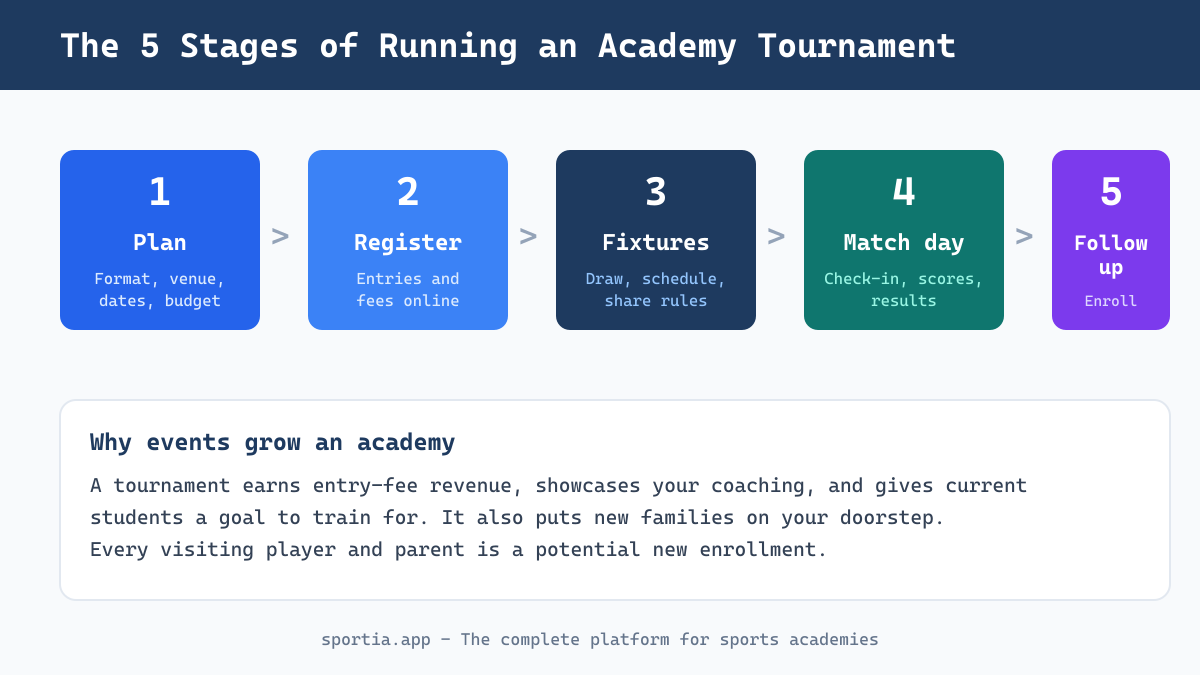
Good sports academy event management flips that story. A well-run event earns entry-fee money. It shows off your coaching to the whole area, and it gives your students a real goal to train for. Best of all, every visiting player and parent is a warm lead on your doorstep.
This guide shows you how to plan, run, and profit from academy events. It covers formats, sign-ups, fixtures, and the match-day details that keep the day calm.
Why hosting events grows your academy
An event is more than a fun day out. It is a business tool that works on many levels at once. Here is what one well-run tournament does for you.
- Revenue: Entry fees, a small canteen, and local sponsors can make the day pay for itself.
- Visibility: Every family sees your coaching, your ground, and how you run things.
- Retention: Students with a match to prepare for train harder and stay longer.
- Recruitment: Visiting players from other academies are your warmest leads.
- Proof: Photos, results, and winners give you months of social media posts.
Think of an event as a live demo of your academy. A parent who watches a smooth, safe, well-run day will trust you with their child far faster than any advert can.
Step 1: Plan the event first
Every good event starts weeks before the first whistle. Rushing this stage is the most common mistake. Nail down these choices first.
Pick the type of event
Not every event is a full open tournament. Start with what fits your size and goal:
- Internal assessment day: Your own students only. Low risk, and great for parent buy-in.
- Inter-academy friendly: Invite two or three nearby academies. It builds ties and visibility.
- Open tournament: Anyone can enter. The biggest reach, but the most to manage.
- Mini league: Matches spread over a few weekends. Steady interest over a month.
Set the format, venue, and budget
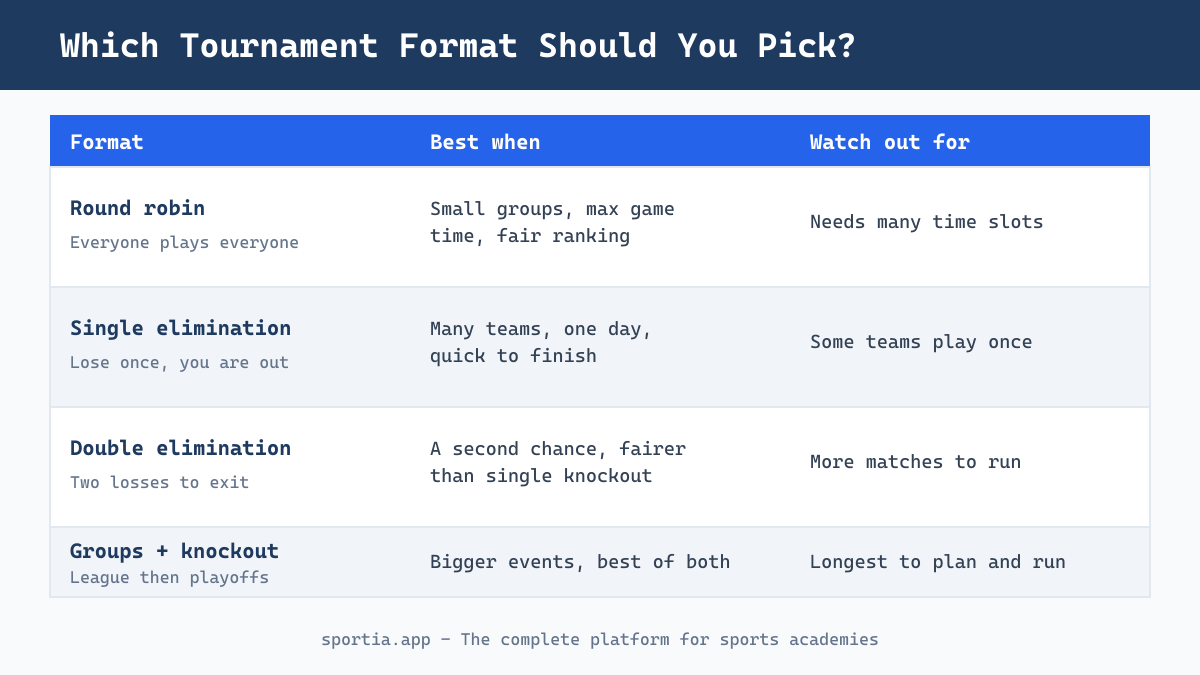
Choose your format early, because it shapes everything else. Book a venue that fits your numbers, with enough space, gear, and safety cover. Then build a simple budget that lists your costs and your likely income. Now you know your break-even point before you commit.
Step 2: Handle sign-ups without the chaos
Sign-ups are where most academy events fall apart. Phone calls, WhatsApp messages, and half-filled forms pile up fast. A clean process saves you hours, and it looks professional to every entrant.
Use one online form to collect entries and fees together. Ask for only what you need: player or team name, age group, phone number, and any medical notes. Collect the fee at the same time through a payment link, so you are not chasing money on the day.
A few habits keep sign-ups tidy:
- Set a clear entry deadline and a cap on the number of teams.
- Confirm each entry with an auto message so families feel looked after.
- Keep every entry in one list, not spread across chats and notebooks.
- Note who has paid and who is pending at a glance.
This is where a management platform earns its place. With Sportia , you collect event sign-ups and fees through the same system that runs your academy. Nothing lives in a random spreadsheet.
Step 3: Build fixtures and share the rules
Once entries close, you turn a list of teams into a schedule. This is the fixtures stage, and clarity here prevents arguments later. Draw the groups or bracket fairly, then build a timetable that gives every team enough rest between matches.
Leave buffer time in the schedule. Matches run late, weather gets in the way, and injuries happen. A packed timetable with no gaps will collapse by mid-morning. A little slack keeps the whole day calm.
Share three things with every team before the event:
- The full schedule, with match times and courts or grounds.
- The rules, including match length, tie-breakers, and eligibility.
- The venue details, arrival time, and what to bring.
When teams know the rules in advance, disputes drop sharply. Send it all in writing so nobody can claim they were not told. Good communication is the quiet secret of a smooth event. It works the same way for daily parent communication at your academy .
Step 4: Run a smooth match day
The event day is about calm control. Your job is to keep things moving and safe while everyone else focuses on the sport. Arrive early and set up before the first team walks in.
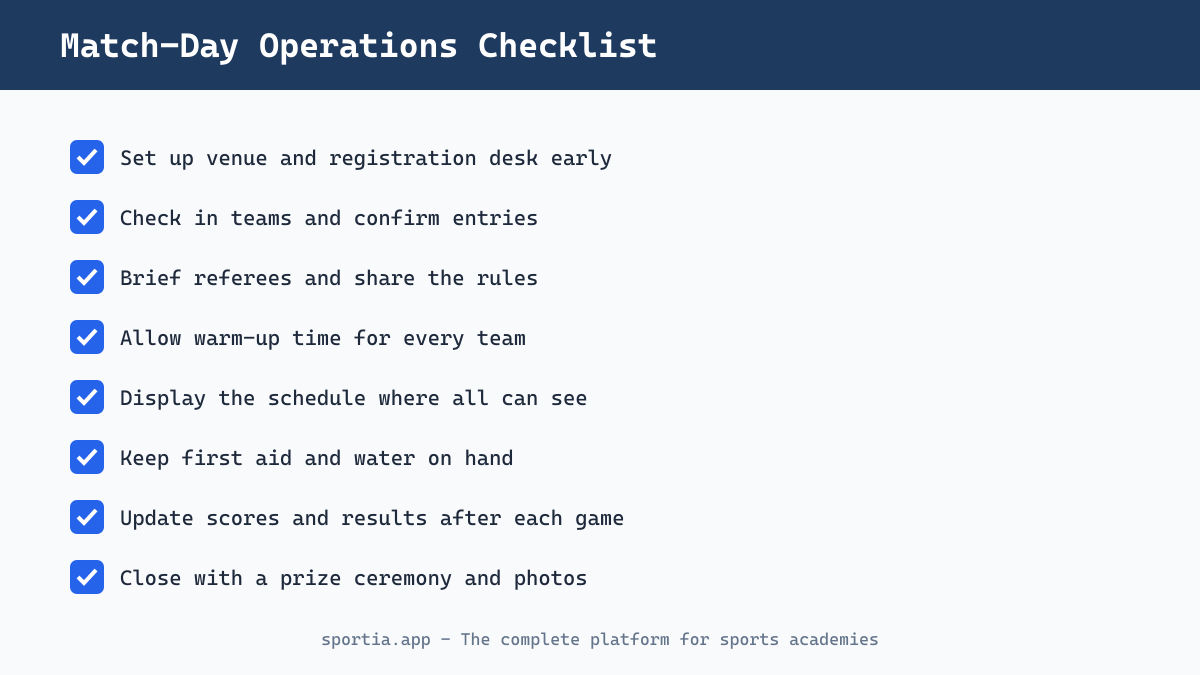
Set up a desk where teams check in as they arrive. Brief your referees on the rules so calls stay consistent. Give every team a warm-up slot. Display the schedule where everyone can see it. Keep first aid, water, and a rain backup plan within reach.
Update the scores and results as each match ends. Live results keep players and parents engaged, and they cut confusion about who plays next. End the day with a short prize ceremony, some photos, and a genuine thank you to every family who came.
Step 5: Turn the event into enrollments
Almost every academy skips this step. Yet this is where the real value sits. The tournament is over, but the marketing has just begun. You now have a room full of families who saw your academy at its best.
Follow up within two days, while the memory is fresh. Reach out to visiting players and parents who are not yet your students. A warm, low-pressure message works well:
Thanks for playing at our tournament today. Your child looked sharp out there. If you would ever like to try a free session with us, we would love to have you. No pressure at all.
Capture every new contact from the day in one place, so none slip away. A simple lead list, or a proper CRM, turns event goodwill into trials and enrollments. Our guide on the academy lead and trial pipeline shows how to run this follow-up well.
Common mistakes to avoid
A few errors show up again and again at academy events. Knowing them in advance saves you a stressful day.
- No buffer time: A schedule with zero gaps always runs late.
- Collecting fees on the day: Cash handling is slow and messy. Collect online, in advance.
- Unclear rules: Vague tie-breakers cause arguments and sour the mood.
- No follow-up plan: Letting families leave without their details wastes the whole event.
- Ignoring safety: Skipping first aid or consent forms is a risk no academy should take.
How Sportia helps you run events
Running an event is far easier when it sits inside the system you use daily. Sportia includes an events module built for this. It handles tournament and competition setup, links to your athlete records, and tracks performance and personal bests from the events you run.
Sign-ups, fees, and athlete data all live in one place. So you avoid the scramble of spreadsheets and chat groups. You can also track which visitors turn into trials and enrollments later. That is the difference between a fun day out and a real growth engine.
Frequently Asked Questions
How do I organize a sports tournament for my academy?
Start by choosing a format, venue, and dates. Then open online sign-ups with fees. Build fair fixtures with buffer time, share the rules early, and run a calm match day. Follow up with visitors afterwards to turn them into students.
What is the best tournament format for a small academy?
A round-robin format works well for small groups, because every team plays several matches. If you have many teams and only one day, single elimination finishes faster. Groups followed by knockouts suit larger events.
How much should I charge for tournament entry?
Entry fees vary by sport and city. They should cover your venue, officials, and prizes with a small margin. Many local academy tournaments in India charge a few hundred to a couple of thousand rupees per team, based on the level.
How do academy events help me get new students?
Events put visiting players and parents inside your academy, watching your coaching first-hand. This makes them your warmest leads. A quick, friendly follow-up offering a free trial session converts many of them into regular students.
What software can help run academy tournaments?
A sports academy management platform like Sportia includes an events module. It handles sign-ups, fees, fixtures, and performance tracking. Running events inside the same system you use daily keeps entries, payments, and athlete data together.
How far in advance should I plan an academy tournament?
Give yourself at least four to six weeks for an open tournament. That allows time to confirm the venue, open sign-ups, close entries, build fixtures, and share everything with teams before the day.
Make your next event a growth engine
A tournament is a rare marketing tool. It pays for itself and fills your academy at the same time. Plan it early. Keep sign-ups clean. Run a calm day. Always follow up. Do that, and every event becomes a steady source of new students.
Want to run your next tournament without the spreadsheet chaos? Sportia's events module handles sign-ups, fees, fixtures, and performance tracking in one place, right alongside your daily academy work. Start a 14-day free trial and turn your next event into your best enrollment day of the year.