
Free vs Paid Sports Academy Software: What Free Really Costs
Almost every academy owner starts the same way. You type "free sports academy management app" into Google, hoping to fix the attendance register and the fee chaos without adding another monthly bill. That is a perfectly sensible instinct. Money is tight in the first years, and nobody wants to pay for software they might not use.
But "free" means very different things depending on the tool. Some free options really are free. Others cost you in time, missed fees or data you cannot take with you when you leave. This guide breaks down the real kinds of free, what they usually hide, and a simple cost model you can run for your own academy. It also covers when free is genuinely the right answer, because sometimes it is.
Why "Free" Is the First Search Most Owners Make
There are good reasons to look for a free tool first:
- Cash flow is uneven. Fees come in at the start of the month, rent and coach salaries go out, and a new subscription feels like one more fixed cost.
- You have been burned before. Many owners have paid for an app that nobody used after the first month.
- WhatsApp already works, sort of. Parents are already in a group, so the problem does not feel urgent until fees start slipping.
The mistake is not looking for free. The mistake is comparing a free tool's price with a paid tool's price, instead of comparing what each one costs you in total.
The Real Kinds of Free
When owners say "free software", they usually mean one of five things. Each option has a different catch.
1. Free tiers of paid apps
The app is free up to a limit, such as 20 athletes or one batch. Once you grow past it, you pay. This is fine if you stay small, but your data and habits are now inside that app, so moving later is harder.
2. Free trials
You get the full product for a short time, usually 7 to 30 days, then you pay or stop. A trial is not really a free tool. It is a test drive, and it is only useful if you test properly. The section below explains exactly how.
3. Free apps that earn in other ways
Some apps are free to use but take a cut of every payment that runs through them, or earn from advertising and brand deals. One popular team app, for example, is free for organisers and charges a percentage on each payment. That can be a fair deal. Just know where the money comes from, because you are still paying, only less visibly.
4. Open-source software
The code is free, but someone has to host it, set it up, secure it and fix it when it breaks. Unless you or a friend can manage a server, this is rarely free in practice.
5. Spreadsheets and WhatsApp
This is the most common "free system" in Indian academies. Google Sheets for fees and attendance, a WhatsApp group for parents, and a notebook for everything else. It costs nothing to start, and it works well for a single batch. Our comparison of Excel versus academy software covers exactly where it starts to break.
What Free Tiers Usually Limit
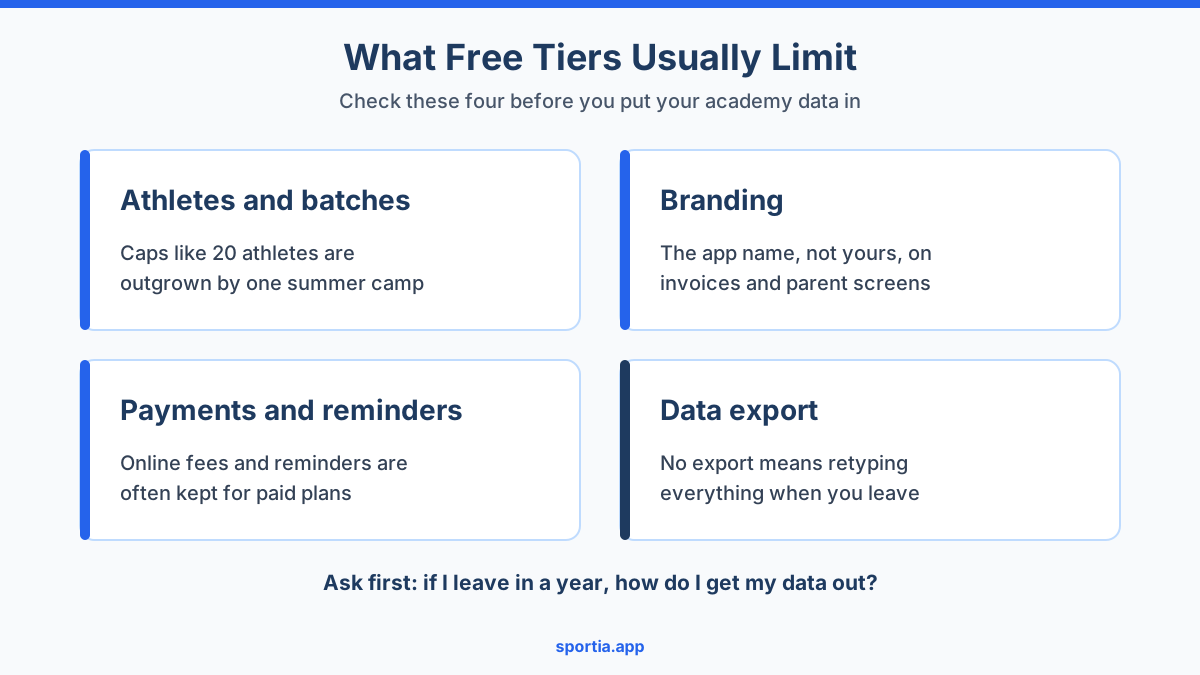
Free tiers are deliberately designed to be outgrown. Before you commit, check these four limits.
- Athletes and batches. This is the most common restriction. A limit of 20 athletes sounds fine until your summer camp adds 30.
- Branding. Free versions often show the app's own name on invoices, messages and parent screens, not your academy's.
- Payments and reminders. Online fee collection and automated reminders are usually kept for paid plans, because they are the features that save the most time.
- Data export. This is the limitation that hurts most later. If you cannot download your athlete list, attendance history and payment records, leaving means typing it all again.
Ask every vendor, free or paid, one plain question before you start: "If I leave in a year, how do I get my data out, and in what format?" A clear, specific answer is an encouraging sign.
The Hidden Costs of Free
Free tools rarely cost you money directly, but they cost you in four other ways.
Your time
Every invoice typed by hand, every attendance sheet tallied and every "please pay by Friday" message is time you are not coaching, selling or resting. For one owner, routine admin can easily reach five or six hours a week at 60 athletes. Our post on academy tasks worth automating breaks down where those hours go.
Missed and late fees
With no automatic invoices and reminders, some fees simply slip. A family pays late, then forgets a month, and nobody notices until the term ends. Even one missed fee a month can cost more than a paid tool.
Data lock-in
The more history you build in a tool, the harder it is to leave. If a free app shuts down, changes its limits or starts charging, you may have little choice but to pay whatever it asks.
No support and no accountability
When a free tool breaks on the day fees are due, there is usually nobody to call. And because you are not a paying customer, your feature requests carry little weight.
A note on children's data
Your academy stores names, ages, phone numbers and sometimes medical notes about children. India's DPDP Rules, notified in November 2025, require verifiable parental consent before processing the data of anyone under 18. Whichever tool you use, free or paid, ask where the data is stored and who can see it. A shared spreadsheet link forwarded to the wrong group is a real risk.
A Cost Model: Free Tool vs a Paid Plan for a 60-Athlete Academy
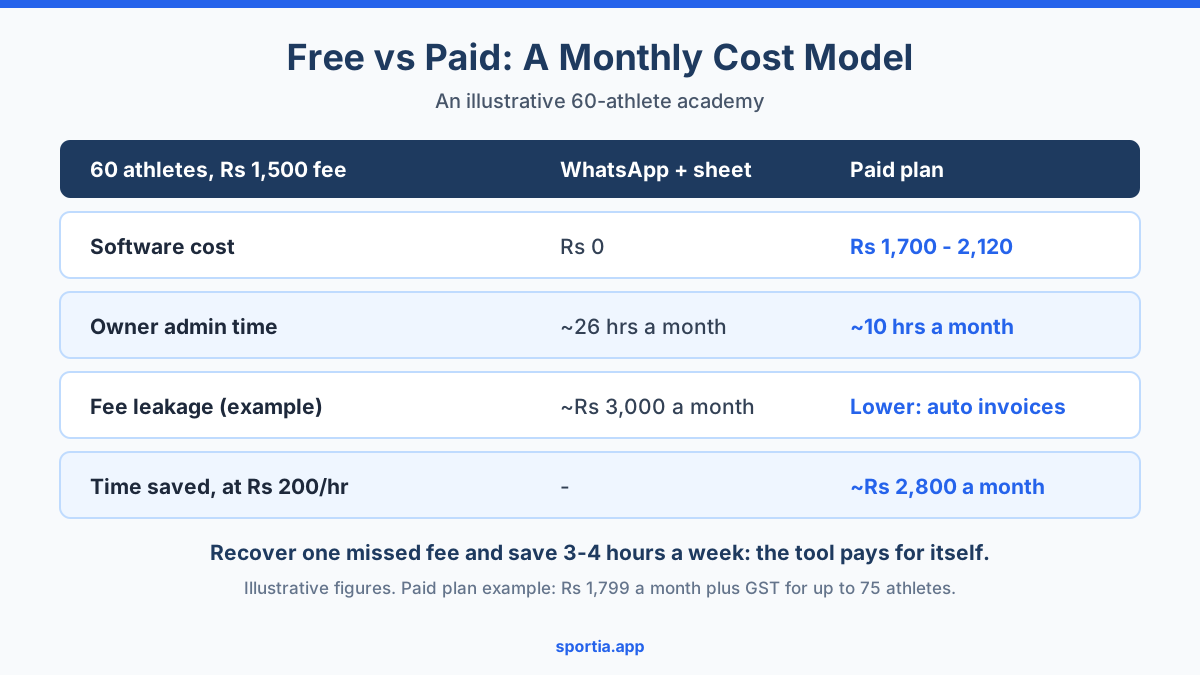
Here is a simple model you can redo with your own numbers. Take a 60-athlete football academy in a city like Pune, with two coaches and an average fee of Rs 1,500 a month. That is Rs 90,000 of monthly fee income.
The "free" setup: WhatsApp plus a spreadsheet
- Software cost: Rs 0.
- Owner admin time: about 6 hours a week, or 26 hours a month.
- Fee leakage: say two families a month pay late by a full month or drift away without paying. That is about Rs 3,000 a month, or 3 percent of fee income.
A paid academy tool
At 60 athletes, you need a plan that covers at least that many. For example, Sportia's Growth plan costs Rs 1,799 a month plus GST for up to 75 athletes. That is about Rs 2,120 a month with GST, or about Rs 1,700 a month if you pay yearly. It includes automatic monthly invoices and online fee payment through your own Razorpay account.
- Software cost: about Rs 1,700 to Rs 2,120 a month.
- Owner admin time: say 2 to 3 hours a week, mostly checking rather than typing.
- Fee leakage: lower, because every family gets an invoice on the 1st and overdue reminders follow on their own.
What the numbers say
If the paid tool saves you 3 to 4 hours a week and recovers even one missed fee a month, it roughly pays for itself. If you value your time at even Rs 200 an hour, the 14 or so hours saved each month are worth Rs 2,800 alone. The free setup only wins if your fees are already collected on time and your admin time is genuinely low.
These numbers are an illustration, not a promise. Your fee levels, payment habits and admin load will differ, so plug in your own.
When Free Genuinely Is the Right Answer
Paid software is not automatically the smarter choice. Free is often the better answer when:
- You have fewer than 20 to 25 athletes and one batch. A clean spreadsheet and a WhatsApp group can handle that well.
- You are testing an idea, like a weekend batch at a new ground, and may not continue.
- Parents pay on time already, perhaps because they are colleagues or neighbours, and the money side runs itself.
- It is a volunteer or parent-run club with no fees, where the main need is scheduling.
If that is you, stay free and keep your spreadsheet tidy. Use one row per athlete, one column per month, and a clear "paid on" date. When you cross 30 to 40 athletes or add a second coach, reconsider the decision carefully.
How to Run a Fair 14-Day Trial of a Paid Tool
Most owners waste their trial. They sign up, click around for ten minutes, get busy and forget about it until the trial ends. Here is a more effective plan.
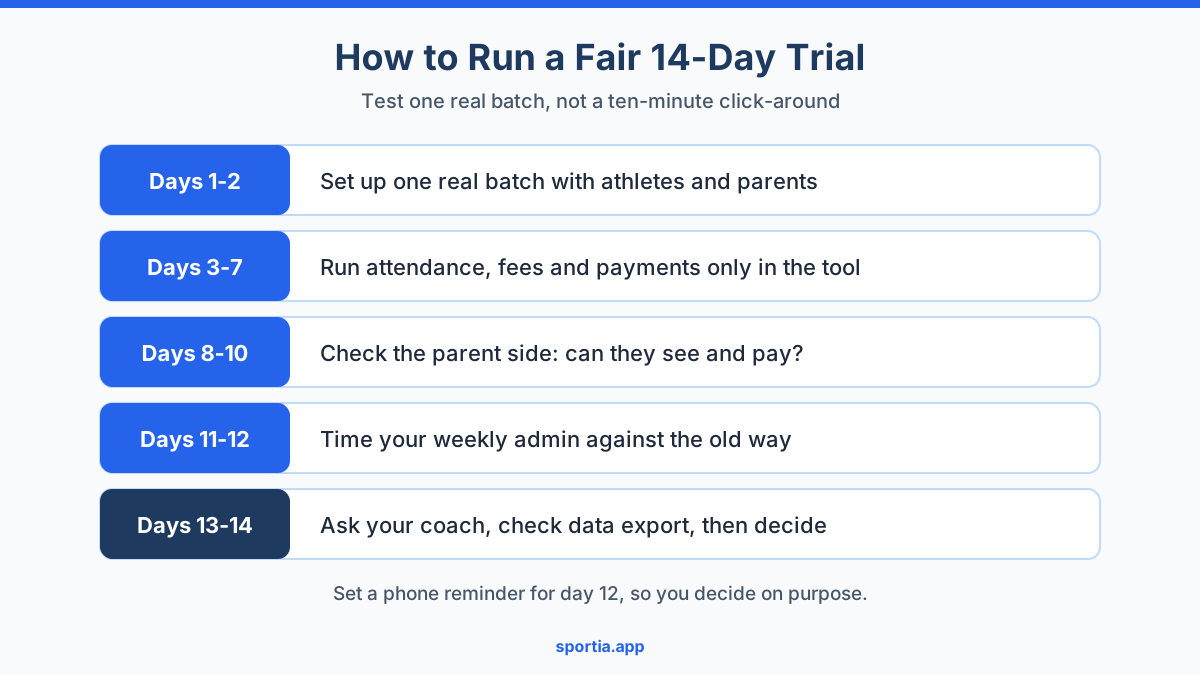
- Days 1 to 2: set up one real batch, not the whole academy. Add its athletes and their parents' contact details.
- Days 3 to 7: run that batch only through the tool. Take attendance in it, raise that month's fees in it and record every payment.
- Days 8 to 10: look at it from the parent's side. Can a parent see the invoice and pay without calling you?
- Days 11 to 12: time yourself. How long does the weekly admin take for this batch, compared with your old way?
- Days 13 to 14: ask your coach what they think, check how to export your data, and decide.
One practical note: many paid tools, including Sportia, ask for payment authorisation when you start a trial. Put a reminder in your phone for day 12, so you decide on purpose rather than by default. For a wider view of the options, see our guide to the best sports academy software in India.
Comparison Table: Free vs Paid Options
| Option | Upfront cost | Best for | Main catch |
|---|---|---|---|
| WhatsApp and spreadsheets | Rs 0 | One batch, under 25 athletes | Your time, missed fees, no history |
| Free tier of an app | Rs 0 up to a limit | Small academies that will stay small | Caps on athletes, branding and export |
| Free app paid by payment fees | Rs 0, plus a cut of payments | Clubs collecting small, irregular fees | Cost grows with your fee income |
| Open-source software | Rs 0, plus hosting | Owners who can run a server | Setup, security and fixes are on you |
| Paid academy software | About Rs 1,000 to Rs 3,500 a month | 30 or more athletes, or several coaches | A fixed monthly cost, so test it properly |
If WhatsApp is your current system, our post on WhatsApp versus academy management software covers the switch in more detail.
Frequently Asked Questions
Is there a free sports academy management app?
Yes. There are free tiers of paid apps, free apps that take a cut of payments, open-source tools and the WhatsApp-plus-spreadsheet setup. Each has limits, usually on athlete numbers, branding, payments or data export. Check those before you put your academy's data into one.
What is the cheapest sports academy software in India?
Paid academy software in India typically starts at around Rs 1,000 a month for small academies. Price usually depends on how many athletes you have. Compare the plan that fits your current athlete count, not just the lowest starting price.
When should I switch from free to paid academy software?
A good time to switch is when you pass 30 to 40 athletes, add a second coach or branch, or notice fees slipping. At that point, the time saved and fees recovered usually cover the monthly cost.
Can I try sports academy software for free before paying?
Most paid tools offer a free trial. Sportia, for example, offers 14 days on every plan, and asks for payment authorisation to start. Use the trial to run one real batch, not just to click around.
Is WhatsApp enough to manage a sports academy?
For one small batch, often yes. As you grow, WhatsApp struggles with fee tracking, attendance history and keeping messages organised. Most academies end up using WhatsApp for chat alongside a proper system for records and fees.
Do I need parental consent to store children's data in an app?
India's DPDP Rules, notified in November 2025, require verifiable parental consent to process the personal data of anyone under 18. Whatever tool you use, collect consent at enrolment and ask the vendor where the data is stored.
Compare It Against What You Have Now
Free is the right starting point for many academies, and there is no shame in staying there while you are small. The real question is what your current setup costs you in hours and missed fees, not what it costs on the invoice.
If you have outgrown the spreadsheet, try Sportia free for 14 days. Run one real batch through it using the plan above, and compare the result honestly against your current setup.