

One Year After the World Cup: Are Indian Academies Ready for Girls' Cricket?
On 2 November 2025, India won the Women's Cricket World Cup for the first time. Within days, academy phones across the country started ringing. A coach running a girls' academy in Bengaluru reported more than 200 calls from parents in the week after the final. A Shivaji Park academy in Mumbai said 20 to 30 new girls had joined. Coaches in Haryana and Chennai described similar experiences.
One year later, the honest question for every academy owner is not whether interest rose. It clearly did, so the real question is whether the girls who walked in last November are still playing, and whether your academy is ready for the next wave. This post looks at what the evidence shows, where girls drop out, and what a girls cricket academy in India needs to look like in 2027.
What the World Cup Win Changed, and What It Did Not
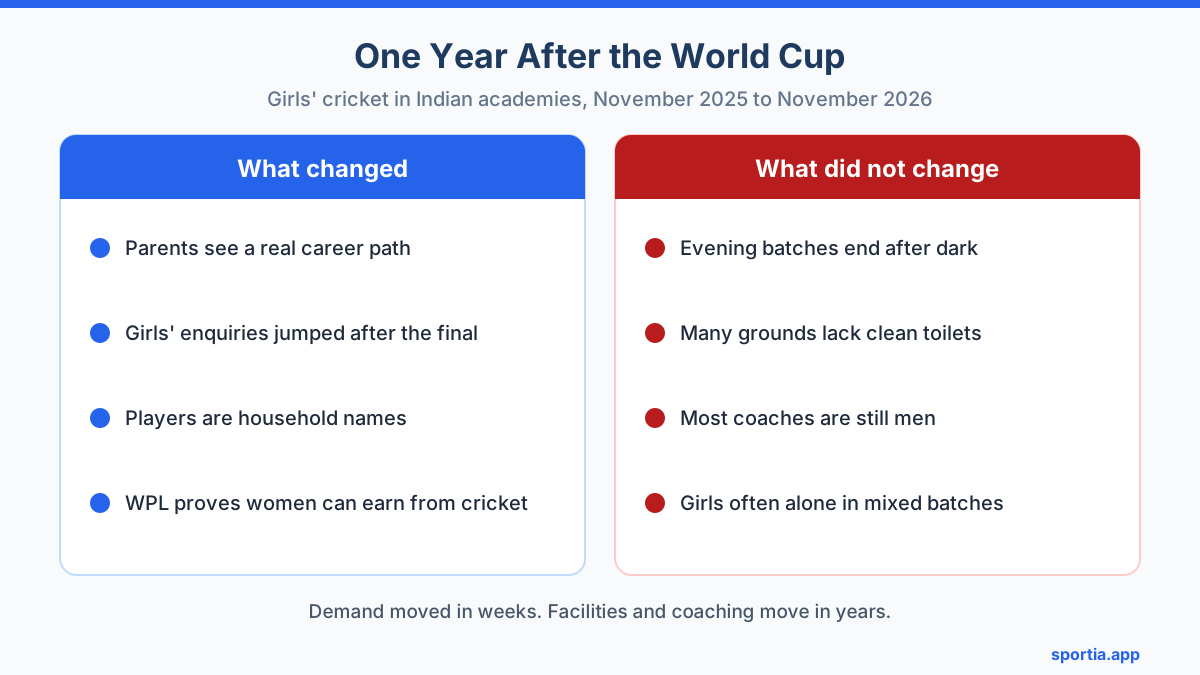
The win permanently changed how parents talk about cricket for their daughters. Before 2025, many families saw cricket as a boys' sport with a small, uncertain path for girls. After the final, players like Harmanpreet Kaur, Smriti Mandhana and Shafali Verma became household names, and the Women's Premier League had already shown that top players could earn a real living from the game.
What the win did not change is the ground under the girls' feet, at least not quickly. The same nets, the same evening timings and the same mostly male coaching staff were waiting for them. A spike in enquiries does not fix a missing changing room or a batch where a 12-year-old girl is the only girl among 25 boys.
That gap between enthusiasm and readiness is the real story of the past year.
The Evidence So Far: Enquiry Spikes, the Goa Example, and Missing Data
Most of what is known comes from individual academies and local reporters, not from national surveys.
- Enquiry spikes in the big cities. Reports from Mumbai, Bengaluru, Kolkata, Chennai and parts of Haryana described sharp jumps in girls' enquiries in the weeks after the final.
- A slower, longer trend. One Ahmedabad academy that had almost no girls three years ago now says girls make up about a quarter of its trainees. The World Cup sped up a change that the WPL had already started.
- The Goa example. Goa is one of the few places with a before-and-after count. Local coverage reported that the number of girls playing regularly rose by nearly 80 percent. The base was small, around 50 to 60 girls, but the direction was unmistakable.
The missing piece is national data. No body publishes how many girls enrol in cricket academies each year, or how many are still playing twelve months later. That means each academy has to monitor its own numbers carefully. If you cannot say how many girls joined you since last November and how many are still active, start counting now.
Where Girls Drop Out of Cricket Academies
Getting a girl through the gate is the easy part, while keeping her for a second year is much harder. Coaches and researchers repeatedly point to the same five problems.
1. The "only girl in the batch" problem
A girl who is the only girl in a mixed batch often feels watched, left out of team games and paired last for drills. Many quit within a few months, not because they lack talent but because they lack company. Two or three friends in the same batch make an enormous difference.
2. Timings and travel
Most academies run their busiest batches from 4 PM to 7 PM. In winter, that means girls travel home after dark, and many parents will not allow it unless one parent leaves work early every day. Morning and weekend batches solve a large part of this problem.
3. Toilets and changing rooms
Many grounds, especially on the edge of cities, have no clean toilet or private changing space. For girls around puberty, this alone can end their cricket, yet it is also the problem most academies can fix fastest.
4. Coaches and staff
Most grassroots cricket coaches in India are men. A survey of more than 800 coaches by Sportz Village found that the lack of female role models and low awareness of menstrual health among coaches push girls out in their teenage years. Even one female coach or assistant on the ground completely changes how safe parents feel.
5. Kit and cost
Pads, gloves, a helmet and a bat can cost Rs 5,000 to Rs 10,000 for a beginner. Families who are uncertain about the sport often hesitate to spend that on a daughter. A small pool of shared kit for the first few months lowers that barrier.
What a Girls-Ready Cricket Academy Looks Like
You do not need a new ground to become girls-ready, only a few deliberate changes.
Batch design
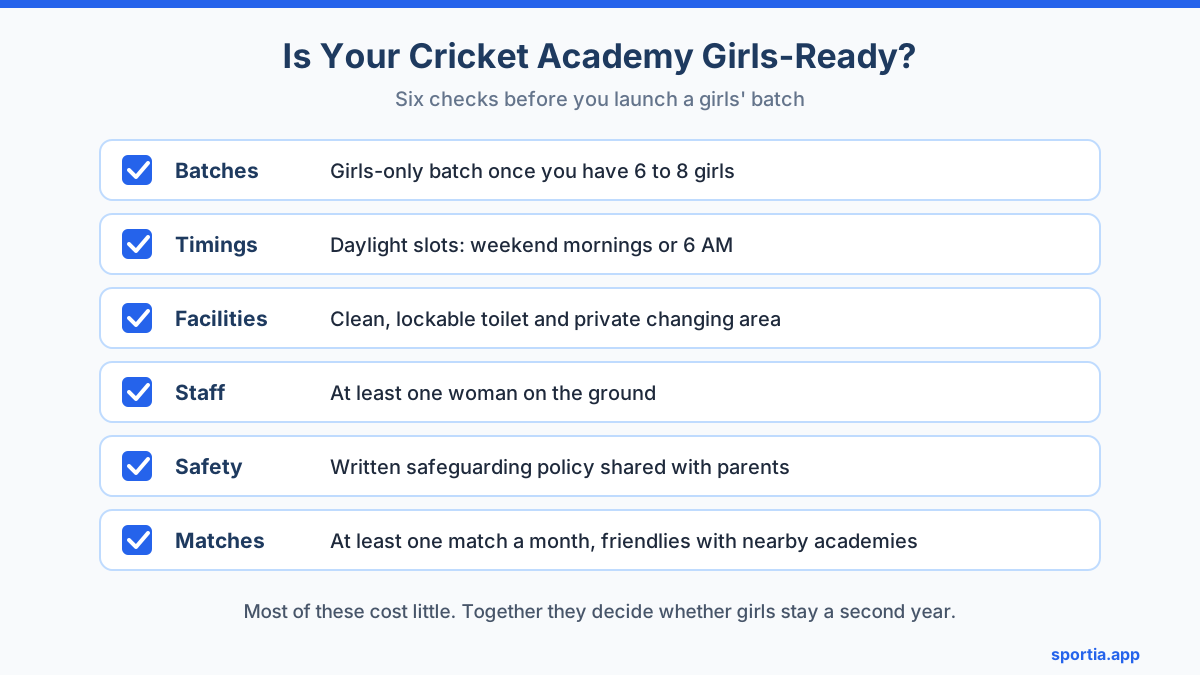
- Start a girls-only batch once you have six to eight girls. It gives them a group of friends and a place to learn without feeling watched.
- Schedule it in daylight. Saturday and Sunday mornings, or 6 AM weekday slots, work well for school-going girls.
- Keep mixed match practice. Once girls are confident, mixed practice matches against younger boys help them face pace and pressure.
Staff and safety
- Bring in at least one woman on the ground, such as a coach, assistant or manager. A former state player or a PE teacher can work part time.
- Write a short safeguarding policy. Cover who can be alone with a child, how coaches communicate with girls and how parents raise concerns. Share it with every parent.
- Fix the basics first. A clean, lockable toilet and a private changing area matter more than a new bowling machine.
Match practice
Girls who only attend net sessions gradually lose interest. Plan at least one match a month, even if it is an internal game. Contact nearby academies to set up friendly girls' matches. Most will happily agree, because their girls need competitive games too.
For more ideas that work across every sport, see our guide to growing girls' participation at your academy .
Pathways: State Trials, the WPL and School Cricket
Parents will ask where cricket can take their daughter, and you should have a clear answer ready.
- State association trials. The BCCI runs women's Under-15 and Under-19 one-day competitions and an Under-19 T20 trophy, plus senior events. State associations pick squads through district and zonal trials. Know your state's trial calendar and tell parents about it early.
- The Women's Premier League. The WPL has made professional cricket a real career for women in India. Most WPL players came up through state teams, so the path still runs through age-group cricket.
- School and inter-school cricket. School tournaments give girls match time and help convince parents that cricket can fit with studies.
- Careers beyond playing. Coaching, umpiring, scoring, physiotherapy and analysis are growing fields for women in cricket.
Be honest about the odds with every family. Very few girls will play for India, but many can play for their district or state, earn a place in a college team and stay active for life. That is a genuinely strong promise.
Pricing and Filling a First Girls' Batch Without Losing Money
Many owners worry that a girls' batch will run half empty, so here is how to start without losing money.
- Start small. Six to eight girls is enough for a first batch with one coach and one net. Do not wait until you have 20.
- Charge your normal fee. If your regular fee is Rs 2,000 to Rs 3,000 a month, keep the girls' batch at the same price. A lower fee quietly signals a lower-quality batch.
- Use spare slots. A Saturday or Sunday morning net is often empty. Putting a girls' batch there costs you very little extra.
- Offer a sibling or friend trial. Let each girl bring a friend for a free trial week. Friends joining together is the best defence against early dropout.
- Visit two girls' schools. A 20-minute fun session for a class of girls during their sports period is your best lead source.
| Item | Example for a first girls' batch |
|---|---|
| Girls enrolled | 8 |
| Monthly fee | Rs 2,500 |
| Monthly income | Rs 20,000 |
| Part-time female assistant | Rs 6,000 to Rs 8,000 |
| Shared kit pool, spread over 12 months | About Rs 1,500 |
With eight girls, a weekend batch can cover its own costs and add to your income. At 12 girls, it becomes one of your more profitable batches, because the ground and net costs are already paid. If you are starting from scratch, our guide to starting a cricket academy in India covers ground rent, staff and fees in detail.
The Opportunity for Academies That Move in the Next 12 Months
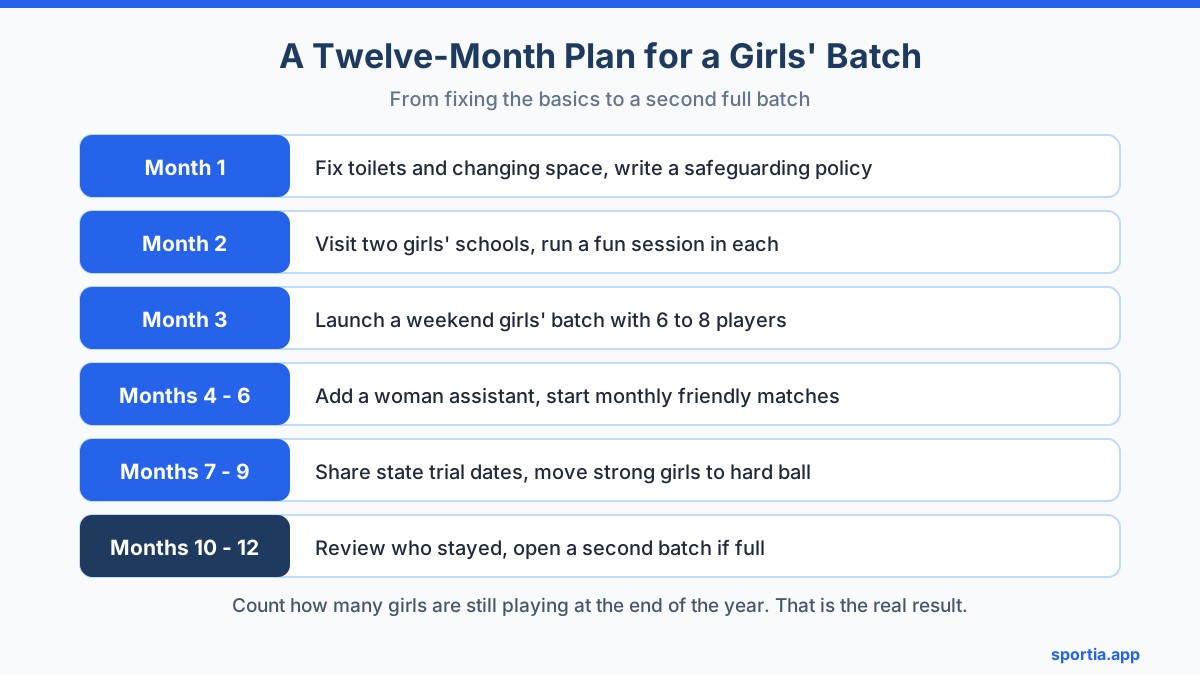
The academies that win the next five years of girls' cricket will not be the biggest ones. They will be the ones that parents genuinely trust with their daughters. That trust is built on small things done well: a safe timing, a friendly batch, a woman on the ground, regular matches and clear updates for parents.
There is also a real advantage in moving early. Girls tend to join where their friends already play. The first academy in a neighbourhood with a strong girls' batch often becomes the default choice for the next 50 families who ask.
Parent communication matters more than usual here. Parents of girls often want to know exactly when the session starts and ends and whether their daughter attended. With Sportia , you can set up a separate girls' batch with its own schedule. Coaches mark attendance, and parents see the schedule, attendance and progress in their own login.
Skill development matters too. For drills that work for girls and boys alike, see our batting tips for young players .
Frequently Asked Questions
Did more girls join cricket academies after India won the World Cup?
Yes, academies in Mumbai, Bengaluru, Kolkata, Chennai and Haryana reported sharp rises in girls' enquiries after the November 2025 win. In Goa, the number of girls playing regularly rose by nearly 80 percent from a small base. There is no national data yet on how many have kept playing.
Should a cricket academy run a separate batch for girls?
Once you have six to eight girls, a girls-only batch usually helps. Girls feel more comfortable, make friends and are less likely to drop out. Mixed match practice can still be added once they are confident.
What age should girls start cricket coaching?
Most girls can start structured cricket coaching at 7 or 8 with soft-ball games and basic skills. Hard-ball training with full kit usually starts around 10 to 12. Starting late is fine too, as many top players began in their teens.
How much does cricket coaching for girls cost in India?
Fees for girls are usually the same as for boys, around Rs 1,500 to Rs 4,000 a month in most cities, depending on the academy and facilities. Some academies and state programmes offer free or subsidised coaching for girls.
What is the pathway for girls in Indian cricket?
Girls usually move from academy and school cricket to district and state trials. The BCCI runs women's Under-15, Under-19 and senior competitions, and state players can be picked for the Women's Premier League and India teams.
How can academies make cricket safer for girls?
Run batches in daylight, provide a clean private toilet and changing area, have at least one woman on staff and share a written safeguarding policy with parents. These steps cost little and build the trust that keeps girls playing.
Be the Academy Parents Trust With Their Daughters
The World Cup opened the door, and now the job is to make sure the girls who walk through it have a reason to stay. Start one girls' batch, fix the basics and keep parents informed. If you want help running that batch with its own schedule, attendance and parent updates, try Sportia free for 14 days .