

How to Grow Girls' Participation in Your Sports Academy
Right now, the world is watching women's cricket. The Women's T20 World Cup is on in England from June 12 to July 5. Back home, the buzz is even louder. In November 2025, India won the Women's ODI World Cup at DY Patil Stadium in Navi Mumbai. Harmanpreet Kaur lifted the trophy. The whole country watched.
Something shifted in living rooms across the country after that victory. Parents who once worried mainly about marriage and education suddenly began asking a different question. If Harmanpreet and Smriti can do it, why not my daughter? This is precisely the moment to grow girls participation in sports India has been waiting for, and your academy is positioned to ride this wave.
This post is written for academy owners and coaches who genuinely want more girls on the field. You will discover why girls drop out, what parents are actually afraid of, and the practical steps a small academy can realistically take this season. The market is enormous and badly underserved, the goodwill is real, and the timing has rarely been better.
The World Cup moment: ride the wave of interest
Big victories genuinely move people. After the 2025 World Cup, coaches at Shivaji Park in Mumbai reported a clear jump in enquiries, with more parents of young girls calling than in any previous month. One 13-year-old joined right after the final. She had been teased for choosing cricket, until she watched Harmanpreet lift that trophy.
Remember that this is a window, not a permanent door. Interest spikes sharply after a major event and then fades within a few months. Smart academies act decisively while the spike is high. Run a "girls week" with free trials, post about local girls who already play, and tie your message directly to the live tournament. When India or any team wins, celebrate it the same day.
You do not need cricket specifically to use this strategy. A badminton victory by PV Sindhu lifts every girl's sport, and a shooting medal by Manu Bhaker accomplishes the same thing. Smriti Mandhana even received her own Barbie doll in 2026. These stories quietly give hesitant parents permission to say yes.
Why girls drop out earlier in India
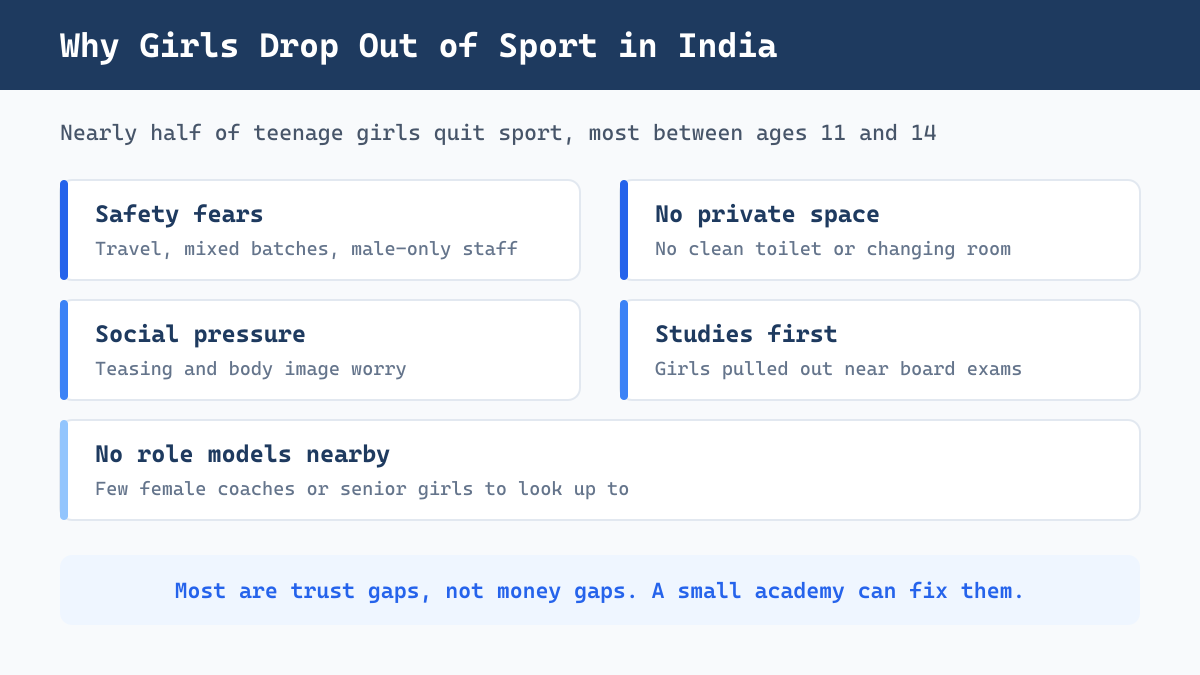
Here is the uncomfortable truth. Girls quit sport at a far higher rate than boys do. A UNESCO study found that nearly half of all teenage girls drop out of sport worldwide. In India the gap is even wider, and it begins early, because most girls leave between the ages of 11 and 14.
The reasons have almost nothing to do with talent. Instead, they are about specific barriers your academy can actually remove. The most common ones across India include the following:
- Safety fears. Parents worry about travel, mixed batches, and male-only staff.
- No private space. No clean toilet or changing room pushes girls away fast.
- Social pressure. Teasing, body image worry, and "sport is not for girls" talk.
- Studies first. Families pull girls out near board exams more than boys.
- No role models nearby. Few female coaches or senior girls to look up to.
Notice the underlying pattern here. Most of these are trust gaps rather than money gaps, so when you fix the trust, many girls choose to stay. That is genuinely good news for a small academy, because you do not need a huge budget to win in this area.
Safety, facilities, and female coaches: the trust factors
Parents of girls weigh three things above everything else, namely safety, basic facilities, and the people who actually coach. Get these three right, and word spreads remarkably fast through local parent circles.
Safety comes first. Set clear rules and state them out loud to every parent. CCTV at the venue helps, and a strict no-entry rule for outsiders during girls' sessions helps even more. In 2025, the Kerala Human Rights Commission ordered female coaches and a ban on men in girls' changing areas. You can voluntarily adopt the same standard without being told to.
Basic facilities matter far more than fancy ones. A clean, private toilet is completely non-negotiable, alongside a small changing space with a working lock. Provide a quiet corner where a girl can rest if she has period cramps, and keep simple hygiene supplies readily on hand. These additions cost very little, yet they signal an enormous amount.
Female coaches change everything. A girl tends to be far more open with a coach who genuinely understands her experience. If you cannot hire a full-time female coach just yet, start small instead. Bring in a part-time female assistant, or train a senior girl as a junior helper. Even one woman on your staff noticeably shifts how parents feel about enrolling.
Designing girls-friendly batches and timings
Many girls will not join a mixed batch at first. Parents worry, and girls feel shy. A dedicated girls' batch solves both. It is the single most useful change you can make.
Think about timings too. Daylight slots feel safer than late evening. A 4 PM to 6 PM girls' batch will fill faster than an 8 PM one. Weekend morning batches work well for school-going girls. Keep batch sizes small at the start so each girl gets attention.
A clean structure helps you manage this. With a tool like a system built to scale from 10 to 100 athletes , you can run a separate girls' batch without extra paperwork. Each batch has its own roster, attendance, and timings. You stay organized as the group grows.
Messaging that reassures parents and inspires girls
Your words decide whether a parent calls or scrolls past. Speak to the parent's fear and the girl's dream in the same breath. One without the other falls flat.
For parents, lead with safety and structure. Use plain lines like these:
- "Dedicated girls' batch with a female coach."
- "Daylight timings, CCTV, and a safe pickup zone."
- "Clean, private washroom and changing space."
- "Parents welcome to stay during sessions."
For girls, lead with belonging and heroes. Show photos of girls who already train with you. Name local women athletes from your city. Tie your message to a star they know, like Smriti Mandhana, who won the BBC Indian Sportswoman award in 2025. Belonging beats pressure. A girl stays where she feels she fits.
Keep your channels active. Share short clips of your girls' batch. Reply fast to enquiries. Strong parent communication builds trust before the first session. If WhatsApp groups feel messy, learn how to handle parent communication beyond WhatsApp so no message gets lost.
Role models and visibility: use women athletes
Visibility is fuel. A girl who sees women win believes she can too. India has never had more sporting heroines to point to.
Use them on purpose. Put a poster of Harmanpreet Kaur or PV Sindhu on your wall. Run a "play like her" theme week. Invite a local woman athlete to a session, even a state-level player. Many will come for a small fee or for free goodwill. One visit can light a fire in ten girls.
Local heroes genuinely work best of all. A girl from your own area who plays at district or state level feels completely real, because she walked the same streets your students walk. If your academy has already produced one, tell her story everywhere you can. Proof from your own ground beats any glossy national poster.
The business case: a large, underserved market
Growing girls participation is not only a good deed. It is good business. Half your local market is girls, yet most academies barely reach them. That gap is your opportunity.
Think about the numbers. If your area has 200 families with sporty kids, roughly 100 have daughters. Most academies sign up a handful. Capture even 30 of those girls and you have a strong new revenue stream. At a Growth plan price point on Sportia of around 1,799 rupees a month, the software cost is tiny next to the fees you collect.
Girls' programs also tend to retain well once trust is built. Loyal parents refer other parents. A safe, well-run girls' batch becomes your best marketing. To find these families on a tight budget, study how to market your sports academy on a low budget and aim the message at parents of daughters.
Practical first steps for a small academy this season
You do not need to do everything at once. Start with a few high-trust moves this month:
- Open one girls-only batch at a daylight slot. Cap it small and give attention.
- Add a female face to your staff, even a part-time assistant or senior girl.
- Fix the basics: a clean private toilet, a changing space with a lock, hygiene supplies.
- Write parent-first messaging that leads with safety, then dreams.
- Run a World Cup tie-in offer: a free trial week while the tournament is live.
- Track every enquiry so no interested parent slips away.
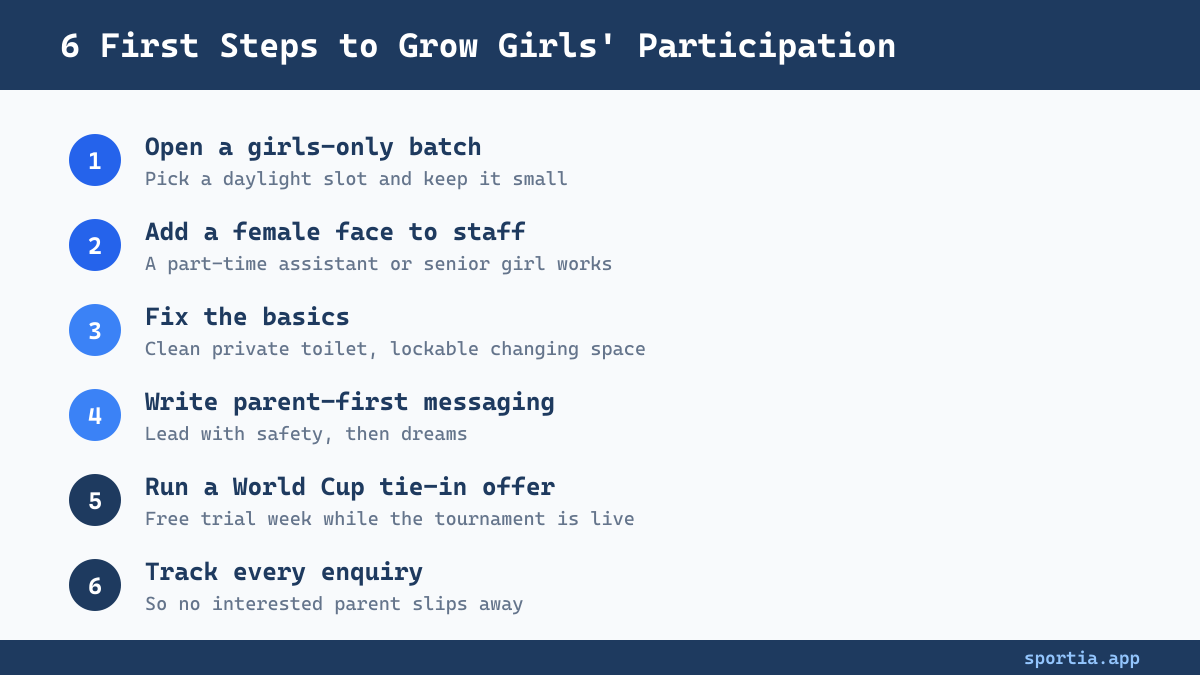
Do these six things and you will see girls join within weeks. The interest is already there. Your job is to make joining feel safe and easy.
Managing a new batch should not add chaos to your day. Sportia lets you run a dedicated girls' program with its own roster, attendance, and fees, right beside your other batches. You see who attends, who paid, and who needs a follow-up call. That clarity frees you to coach.
Frequently Asked Questions
Why do girls drop out of sports earlier than boys in India?
Girls often leave sport between ages 11 and 14 due to safety fears, lack of private facilities, social pressure, and a focus on studies near exams. Most of these are trust gaps an academy can fix. Female coaches, girls-only batches, and clean facilities keep many girls in the game.
How can a small academy attract more girls without a big budget?
Start with one girls-only batch at a daylight time and add even one female staff member. Fix the basics like a clean private toilet and a lockable changing space. Then share photos of your girls and tie your message to women athletes. Trust, not money, brings most girls in.
Do I really need a female coach to grow girls participation in sports?
A female coach helps a lot, since girls open up more and parents feel safer. You do not need a full-time hire right away. A part-time female assistant or a trained senior girl can fill the role. Even one woman on staff changes how families feel about joining.
How do I reassure parents about safety for their daughters?
Be specific and say your rules out loud. Mention daylight timings, CCTV, a safe pickup zone, and a no-entry rule for outsiders during girls' sessions. Invite parents to stay and watch. Clear, plain promises about safety move parents from worry to a yes.
Is the Women's T20 World Cup a good time to promote girls' programs?
Yes, big tournaments lift interest in women's sport for a short window. The 2026 Women's T20 World Cup runs in England from June 12 to July 5. Run a free trial week and post about the matches while girls and parents are paying attention. Act fast, since the spike fades in a few months.
Can sports academy software help me manage a girls' batch?
Yes, a tool like Sportia lets you run a girls-only batch with its own roster, timings, attendance, and fees. You can track every enquiry so no interested parent slips away. This keeps a new program organized while you focus on coaching.
The wave of interest in women's sport will not last forever. Build your girls' program while parents are saying yes. Manage every batch, including dedicated girls' programs, with Sportia and start your free 14-day trial today.