

How to Price Sports Coaching in India: A Simple Formula for Academy Fees
Ask most academy owners how they set their fees, and the honest answer is that the academy down the road charges Rs 2,500, so they charge Rs 2,500 too. It feels safe, but it ignores the only numbers that matter: what it costs you to coach one child, and what your coaching is actually worth. This guide shows you how to price sports coaching with a simple three-step formula, worked through with real rupee figures for a badminton academy and a cricket academy.
You do not need a finance degree for this. You need a notebook, your last three months of expenses, and an honest count of how many athletes actually turn up.
Why Copying the Academy Down the Road Is Risky
Copying a competitor's fee assumes their costs match yours. They rarely do. The other academy may own its ground while you rent courts by the hour. Their head coach may be the owner, drawing no salary, while you pay an NIS-certified coach Rs 45,000 a month. Their batches may hold 30 children while yours hold 12.
Copying also traps you in a race to the bottom. When a new academy opens nearby at Rs 2,000, you feel pressure to match it, even if that fee loses you money on every child. Within a year, you are working harder and earning less.
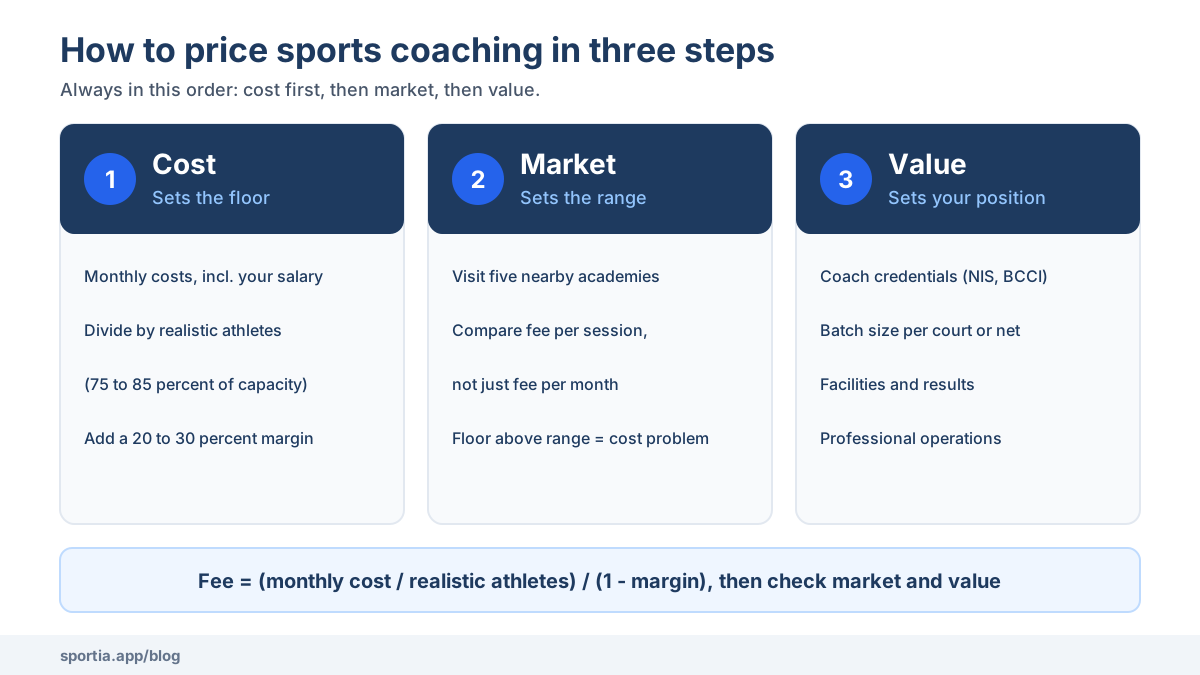
The fix is to build your fee from three directions, in a fixed order: cost first, then the market, then value.
Step 1: Start From Your Cost Per Athlete
Your cost floor is the fee below which every new athlete loses you money. To find it, add up a normal month of costs and divide by the number of athletes you can realistically serve.
List every monthly cost, including the small ones:
- Venue: ground lease, court rent by the hour, pool time or net maintenance
- Coaches: salaries or per-session fees for head and assistant coaches
- Consumables: shuttles, balls, cones, bibs and first-aid supplies
- Admin: software, phone, printing, payment gateway charges and accounting help
- Marketing: flyers, social media ads and trial-day costs
- Your own salary: if you work in the academy, pay yourself, or the numbers lie
Then divide by your realistic number of athletes, not your maximum. This is where most owners go wrong. A batch that can hold 16 children will average 12 or 13 across the year, because of exams, holidays, illness and families who pause. Plan on about 75 to 85 percent of full capacity.
One more adjustment matters in India. Most families do not pay all 12 months. Board exams, summer travel and festival months mean many academies collect fees for only 10 or 11 months a year from each athlete, while costs continue all 12. If that is true for you, multiply your monthly cost by 12, and then divide by 10 or 11 paying months.
Step 2: Check the Market for Your Sport and City
Your cost floor tells you the minimum. The market tells you what parents in your area are used to paying. Typical monthly coaching fees in 2026 look roughly like this:
| Sport | Tier-1 cities | Tier-2 and tier-3 cities |
|---|---|---|
| Cricket | Rs 2,500 to Rs 5,000 | Rs 1,200 to Rs 2,500 |
| Badminton | Rs 2,500 to Rs 4,500 | Rs 1,500 to Rs 3,000 |
| Football | Rs 2,000 to Rs 4,000 | Rs 1,000 to Rs 2,000 |
| Swimming | Rs 2,000 to Rs 5,000 | Rs 800 to Rs 2,500 |
| Tennis | Rs 4,000 to Rs 8,000 | Rs 2,000 to Rs 4,000 |
These ranges are wide on purpose, because the right fee depends on batch size, sessions per week and the level of coaching. To check your own area, call or visit five nearby academies as a parent would. Note the fee, sessions per week, batch size and what is included. Divide each fee by the sessions per month to compare like with like.
If your cost floor sits above the market range, you have a cost problem, not a pricing problem. Look at batch sizes, court hours or coach mix before you raise the fee.
Step 3: Price Your Sports Coaching on Value
Once you know the floor and the range, decide where in that range you belong. Parents will pay more when they can see the difference. Things that justify a higher position include:
- Coach credentials, such as an NIS diploma, BCCI Level 2 or a former state player
- Smaller batches, for example 8 children per badminton court instead of 14
- Better facilities, like synthetic courts, floodlights or a covered area for the monsoon
- Visible results, such as district selections and tournament wins
- Professional operations, including clear schedules, regular progress updates and proper invoices
Be honest here. If your batches are large and your coach is new, price in the lower half of the range and compete on convenience and consistency instead.
How to Price Sports Coaching: The Formula for Two Academies
The formula combines all three steps:
Fee = (monthly costs divided by realistic athletes) divided by (1 minus your target margin), then checked against the market range and adjusted for value.
A target margin of 20 to 30 percent is sensible for most academies. It covers bad months, equipment replacement and growth.
Example 1: A badminton academy in Pune
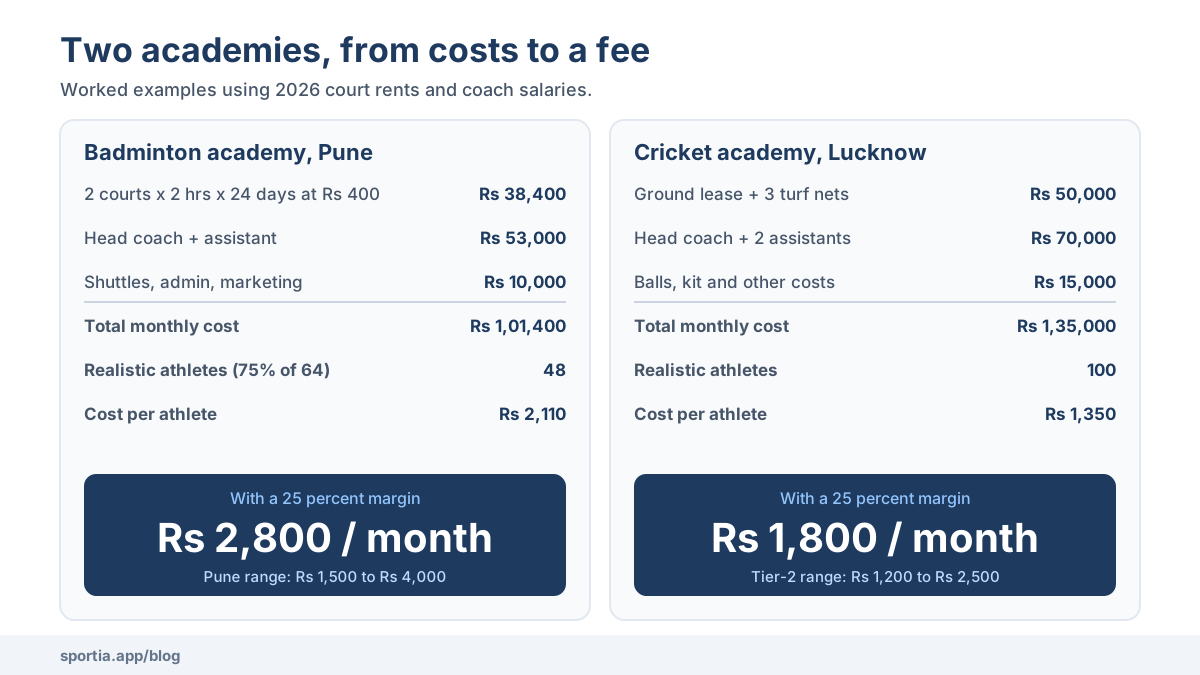
The academy rents two courts for two hours every evening, six days a week, at Rs 400 per court per hour. That is Rs 38,400 a month. It pays a head coach Rs 35,000 and an assistant Rs 18,000. Shuttles cost about Rs 6,000 a month, and admin and marketing add Rs 4,000. Total monthly cost: Rs 1,01,400.
With eight children per court per hour and athletes training three days a week, the academy can serve 64 athletes. At a realistic 75 percent, that is 48 athletes, so the cost per athlete is about Rs 2,110. With a 25 percent margin, the fee comes to about Rs 2,815. Pune badminton fees run from about Rs 1,500 to Rs 4,000, so Rs 2,800 sits comfortably in the middle. With an NIS-certified head coach and small batches, Rs 3,000 is also defensible.
Example 2: A cricket academy in Lucknow
The academy leases a ground for Rs 40,000 a month and spends Rs 10,000 maintaining three turf nets. It pays a BCCI Level 1 head coach Rs 30,000 and two assistants Rs 20,000 each. Balls and kit cost Rs 8,000, and other costs add Rs 7,000. Total: Rs 1,35,000 a month.
It can handle about 120 athletes, and realistically averages 100. That makes the cost per athlete Rs 1,350, and with a 25 percent margin, the fee is Rs 1,800. That fits the tier-2 range well, leaving room to charge more for a separate advanced batch.
Monthly Fee vs Session Packages vs Term Fees
The number is only half of pricing. The format matters too.
- Monthly fees are simple and predictable, and parents in India are used to them. They suit regular batches with fixed days.
- Session packages, such as 24 sessions valid for three months, suit families with irregular schedules. You are paid upfront, and athletes who miss sessions use them later instead of asking for refunds.
- Term or quarterly fees improve your cash flow and reduce dropouts, because families commit for longer. Offer a small discount, around 5 percent, to make them attractive.
Many academies use all three: monthly for most families, packages for flexible adults, and a quarterly option with a discount. In Sportia, you can set up packages with their own fees, session quotas and validity periods, so each format is billed correctly. The guide to sports academy fee structures covers how to present these options clearly.
Sibling Discounts, Early-Bird Offers and When Discounts Backfire
Discounts work when they reward something you want, such as loyalty or commitment. A 10 percent sibling discount is common in India and builds goodwill with families. Early-bird offers for paying a term in advance help cash flow before a new season.
Discounts backfire when they become the norm. If you offer a "special price" to every family who asks, your real fee is the discount, and loyal families who paid in full feel cheated. Keep discounts to a short, written list, and never negotiate fees individually at the desk.
How and When to Raise Your Fees Without Losing Families
Costs rise every year, especially court rent and coach salaries. If your fee stays flat for three years, your margin quietly disappears. A small yearly increase is far easier for parents to accept than a large jump after years of no change.
A few habits make increases go smoothly:
- Raise once a year, at a natural point such as April or the start of a new season.
- Keep it modest, usually 5 to 10 percent.
- Give at least 30 days' notice, in writing.
- Explain what improved, such as a new coach, better courts or more tournaments.
- Consider holding the old fee for one term for long-standing families, as a thank-you.
Before you raise fees, check your margins. The guide to sports academy profit margins explains what a healthy margin looks like for Indian academies.
Frequently Asked Questions
How much should a sports academy charge for coaching in India?
Most academies charge between Rs 1,000 and Rs 5,000 a month, depending on the sport, city and batch size. Work out your cost per athlete first, then check local fees, and position yourself based on coach quality and facilities.
How do you calculate sports coaching fees?
Add up your monthly costs and divide by your realistic number of athletes, not your maximum capacity. Then divide by one minus your target margin, for example 0.75 for a 25 percent margin, and check the result against local market rates.
What profit margin should a sports academy aim for?
A margin of 20 to 30 percent is a sensible target for most academies. It covers months with lower attendance, equipment replacement and the cost of growing the academy.
Should sports academies offer sibling discounts?
A sibling discount of around 10 percent is common and builds loyalty. Keep it as a written rule that applies to every family, rather than a discount negotiated case by case.
How often should a sports academy increase fees?
Once a year is best, usually by 5 to 10 percent, with at least 30 days of written notice. Small regular increases are much easier for parents to accept than large, rare ones.
Price With Confidence, Not Guesswork
A good fee is not the cheapest in town or the most expensive. It covers your real costs, sits within what local parents expect, and reflects the quality you deliver. Run the three steps once a year, adjust gently, and write your rules down. When you are ready, set up packages and fee plans that match your pricing in Sportia, so every family is billed the same way, every month.