
Sports Academy Profit Margins in India: What Owners Can Really Expect
Ask ten academy owners about their profit and you will get ten vague answers. Most know what fees come in, but few can tell you what they truly keep. The honest picture matters, especially if you are about to invest your savings into coaching.
Here is the direct answer. A well-run sports academy in India earns a net profit margin of about 15 to 25 percent once it is established. Small academies often sit near break-even in year one, while large, well-filled ones can push past 30 percent. This guide shows you exactly where that money goes, with real Indian numbers.
You will see the revenue streams, the cost buckets, and a full sample monthly account. You will also learn the few levers that decide whether your academy thrives or just survives.
What profit margin can you really expect?
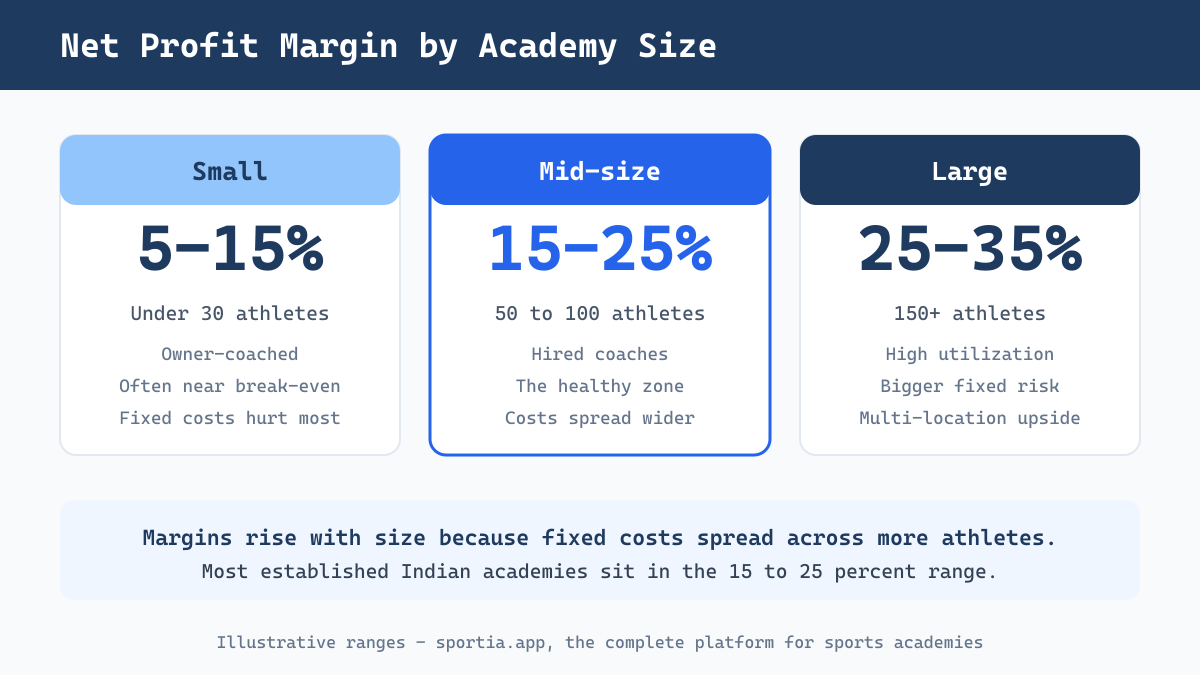
The sports academy profit margin you earn depends heavily on your size and your fixed costs. A small academy carries the same rent burden as a bigger one, but spreads it over fewer students. That is why margins climb as you grow.
Here is a realistic view for the Indian market:
- Small (under 30 athletes): Often 5 to 15 percent, and frequently near break-even. The owner usually coaches to save on staff costs.
- Mid-size (50 to 100 athletes): Around 15 to 25 percent. This is the healthy zone, where costs spread across enough fees.
- Large (150 or more athletes): Can reach 25 to 35 percent, but fixed-cost risk is higher if enrollment dips.
So is a sports academy profitable? Yes, but rarely in the first few months. Most owners reinvest early profit into better facilities, more coaches, and marketing to grow.
Where the money comes from: revenue streams
Coaching fees are the heart of any academy's income, but smart owners build other streams too. A single revenue source is fragile. Several smaller ones make your academy far more stable.
The main revenue streams for an Indian sports academy are:
- Monthly coaching fees: The core income. Fees range widely, from about 1,500 rupees a month at a basic setup to over 10,000 rupees at a premium one.
- Summer and holiday camps: Short, high-energy programs that bring a cash boost during school breaks.
- School tie-ups: Coaching contracts with nearby schools that fill your quiet daytime hours.
- Kit and merchandise: A small margin on jerseys, shoes, and gear bought in bulk.
- Events and tournaments: Entry fees and sponsorships from hosting local competitions.
Setting the right fee is the single biggest revenue decision you make. Our guide to building a sports academy fee structure walks through how to price by tier and city. Get this number right and everything else gets easier.
Where the money goes: the big cost buckets
Understanding your sports academy running costs is what separates a hobby from a business. Costs in this sector usually eat 60 to 80 percent of revenue. Two buckets dominate the bill: your venue and your people.
The major cost buckets are:
- Venue and ground rent: Often your single largest cost. Turf and ground hire in metros can run from 10,000 to 40,000 rupees a month, and far more for prime slots.
- Coaching staff: Salaries for assistant and head coaches. A qualified coach in a tier-1 city may cost 25,000 to 45,000 rupees a month.
- Equipment and consumables: Balls, cones, nets, and safety gear that wear out and need replacing each term.
- Marketing: Ads, banners, and referral rewards to keep new inquiries coming in.
- Software and admin: Tools for attendance, fees, and communication, plus any office or phone costs.
Many new owners forget the small, regular costs. Utilities, repairs, and replacement gear add up quietly. Build these into your plan from day one.
A sample monthly account for a 75-athlete academy
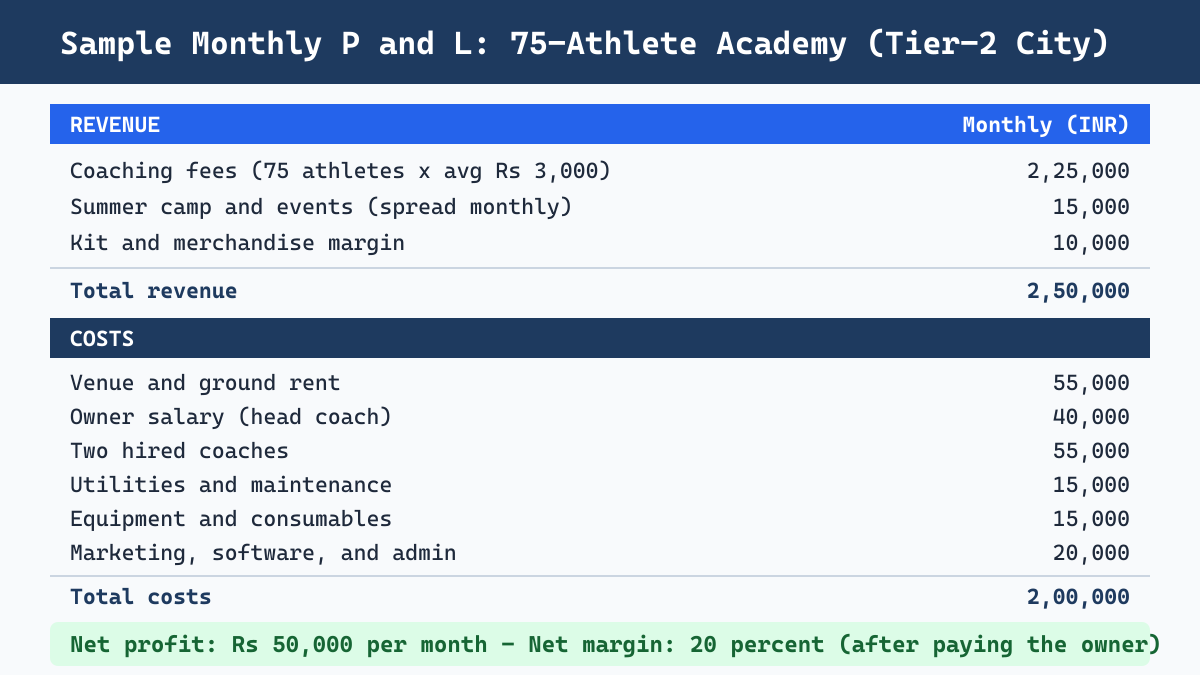
Numbers make this real. Picture a mid-size academy with 75 athletes in a tier-2 city. The figures below are illustrative, but they reflect typical Indian costs and fees.
On the income side, 75 athletes paying an average of 3,000 rupees bring in 2,25,000 rupees. Add 15,000 from camps spread across the year and 10,000 from kit sales. That gives a total monthly revenue of about 2,50,000 rupees.
On the cost side, the venue takes 55,000 rupees. The owner pays themselves a head-coach salary of 40,000, plus 55,000 for two hired coaches. Utilities, equipment, marketing, software, and admin add roughly 50,000 more. Total costs come to about 2,00,000 rupees.
That leaves a net profit of 50,000 rupees a month, or a 20 percent margin. The important detail is that this profit is real. It sits on top of the owner's own salary, not instead of it.
Why cash flow matters more than profit
A profitable academy can still fail. The reason is cash flow, which is the timing of money in and out. Profit is a yearly idea, but rent and salaries are due every single month.
Most Indian academies face lumpy income. Enrollment surges after exams and dips during them. Fees often arrive late, while your costs never wait. A strong month on paper can still leave your bank account empty.
Protect yourself with a few simple habits:
- Keep a cash buffer of two to three months of fixed costs.
- Collect fees on time with clear due dates and reminders.
- Watch the slow months and save during the busy ones.
Late fees are a silent killer. When parents pay weeks late, you fund their child's training from your own pocket. Tight fee collection is often the fastest way to fix a cash crunch.
The levers that move margin most
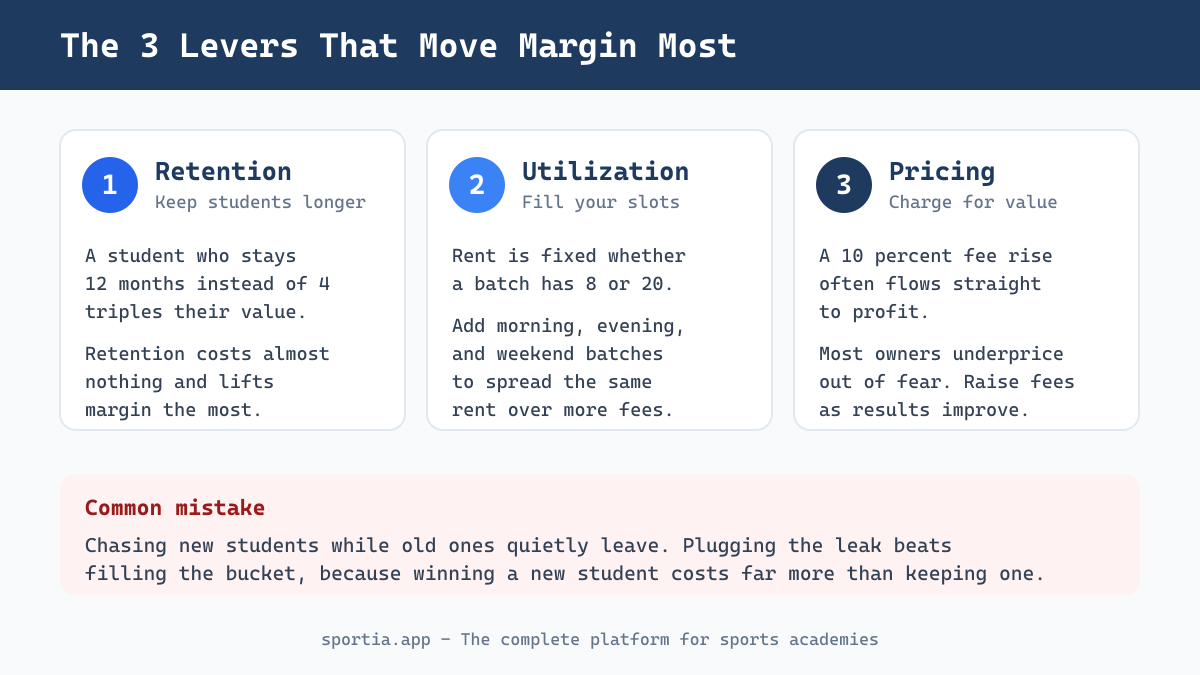
You cannot control everything, but three levers shape your margin more than any others. Pull these well and a thin margin becomes a healthy one.
Retention: keep students longer
This is the most powerful lever, and it costs almost nothing. A student who stays a full year is worth three times one who quits after four months. Strong coaching, clear progress, and a warm community keep families enrolled.
Utilization: fill your slots
Your rent is the same whether a batch has 8 students or 20. Empty slots burn money. Add morning, evening, and weekend batches to spread the same fixed rent across more paying athletes.
Pricing: charge for the value you give
Most owners underprice out of fear of losing students. Yet a careful 10 percent fee rise often flows straight to profit. Raise fees as your results and facilities improve, and explain the value clearly to parents.
Common financial mistakes new owners make
Most academy money problems come from a handful of avoidable errors. Knowing them early saves you painful lessons later.
- Not paying themselves: Treating all leftover cash as profit hides the truth. Your salary is a real cost.
- Chasing new students while old ones leave: Winning a new student costs far more than keeping one. Plug the leak first.
- Signing a costly lease too early: A big ground feels exciting, but high fixed rent can sink a young academy.
- Ignoring the numbers: Owners who never check their fees and costs cannot spot a problem until it is large.
- Underpricing forever: Low fees may fill batches, but they leave no room for quality or profit.
As you grow past your first 50 students, these mistakes get more expensive. Our guide on scaling an academy from 10 to 100 athletes covers the systems that keep margins healthy through growth.
Using your data to improve margin each term
You cannot improve what you do not measure. The academies with the best margins are simply the ones that watch their numbers. You do not need a finance degree, just a steady habit.
Track a few key figures every term:
- Total fees billed versus fees actually collected.
- How many students join and how many leave.
- Average revenue per athlete.
- Batch fill rates across your time slots.
This is where good software earns its place. With Sportia , you can see fees billed, payments received, and pending dues at a glance. You can also track enrollment as students join and batches fill. Clear numbers turn guesswork into decisions.
Before you write a full plan, it helps to model these figures. Our sports academy business plan template includes a simple costing sheet to start from.
Frequently Asked Questions
What is the average profit margin of a sports academy in India?
A well-run sports academy in India usually earns a net profit margin of 15 to 25 percent once established. Small academies often run near break-even at first, while large, well-filled ones can exceed 30 percent.
Is a sports academy a profitable business in India?
Yes, a sports academy can be profitable, but rarely in the first few months. Most owners reach steady profit after building enrollment past 50 to 75 students and controlling venue and staff costs.
What are the biggest costs of running a sports academy?
Venue or ground rent and coaching salaries are the two largest costs, often making up most of the budget. Equipment, marketing, utilities, and software make up the rest of a typical academy's running costs.
How long does it take a sports academy to become profitable?
Many Indian academies take 12 to 24 months to turn a steady profit. The timeline depends on how fast you fill batches, how well you retain students, and how heavy your fixed rent is.
How can I increase my sports academy profit margin?
Focus on three levers: keep students longer, fill empty batch slots, and price fees for the value you deliver. Improving retention is usually the cheapest and most powerful way to lift your margin.
How much revenue does a sports academy make per month?
Monthly revenue varies widely by size and fees. A 75-athlete academy charging an average of 3,000 rupees can bill around 2,25,000 rupees in fees, plus extra income from camps, kit, and events.
Know your numbers, grow your margin
A sports academy can be a genuinely good business in India. The owners who succeed are not the ones with the fanciest grounds. They are the ones who know their numbers and act on them.
Start by tracking your fees, your dues, and your enrollment clearly. Sportia brings fee collection, payment tracking, and enrollment into one place, so you always know where you stand. Start a 14-day free trial and take control of your academy's finances this term.