
How to Start an Athletics Academy in India: The Complete 2026 Guide
Athletics is the strangest business in Indian sport. It produces the country's biggest Olympic moments, it receives more government money than almost any other discipline, and yet very few people run a private athletics academy.
The reason is simple. Everyone assumes you need a track, and a track costs more than a house.
You do not need a track. This guide covers how to start an athletics academy in India without one, what the certification actually costs, what you can charge, and where the athletes go once they are good.
Why Athletics Is a Smart Pick in 2026
Three things have changed, and most coaches have not noticed yet.
The money is real. The revamped Khelo India scheme carries an outlay of roughly Rs 36,441 crore. The network already includes more than 1,000 Khelo India Centres, around 267 accredited academies and about 2,745 supported athletes. Athletics takes a large share because it holds the most medal events of any sport.
Private academies can now be accredited. The scheme introduced Khelo India Accredited Academies on a public-private partnership model. A registered private academy can apply. You need a legal entity, PAN and GST, and a Rs 10,000 application fee. The Expression of Interest runs all year and is reviewed monthly.
Local competition is thin. Count the cricket academies within five kilometres of your ground. Now count the athletics academies. In most Indian cities the second number is zero or one. Parents who want their child to run, jump or throw usually have nowhere to go except the school PT period.
That gap is the opportunity. It is also why athletics rewards a coach who starts small and stays patient.
Ground Reality: Do Not Build a Track
This is the decision that kills most athletics academies before they open.
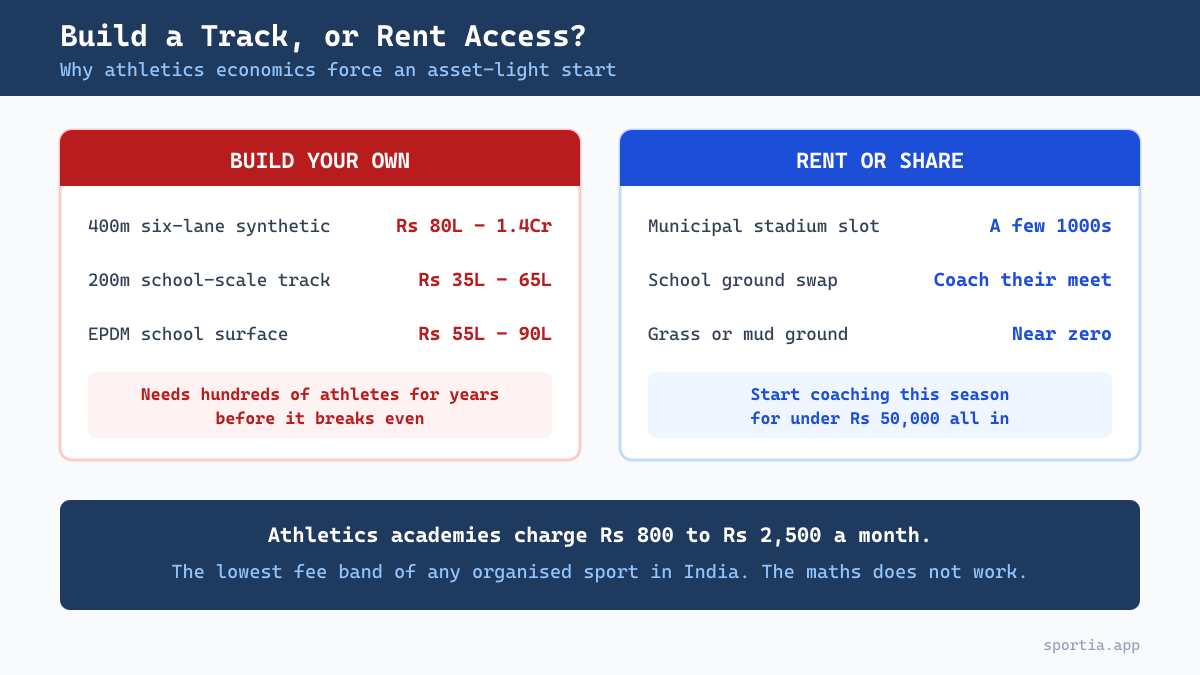
A 400 metre six-lane synthetic track costs between Rs 80 lakh and Rs 1.4 crore on a prepared site. Even a 200 metre school-scale track runs Rs 35 lakh to Rs 65 lakh. An EPDM surface for school use sits around Rs 55 lakh to Rs 90 lakh.
Now compare that with what athletics academies charge. Most sit between Rs 800 and Rs 2,500 per month. That is the lowest fee band of any organised sport in India.
The maths does not work. A track that costs a crore, funded by fees of Rs 1,500 a month, needs hundreds of athletes for many years before it breaks even.
So do not buy the surface. Rent access to one, or work without it.
- Municipal and district stadiums often rent morning slots cheaply, sometimes for a few thousand rupees a month. Many sit empty between 6am and 8am.
- School grounds are the most underused asset in Indian athletics. A school with a 200 metre grass loop will frequently let you train there in exchange for coaching their sports day squad.
- University and college tracks may allow outside groups in off hours.
- Grass and mud are genuinely fine for young athletes. Endurance running, drills, technique work and most jumps coaching do not require synthetic surface.
What actually needs a synthetic track is competitive sprinting in spikes, and that matters only once an athlete is close to state level. By then you can travel to one for a few sessions a month.
Coaching Certification: The NIS Pathway
Parents in athletics ask about qualifications far more than parents in cricket or football do. The pathway is well defined, which helps you.
The main route is the Netaji Subhas National Institute of Sports, usually called NIS Patiala. It runs the Diploma in Sports Coaching, a one year course delivered at Patiala, Bengaluru, Kolkata and Thiruvananthapuram, covering more than 26 disciplines.
- Eligibility: you need to have passed 10+2, or hold a graduate degree.
- Fee: about Rs 63,800 for Indian candidates.
- Selection: through a written entrance examination, with the 2026-27 cycle testing at the end of May.
- Attendance: at least 85 percent per semester is compulsory to sit the exam.
A full year away is not possible for everyone. SAI also runs a six week Certificate Course in Sports Coaching through NSNIS, held twice a year. That is the realistic starting point for a working coach, and it is enough to open an academy.
Get the certificate first and the diploma later, once the academy pays for itself. Do not wait a year to start coaching.
Age Groups and When to Specialise
The most common coaching mistake in Indian athletics is early specialisation. A ten year old labelled a sprinter usually stops improving by fifteen.
A workable structure looks like this:
- Ages 8 to 11: general movement. Running, jumping, throwing a soft ball, climbing, games. No event specialisation at all.
- Ages 12 to 14: event groups rather than events. An athlete trains across sprints and jumps, or across endurance, rather than picking the 100 metres.
- Ages 15 to 17: a primary event with a related second event. A long jumper still sprints. An 800 metre runner still does some 400 metre work.
- Age 18 and above: full specialisation, with a training plan built around the competition calendar.
Throws deserve a note. Shot put and javelin have grown fast since Neeraj Chopra, and throwers are often the athletes nobody else wanted. A tall, strong, slightly heavy teenager who was cut from the cricket team can become a district level thrower within two seasons. Look for them.
Equipment: What You Need and What Can Wait
Athletics has the friendliest startup cost in Indian sport, provided you buy in the right order.
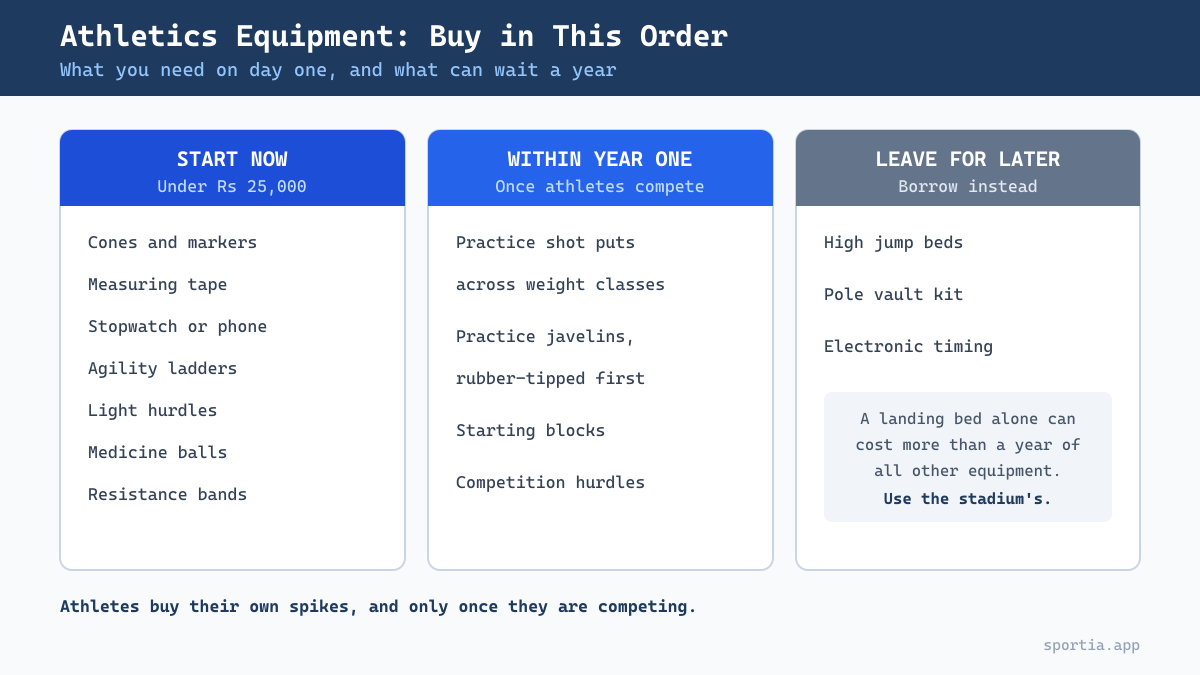
Start with this, under Rs 25,000:
- Cones, markers and a measuring tape
- A stopwatch, or a phone with a timing app
- Agility ladders and light hurdles
- Medicine balls, in two or three weights
- Resistance bands
Add within the first year:
- Practice shot puts across weight categories
- Practice javelins, including rubber-tipped versions for beginners
- Starting blocks, once you have sprinters entering competitions
- Competition-standard hurdles at the correct heights
Leave for later: high jump beds, pole vault equipment and electronic timing. A landing bed alone can cost more than a year of your other equipment combined, and a school or stadium usually has one you can use.
Athletes buy their own spikes. Tell parents to wait until the child is competing, because spikes are not required for training on grass.
What to Charge Across City Tiers
Athletics fees are lower than cricket or tennis, and pretending otherwise loses you enrollments. Price honestly and make the volume work.
- Tier 1 cities: roughly Rs 1,500 to Rs 3,000 a month for group coaching. Specialist and elite coaching runs far higher, and a well known Hyderabad academy charges around Rs 25,000 a month for one session a day.
- Tier 2 cities: roughly Rs 800 to Rs 1,800 a month.
- Tier 3 cities and towns: roughly Rs 500 to Rs 1,200 a month.
Three additions improve the economics without raising the base fee:
- School contracts. One school paying you a fixed monthly amount to run athletics for its students is worth thirty individual enrollments and takes far less admin.
- Personal training. Individual sessions in India commonly run from Rs 500 to Rs 2,000 an hour.
- Competition season packages. Charge separately for the eight week block before district and state meets.
Collect fees on a fixed date and track dues properly from day one. Low fees mean thin margins, and thin margins do not survive a 30 percent collection gap.
The Competition Pathway
This is what parents are really buying, and it is where your academy earns its reputation.
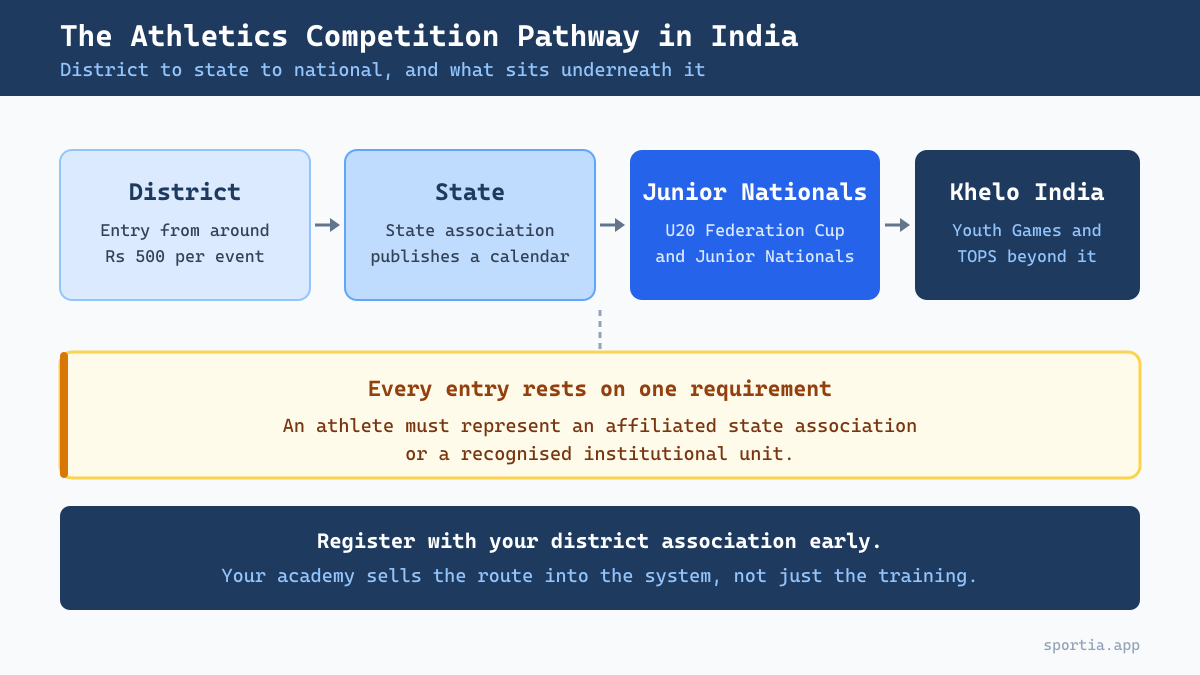
The ladder runs district, then state, then national. The Athletics Federation of India publishes a national calendar each year, and every state association publishes its own.
One detail matters more than any other. An athlete must represent an affiliated state association or a recognised institutional unit to enter. Entry is typically around Rs 500 per event, submitted online.
Read that again, because it is your business model. Your academy is not selling training. It is selling the route into a system that a parent cannot navigate alone. Register with your district athletics association early, and keep that relationship warm.
Key fixtures give the year its shape. The 2026 domestic season opened with the National Cross-Country Championships in Ranchi in January. The 24th National Junior U20 Federation Competition ran in Tumkur, Karnataka in April, with performances counting towards World Athletics U20 qualification. The 41st National Junior Athletics Championships close the season in Chennai in October.
Alongside this sits the Khelo India Youth Games, which is the highest profile route for a school age athlete and the one parents have heard of.
Scholarships and the Honest Career Picture
Athletes who reach the top tier can enter the Target Olympic Podium Scheme, which funds training, equipment, travel and a monthly allowance. Khelo India athletes receive coaching, equipment, medical support and a stipend.
Be straight with parents about the odds. Very few athletes reach TOPS. The realistic outcomes are broader and worth naming clearly:
- Sports quota admission to a good college
- Sports quota employment in the railways, banks, police and armed forces, which remains one of the strongest job pathways in Indian sport
- State and national representation, which carries real weight on a resume
- A coaching career, often through the same NIS route you took
Parents respect a coach who explains this honestly far more than one who promises an Olympic future. For the detail on funding routes, point them to the guide on sports scholarships for young athletes in India .
Registration and Getting Digital From Day One
Register the academy properly before you take your first fee. A sole proprietorship works to begin with, but Khelo India accreditation and most school contracts need a formal legal entity with PAN and GST. The guide on registering a sports academy in India covers the options.
Athletics has one record keeping demand that other sports do not. Every athlete has performance marks, and those marks decide entries, selections and progress conversations. Times, distances and heights need to sit somewhere better than a notebook.
You will be tracking attendance across age groups, personal bests by event, and a competition calendar that changes through the season. Doing this on paper falls apart at about forty athletes.
Marketing, meanwhile, is easier than most coaches expect:
- Approach schools before individual parents. Schools need athletics for their sports day and inter-school meets, and they have no one to run it.
- Post results, not motivational quotes. A photo of a district medal with the athlete's name brings enquiries.
- Ask every parent for one referral after a good result.
- Turn up at district meets even in your first season, and talk to the officials there.
The same starting sequence applies across sports. The guide on starting a hockey academy in India follows a similar structure if you are weighing both.
Frequently Asked Questions
How much does it cost to start an athletics academy in India?
You can start for under Rs 50,000 if you rent ground access rather than building a track. Basic equipment costs around Rs 25,000, with registration, certification and initial marketing making up the rest. Building a 400 metre synthetic track would cost between Rs 80 lakh and Rs 1.4 crore, which the fee levels in athletics cannot justify.
Do you need a synthetic track to coach athletics?
No. Endurance running, technique drills, most jumps coaching and all early development work can be done on grass or mud. A synthetic surface matters only for competitive sprinting in spikes, at which point you can rent access to a municipal or college track for a few sessions each month.
What qualification do you need to coach athletics in India?
The recognised route is through NIS Patiala. The one year Diploma in Sports Coaching costs about Rs 63,800 and requires 10+2 or a degree plus an entrance exam. SAI also runs a six week certificate course twice a year through NSNIS, which is the practical starting point for a working coach.
How much do athletics academies charge per month in India?
Group coaching typically runs Rs 1,500 to Rs 3,000 a month in tier 1 cities, Rs 800 to Rs 1,800 in tier 2, and Rs 500 to Rs 1,200 in smaller towns. Specialist and elite coaching costs far more, with some established academies charging around Rs 25,000 a month.
How does an athlete enter district and state athletics competitions?
The athlete must represent an affiliated state association or a recognised institutional unit, so your academy should register with the district athletics association early. Entries are submitted online, usually at around Rs 500 per event. The ladder then runs district, state and national, with the Athletics Federation of India publishing the calendar each year.
At what age should a young athlete specialise in one event?
Not before fifteen. Athletes aged 8 to 11 should do general movement work, and those aged 12 to 14 should train across event groups such as sprints and jumps together. A primary event with a supporting second event suits 15 to 17, with full specialisation from 18.
Start Small, Start This Season
Athletics rewards the coach who begins with twenty children on a school field and a bag of cones. It punishes the one who waits for a track.
Rent your ground. Take the six week certificate. Register with your district association. Buy Rs 25,000 of equipment and coach event groups rather than events. Put your athletes into a district meet this season, however they place.
Sportia handles the parts that break as you grow: attendance across age groups, personal bests by event, fee collection and the parent communication that comes with a competition calendar. Start a free 14 day trial and set it up before your first intake.