
How to Start a Hockey Academy in India: The Complete 2026 Guide
To start a hockey academy in India, you need three things: a safe playing surface, a Hockey India certified coach, and a simple way to run enrollments, fees, and attendance. You can begin on a shared grass or multi-purpose ground for very little, add gear over time, and grow into a turf when your numbers justify it. This guide walks you through the ground, the certifications, the fees, the equipment, and the digital setup, step by step.
Hockey is India's most decorated Olympic sport. Yet very few academies serve it well. That gap is your opportunity. The men's team won back-to-back Olympic bronze medals at Tokyo 2021 and Paris 2024. It also won gold at the 2023 Asian Games and lifted the 2025 Asia Cup in Rajgir. Parents have noticed. Kids want to play. But most cities still have far more cricket and football academies than hockey ones. If you can offer real coaching and a clear pathway, you can build a loyal base fast.
Why Hockey Is a Smart Sport to Build an Academy Around
Hockey has a rare mix of low competition and strong support. Here is why it makes sense in 2026.
- Low local competition. Most towns have a handful of cricket academies but almost no hockey coaching. You can own the category in your area.
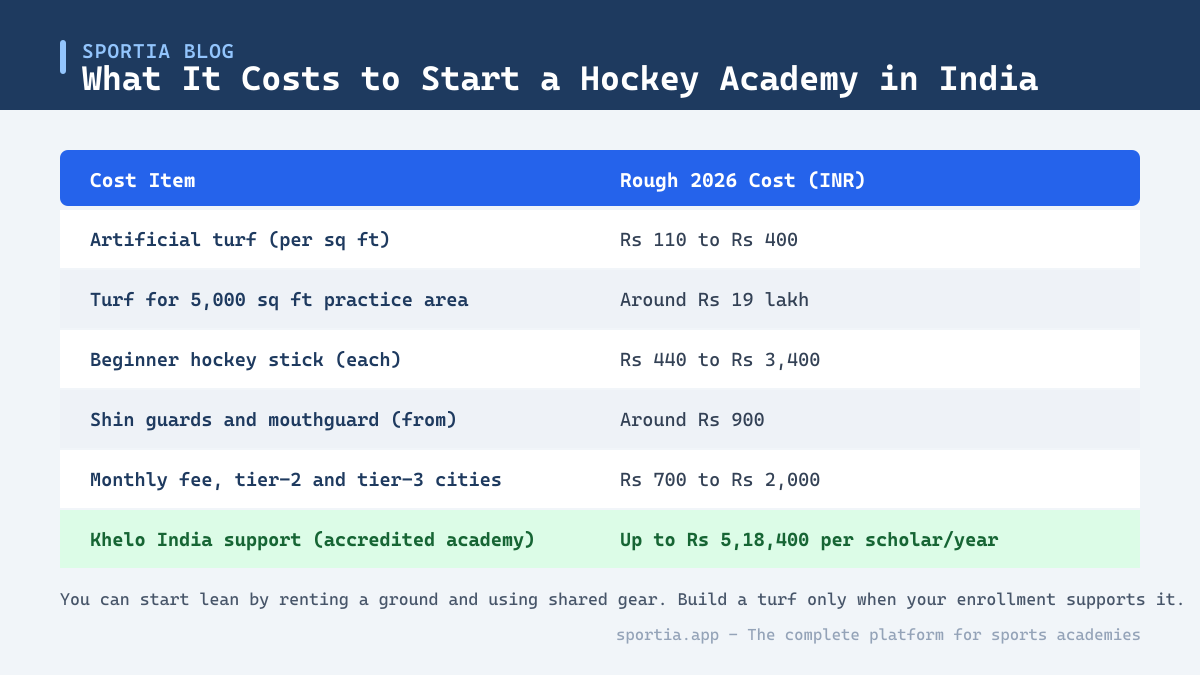
- Government support. The Khelo India scheme funds accredited academies. Support can go up to Rs 5,18,400 per year per scholar for approved centres. This is real money that few sports get.
- A growing coaching base. Hockey India has certified over 600 coaches through its coaching pathway since 2019. New Level-1 courses now run in cities like Coimbatore and Haridwar. It is easier than ever to find or become a qualified coach.
- A clear talent pathway. District, state, and national tournaments give your students a ladder to climb. Scouts watch junior and sub-junior nationals for new talent.
The catch is honest: hockey gear and turf cost more than a bat and a cricket net. But you do not need a turf on day one. Smart founders start lean and reinvest.
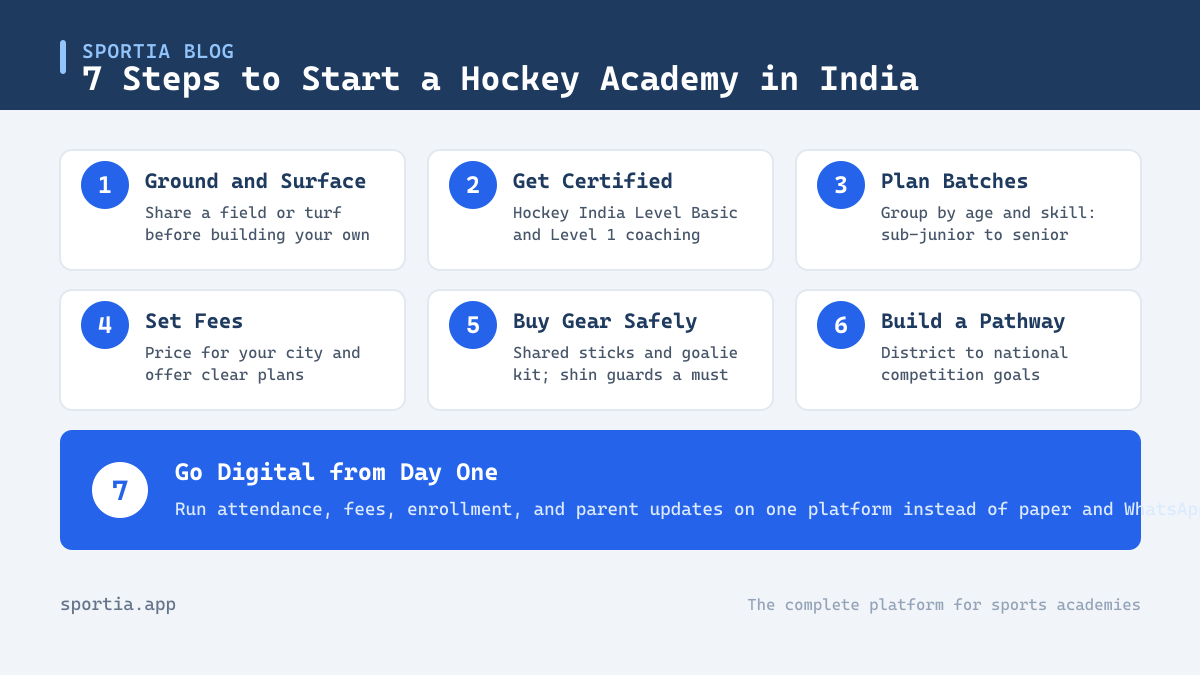
Step 1: Sort Out Your Ground and Playing Surface
Your surface is your biggest early decision. You have three broad options, from cheapest to costliest.
Option A: Share a school or stadium ground
This is how most academies begin. You rent slots at a school field, a district stadium, or a college ground. You pay by the hour or by the month. You avoid a huge upfront cost. Many district sports complexes already have a hockey turf that sits idle in the mornings and afternoons. Approach them with a fixed monthly rental offer.
Option B: Train on a good grass or multi-purpose field
Modern hockey is built for turf. But young beginners can learn skills, fitness, and basic play on firm, well-cut grass. Use this stage to build numbers and cash flow. Just be clear with parents that match play will move to turf later.
Option C: Build your own artificial turf
A full water-based or sand-dressed hockey turf is a serious investment. In India, turf projects typically cost between Rs 110 and Rs 400 per square foot. That figure includes the turf, the base work, drainage, and installation. A 5,000 square foot practice area can run to around Rs 19 lakh. Drainage layers and shock pads can add Rs 100 to Rs 150 per square foot.
A good turf lasts 8 to 10 years with proper care. Only build one when your enrollment and fees can support the loan. Most academies reach this stage after two or three steady years, not on day one.
Step 2: Get the Right Coaching Certification
Good coaching is what parents pay for. It is also a rule if you want accreditation. Hockey India runs a clear coaching education pathway. It has seven levels in all.
- Hockey India Level Basic
- Hockey India Level 1
- Hockey India Level 2
- FIH Level 1
- FIH Level 2
- FIH Level 3
- FIH High Performance
You start with the Level Basic course. It mixes online modules with in-person sessions and a competency test. You must pass it before you can take the Level 1 course. The Level 1 course includes an eight-hour session where you are assessed while coaching a real team.
If you are not a coach yourself, hire at least one certified coach and register them with Hockey India. To apply for academy accreditation, your coaches must be registered, and your academy must be linked to a Hockey India affiliated state member. Start the Basic course early. Dates fill up, and intakes open only a few times a year.
Step 3: Plan Age Groups, Batches, and a Development Path
Clear batches keep training safe and effective. Group students by age and skill, not just by who signs up. A simple structure works well.
- Sub-junior (under 10 to under 14): basics, fun, and stick skills.
- Junior (under 14 to under 17): tactics, positions, and match play.
- Senior and open (17 and above): fitness, strategy, and competition prep.
Keep beginner batches small so each child gets touches on the ball. As students improve, move them into advanced batches. This visible progress is what keeps families enrolled year after year. Map each batch to the next goal, such as a school tournament or a district trial. For more on structuring sessions and timetables, see how other academies plan their schedules.
Step 4: Set Your Fee Structure
Price for your city and your costs, not for a metro you saw online. Fees vary a lot across India. A useful rule is to look at what local cricket and football academies charge, then position hockey just below or in line with them.
As a rough guide for 2026:
- Tier-1 cities (Mumbai, Delhi, Bengaluru): Rs 1,500 to Rs 4,000 per month, higher for turf-based coaching.
- Tier-2 and tier-3 cities: Rs 700 to Rs 2,000 per month.
Offer a few clear plans. A monthly plan, a quarterly plan with a small discount, and an annual plan work well. Charge a one-time joining fee that covers a starter kit or academy jersey. Always give parents a proper receipt. Clear billing builds trust and cuts down on awkward fee-chasing later.
Step 5: Buy the Right Equipment and Safety Gear
You can start with shared academy gear and let families buy personal kit over time. This lowers the barrier for new students.
Basic equipment and rough India prices:
- Hockey sticks: beginner sticks run from about Rs 440 to Rs 3,400 each.
- Hockey balls: low cost; buy in bulk for drills.
- Shin guards and mouthguards: from around Rs 900; essential for safety.
- Goalkeeping kit: the biggest cost; buy one or two shared sets to start.
- Cones, bibs, and training aids: cheap and vital for good sessions.
Keep a shared stock of sticks and goalie gear so a new child can join without spending much on day one. Insist on shin guards and mouthguards for every player. Safety is non-negotiable, and it reassures parents.
Step 6: Build a Competition Pathway
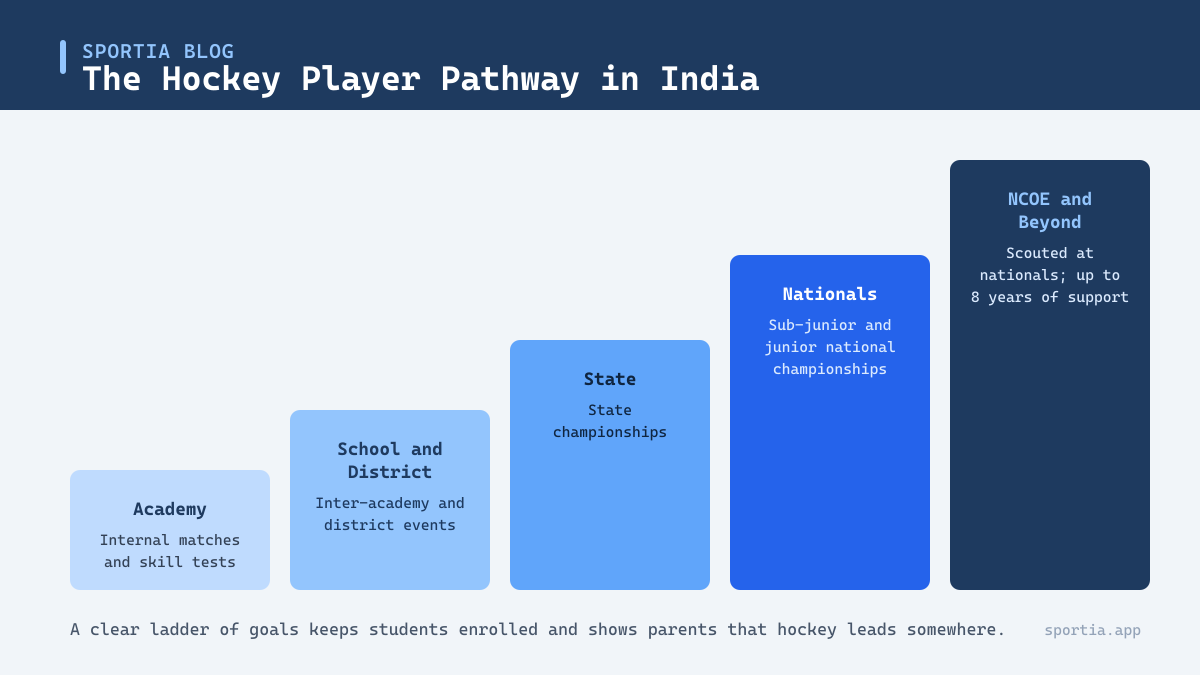
Students stay when they can see where the sport leads. Give them a ladder of goals, from local to national.
- Internal academy matches and skill tests.
- School and inter-academy tournaments.
- District championships.
- State championships.
- Sub-junior and junior national championships.
Strong players can then aim for a National Centre of Excellence trial. Talent scouts watch the junior and sub-junior nationals closely. Identified athletes can get long-term support for up to eight years. Tell parents this story clearly. It shows that hockey is not a dead end but a real path with scholarships and careers at the top.
Step 7: Go Digital from Day One
Most new academies drown in WhatsApp groups and paper registers. You do not have to. Running your academy on proper software from the start saves hours every week. It also makes you look professional to parents who are comparing you with other options.
Here is what a management platform handles for you:
- Attendance: mark it in seconds with QR check-in instead of a paper register.
- Fees and invoicing: auto-generate invoices, send reminders, and track dues.
- Enrollment: manage batches, packages, and session quotas in one place.
- Parent updates: give parents a portal to see attendance, fees, and schedules.
A tool like Sportia brings all of this together for Indian sports academies. It handles attendance, billing, enrollment, and parent communication, so you can spend your time on the pitch, not on spreadsheets. Going digital early also makes Khelo India or Hockey India accreditation paperwork far easier, since your records are clean and ready.
If you are weighing hockey against other sports, you may also find it useful to read the guide on how to start a football academy in India and the guide on registering a sports academy in India for the legal steps that apply to every sport.
A Realistic First-Year Plan
Here is a simple path many successful academy owners follow.
- Months 1 to 3: secure a shared ground, get one coach certified, buy shared gear, and enroll your first two or three batches.
- Months 4 to 8: add batches, run internal matches, set up clean billing and attendance, and register with your state hockey body.
- Months 9 to 12: enter students in district events, collect testimonials, and plan for accreditation and, in time, your own turf.
Start small, stay consistent, and let results bring in new families. Hockey rewards patient academies that build real skill.
Frequently Asked Questions
How much does it cost to start a hockey academy in India?
You can start small by renting a shared ground and buying basic shared gear, which keeps early costs low. A full artificial turf is a much larger investment, often around Rs 19 lakh for a 5,000 square foot area. Most owners begin lean and build a turf only after two or three steady years.
What coaching certification do I need to run a hockey academy?
Hockey India runs a seven-level coaching pathway that starts with the Level Basic course, followed by Level 1. You or your coaches should complete at least the Basic and Level 1 courses. For accreditation, coaches must be registered with Hockey India and linked to a state member unit.
Do I need my own turf to start a hockey academy?
No. Many academies begin on shared school grounds, district stadium turfs, or good grass fields. Young beginners can learn skills and fitness without a private turf. Build your own turf later, once your enrollment and fees can support the cost.
Is a hockey academy profitable in India?
It can be, especially because local competition is low and government support through Khelo India is available for accredited academies. Profit depends on steady enrollment, clear fees, and controlled costs. Starting lean and reinvesting into gear and grounds is the safest route to profit.
What age should children start learning hockey?
Children can begin basic hockey skills from around 7 to 8 years of age in a fun, safe setting. Group young beginners in small sub-junior batches focused on stick skills and movement. As they grow, move them into junior batches with tactics and match play.
How do I get students for a new hockey academy?
Start with local schools, as they are the fastest source of young players and often lack a hockey program. Use social media to share India's Olympic hockey success and your own students' progress. Clean digital records and a professional image also help you win parents who are comparing academies.