

Pro-Rata Billing for Sports Academies: Fair Fees When Athletes Join Mid-Month
A parent walks in on the 18th of October and wants their daughter to start badminton tomorrow. The monthly fee is Rs 3,000. Do you charge the full Rs 3,000, half of it, or nothing until 1 November? Most academies answer differently every time, depending on whoever happens to be at the front desk that evening. Pro-rata billing for a sports academy turns that awkward guess into a simple, fair rule that every parent can check for themselves.
This guide explains how pro-rata fees work with real rupee examples, when you should not use them, and the wording that keeps parents from arguing about them.
The Mid-Month Admission Problem
Admissions do not arrive neatly on the 1st, because they follow a school sports day, a trial session, or a friend's recommendation. In a busy month, a 100-athlete academy might add eight or ten children in the middle of the month.
Each one forces the same choice, and every option has a cost:
- Charge the full month. It is simple, but parents feel cheated, and some will wait for the 1st to join. You lose two weeks of momentum.
- Charge nothing until the 1st. Parents love it, but you coach a child for free for up to four weeks.
- Charge half. It sounds fair, but a child who joins on the 28th pays the same as one who joins on the 16th.
- Decide case by case. This is the worst option, because parents compare notes in the WhatsApp group.
What Pro-Rata Billing Means for a Sports Academy
Pro-rata simply means "in proportion", so you charge only for the part of the month the athlete will actually be enrolled. The usual method is to divide the monthly fee by the number of days in the month, then multiply by the days remaining.
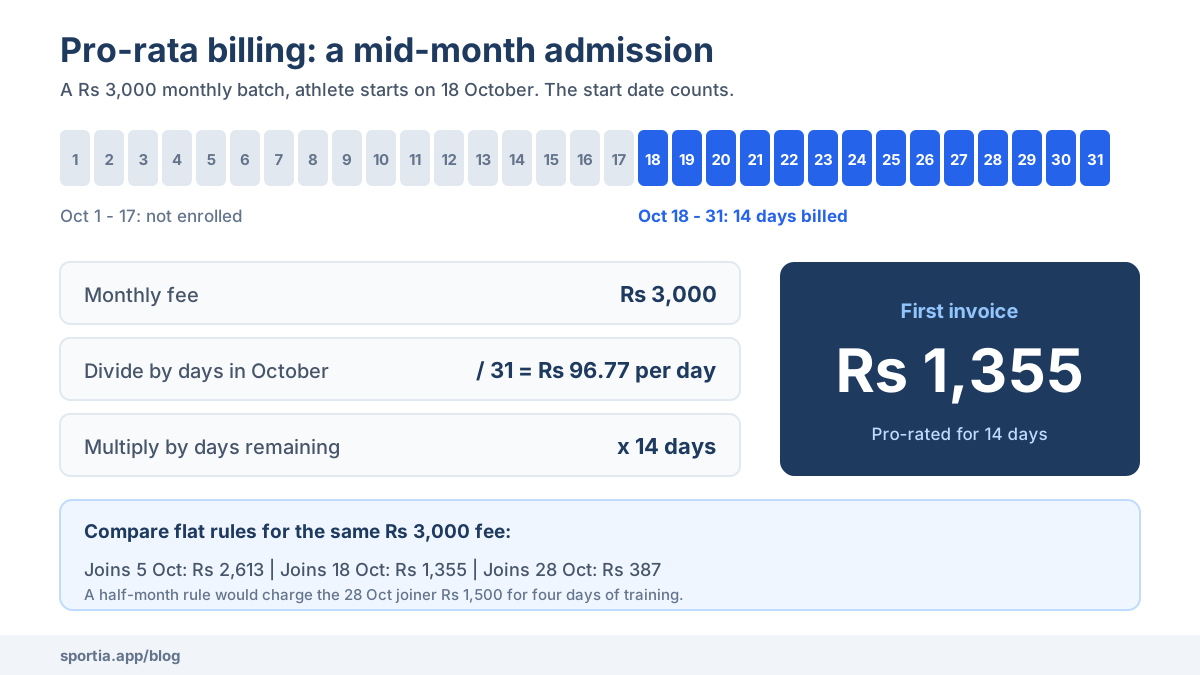
Take the parent from the start of this guide. October has 31 days, and the girl starts on the 18th. Counting the 18th itself, she is enrolled for 14 days.
Rs 3,000 divided by 31 days = Rs 96.77 per day. Rs 96.77 x 14 days = Rs 1,355.
She pays Rs 1,355 for October, then the normal Rs 3,000 from November. The parent can check the maths on a phone calculator, and that is the real strength of the method, since nobody can call a rule unfair when it applies identically to everyone.
Day-Based vs Session-Based Proration
There are two common ways to calculate prorated fees for coaching classes, and although both are fair, they suit different academies.
Day-based proration
You divide by calendar days, as in the example above, which makes it easy to explain and easy to automate. It works best for academies with daily or near-daily training, where every day of the month has value.
Session-based proration
You divide by the number of sessions in the month instead. Suppose the batch trains every Monday, Wednesday and Friday throughout the month. In October 2026, that is 13 sessions. After the 18th, six remain, so the fee is Rs 3,000 divided by 13, times 6, which is about Rs 1,385.
Session-based maths is a little fairer for batches that meet only two or three times a week. However, it is harder to explain, and it changes every month as the calendar shifts. In this particular example, the two methods differ by only Rs 30. For most academies, day-based is the better default because parents understand it instantly.
| Joins on | Full month | Half-month rule | Day-based pro-rata |
|---|---|---|---|
| 5 October | Rs 3,000 | Rs 3,000 | Rs 2,613 |
| 18 October | Rs 3,000 | Rs 1,500 | Rs 1,355 |
| 28 October | Rs 3,000 | Rs 1,500 | Rs 387 |
The table shows exactly why flat rules feel unfair to families. Under a half-month rule, the child who joins on the 28th pays Rs 1,500 for four days of training. With day-based pro-rata, the fee follows the actual time enrolled.
When Not to Pro-Rate
Pro-rata is right for regular monthly batches. It is the wrong tool in several other cases:
- Session packages. If you sell 24 sessions valid for three months, the athlete pays for sessions, not days. Joining mid-month changes nothing. The guide to training packages with session quotas explains this model.
- Fixed-term programmes and camps. A six-week summer camp or a ten-week term has a set price. Late joiners usually pay in full, because the coaching plan and kit are fixed.
- Trial weeks. If you offer a free or paid trial, start billing from the day the athlete converts, not from the trial date.
- The last few days of the month. Some academies prefer to let a child who joins on the 29th train free until the 1st, as goodwill. That is a fine choice, as long as it is a stated rule.
How Parents Perceive Fairness
Parents rarely object to paying, but they do object to feeling that someone else received a better deal. Three habits remove most of the friction.
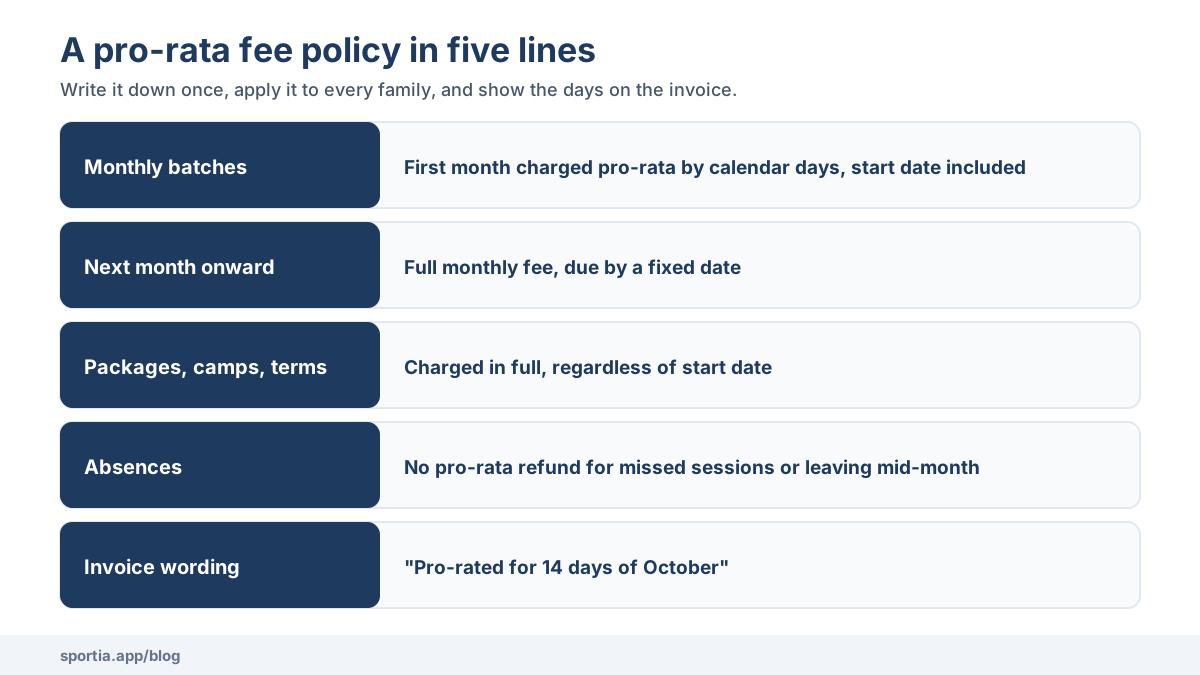
Show the maths on the invoice. A clear line such as "Pro-rated for 14 days of October" answers the question before it is asked. A bare figure of Rs 1,355 invites a phone call.
Explain it at the trial, not at payment. When a parent is deciding to join, mention that the first month is charged only for the days remaining. At that moment it sounds generous to the family, rather than complicated.
Use the same rule for everyone. The rule only feels fair if no family gets a special exception. If you want to give a discount, call it a discount, and keep it separate from the pro-rata calculation.
Doing It Manually in Excel, and Where It Goes Wrong
You can calculate pro-rata in a spreadsheet with one formula: the fee, divided by days in the month, times days remaining. The trouble is not the formula itself, but everything that happens around it.
- Someone forgets that February has 28 days, or counts from the wrong date.
- The prorated amount is typed into the fee register, but the receipt still says Rs 3,000.
- Next month, the athlete is billed the prorated amount again by mistake.
- GST is calculated on the full fee instead of the prorated one.
Each error is small, but together they create exactly the kind of disputes that pro-rata billing was supposed to prevent in the first place. The sports academy fee structure guide covers how to keep the rest of your fee rules consistent.
How Sportia Handles Pro-Rata Billing
In Sportia, pro-rata is built into enrollment for recurring monthly batches. When you enroll an athlete with a start date after the 1st, Sportia generates the first invoice automatically. It divides the monthly fee by the days in the month and charges for the days remaining, counting the start date.
The invoice is marked as pro-rated for the exact number of days, so parents see why the amount is lower. GST, if you have it switched on, is applied to the prorated amount, not the full fee. From the next month, the athlete is billed the normal fee.
Other batch types follow their own logic, so fixed-term batches are charged the full batch fee, and single-session batches are charged per session. This means each kind of programme receives the right treatment without anyone working out the maths by hand. The guide to online fee collection and invoicing shows how these invoices connect to payments.
What About Athletes Who Leave Mid-Month?
Pro-rata billing for a sports academy usually works in one direction only. Most academies charge pro-rata when an athlete joins, but they do not refund part of the month when an athlete leaves. That is a reasonable position, provided it is written down before anyone asks.
The logic is simple. A batch place is planned for the whole month, the coach is paid for the whole month, and the ground rent does not drop when one child stops coming. Ask for notice instead, for example by the 25th, so that the athlete is not billed for the next month. That protects your income while still treating families fairly.
There are sensible exceptions, such as a family relocating to another city or an injury that ends the season. Handle these as goodwill credits, decided by the owner, rather than as part of the standard rule.
Writing Your Pro-Rata Policy
Put your rule in writing, in the same place as your other fee rules. A good policy fits in four lines:
- Monthly batches are charged pro-rata for the first month, based on calendar days remaining, including the start date.
- From the following month, the full monthly fee applies, due by a fixed date.
- Session packages, camps and fixed-term programmes are charged in full, regardless of start date.
- Pro-rata applies only to new admissions, not to athletes who miss days during a month.
The last line matters, because pro-rata is designed for joining late, not for being absent. Without it, some parents will ask for a refund every time their child skips a week for exams or a family wedding.
Frequently Asked Questions
What is pro-rata billing for sports academies?
Pro-rata billing means charging a new athlete only for the part of the month they are enrolled. The monthly fee is divided by the days in the month and multiplied by the days remaining from their start date.
How do you calculate prorated fees for a mid-month admission?
Divide the monthly fee by the number of days in that month, then multiply by the days left, including the start date. For a Rs 3,000 fee and a start on 18 October, that is Rs 3,000 divided by 31, times 14, or about Rs 1,355.
Should a sports academy charge the full fee for a mid-month joiner?
Charging the full month is simple, but it can put parents off and delay admissions until the 1st. Pro-rata is usually fairer for monthly batches, while camps and fixed-term programmes are normally charged in full.
Is GST charged on the prorated fee or the full fee?
GST is charged on the amount actually billed. If the first month is prorated to Rs 1,355, GST applies to Rs 1,355, not to the full monthly fee.
Do athletes get a pro-rata refund for missed sessions?
Usually not. Pro-rata is meant for late admissions, not for absences during a month. Stating this clearly in your fee policy prevents refund requests every time a child misses a week.
Make Every First Invoice Fair and Automatic
Mid-month admissions are good news, and the first invoice should not spoil them. Pick a clear pro-rata rule, put it in writing, and show the days on every invoice. Then let Sportia calculate pro-rata fees automatically on every mid-month enrollment, so your desk staff never have to guess again.