
Does Your Sports Academy Need GST Registration? A Plain Guide for 2026
Most academy owners first think about GST when a parent asks for a "proper bill" for office reimbursement. Others think about it when a friendly accountant mentions it over tea. Very few plan for it, and that is how academies end up paying 18 percent tax out of their own pocket on fees they already collected. This guide answers the question every owner asks sooner or later: when does sports academy GST registration become necessary, and what changes once you register?
The rules below are current as of October 2026. Tax rules change, so treat this as a clear starting point, and confirm the details for your situation with a chartered accountant.
The Short Answer: When Sports Academy GST Registration Becomes Mandatory
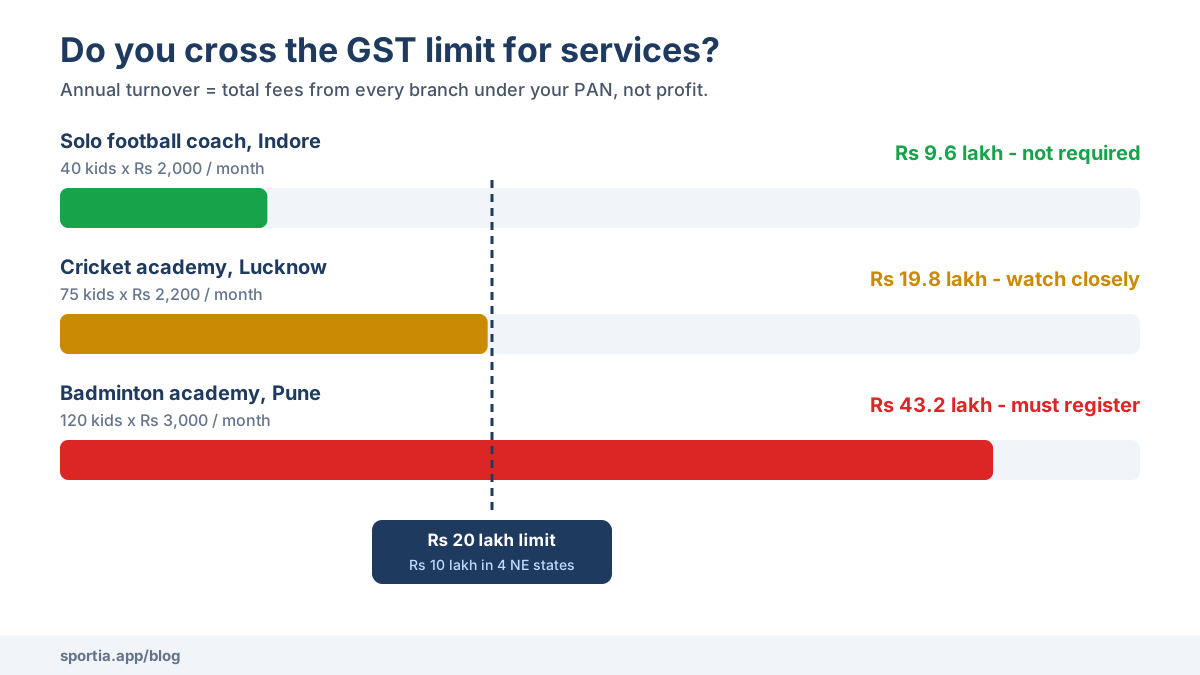
Your academy must register for GST once its total turnover in a financial year crosses Rs 20 lakh. In the special category states of Manipur, Mizoram, Nagaland and Tripura, the limit is Rs 10 lakh. You have 30 days from crossing the limit to apply.
Three details catch owners out:
- Turnover means gross fees, not profit. Coach salaries and ground rent do not reduce it.
- It counts every branch under the same PAN, across India. Two small centres can cross the limit together.
- It includes everything you sell, such as summer camps, kit sales and ground rental to other groups.
Here is how that looks in practice. A solo football coach in Indore with 40 children at Rs 2,000 a month earns Rs 9.6 lakh a year, so registration is not required. A badminton academy in Pune with 120 students at Rs 3,000 a month earns Rs 43.2 lakh, so it must register. Roughly, if your monthly fees cross Rs 1.67 lakh, you are past the limit.
The GST Rate on Sports Coaching: Why It Is Usually 18 Percent
Commercial sports coaching falls under education and training services, and a private academy charges 18 percent GST on its fees. On invoices, it is usually shown with the SAC code for sports and recreation education services.
There is one recent change that confuses many owners. Under the GST rate changes from 22 September 2025, gyms, health clubs, yoga centres and fitness services dropped to 5 percent, without input tax credit. Structured sports coaching did not get the same cut. So a cricket or tennis academy running a coaching programme is still at 18 percent.
This matters if your academy does both. Suppose you run a football academy and also sell open gym memberships in the same building. The gym membership may fall in the 5 percent group, while coaching stays at 18 percent. Keep the two as separate fee lines, and ask your CA to confirm the rate for each.
The Narrow Exemptions, and Why Most Academies Do Not Qualify
Owners often hear that "sports coaching is exempt". That is only true in narrow cases:
- Charitable entities: training or coaching in sports by an organisation registered under section 12AB of the Income Tax Act is exempt. This suits a trust or Section 8 company that is genuinely run as a charity.
- Recognised educational institutions: a school that coaches its own students in sport as part of the curriculum does not charge GST on it.
A private academy, a proprietorship or a partnership running coaching for profit does not fit either case. Setting up a trust only to avoid GST is a bad idea. A trust brings its own rules on how money can be used, and the exemption depends on running it as a real charity. The guide to registering a sports academy in India compares the legal structures in more detail.
Should You Add GST on Top of the Fee or Include It?
Once registered, you choose how to show the tax to parents. The choice affects both your income and how families react.
| Approach | Parent pays | Academy keeps | Parent reaction |
|---|---|---|---|
| GST on top (Rs 2,500 + 18%) | Rs 2,950 | Rs 2,500 | Notices a jump of Rs 450 |
| GST included (Rs 2,500 total) | Rs 2,500 | About Rs 2,119 | No change felt |
Neither choice is wrong, but each has a cost. Adding GST on top protects your income, yet a sudden 18 percent rise can push some families away. Including it keeps fees steady, but you lose about Rs 381 on every Rs 2,500.
Many academies find a middle path works best. They include GST for existing families until the next annual fee revision, and then quote new fees as "plus GST". Corporate parents who claim the fee back from their employer often prefer a clear GST line anyway. The sports academy fee structure guide covers how to announce a fee change without losing families.
Voluntary Registration Below the Limit
You can register even if your turnover is below Rs 20 lakh. It is worth it in a few situations:
- Schools, corporates or clubs hire you for coaching and want GST invoices so they can claim credit.
- You are about to spend heavily on a turf, nets or equipment, and want to claim back the GST on it.
- You expect to cross the limit within a year, and want your systems ready in advance.
For a small academy whose customers are all parents, voluntary registration usually adds cost without benefit. Parents cannot claim the tax back, so you either raise fees or absorb 18 percent. Once registered, you must also file returns every period, even in months with no income.
There is also a composition scheme for small service providers with turnover up to Rs 50 lakh. You pay a flat 6 percent of turnover, with simpler returns. But you cannot charge GST to customers or claim input credit, and there are other conditions. Ask your CA whether it suits you before choosing it.
Input Tax Credit: The Part Owners Forget
Registration is not only a cost. Once registered, you can usually claim back the GST you paid on business purchases. That credit reduces the tax you owe on your fees.
Typical claims for an academy include:
- Turf, court or ground rental from a GST-registered owner
- Equipment such as bowling machines, nets, balls, cones and mats
- Software subscriptions, including your academy management system
- Marketing costs, such as printing and online ads
Some purchases are blocked, such as food and drink for staff, and most motor vehicles. The rule of thumb is simple. Only buy from GST-registered suppliers when you can, and insist on a proper tax invoice with your GSTIN on it.
Invoicing and Filing After Sports Academy GST Registration
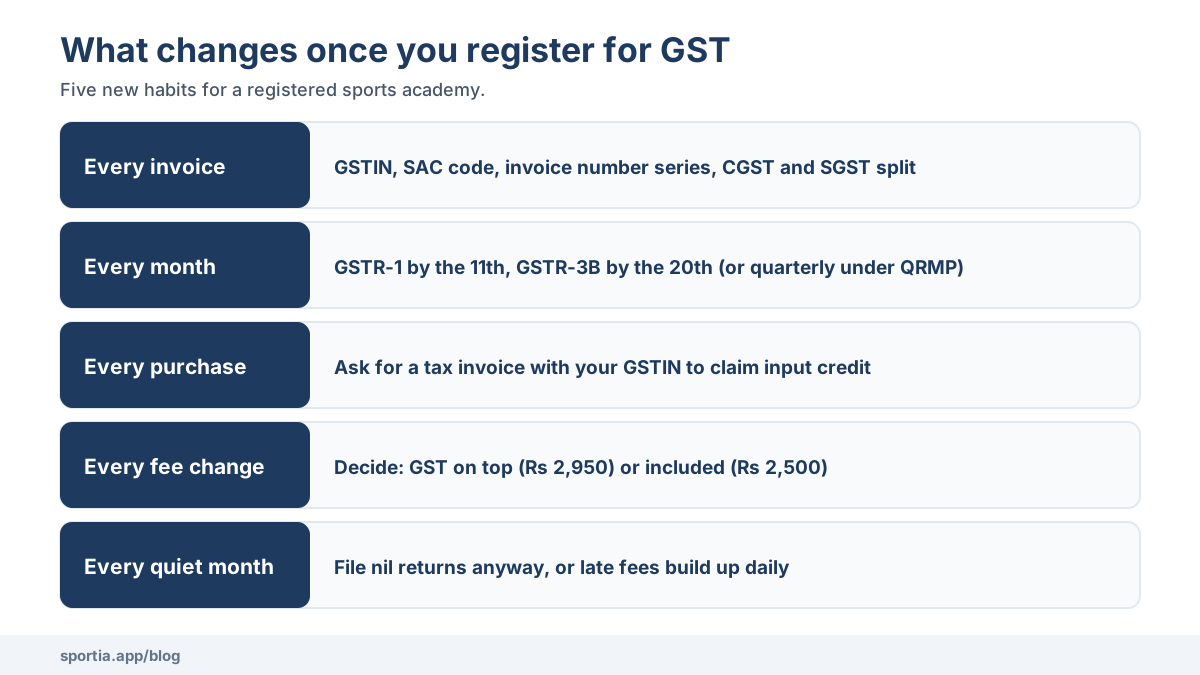
Registration itself is free, on the GST portal. You need your PAN, Aadhaar, address proof for the academy, bank details and a photograph. Once you have your GSTIN, every fee invoice must show:
- Your academy name, address and GSTIN
- A unique invoice number in a continuous series
- The SAC code for the service
- The taxable amount and the tax, split as CGST and SGST within your state
- The total amount and the date
Filing comes next. Monthly filers submit GSTR-1 by the 11th and GSTR-3B by the 20th of the following month. Small taxpayers with turnover up to Rs 5 crore can choose the QRMP scheme instead. Under it, you file returns every quarter but still pay tax monthly.
Doing this by hand gets messy fast, because one wrong total on a fee invoice flows into the return. In Sportia, you switch GST on in your invoice settings and enter your GSTIN. You then set the rate, which is 18 percent by default, and choose whether fees include tax or add it on top. Every invoice then shows the SAC code and the CGST and SGST split automatically. You can also set a different rate on a single package, such as a gym membership. The guide to online fee collection and invoicing shows how this connects to payments.
Common Mistakes That Lead to Notices
Most GST trouble at academies comes from a handful of avoidable errors:
- Charging GST without being registered. Collecting tax without a GSTIN is not allowed, even if you mean to pay it later.
- Not charging after crossing the limit. The tax is still due, so you end up paying 18 percent from your own margin.
- Skipping nil returns. Late fees build up daily, even in months with no income, such as a closed May.
- Mixing services in one fee. A single "all-inclusive" fee that covers coaching, gym and kit makes the correct rate hard to prove.
- Counting only one branch. Turnover is measured across your PAN, so every centre counts toward the limit.
- Losing purchase invoices. Without them, you cannot claim input credit, and you pay more tax than you need to.
Frequently Asked Questions
Does a sports academy need GST registration?
Only if your annual turnover crosses Rs 20 lakh, or Rs 10 lakh in Manipur, Mizoram, Nagaland or Tripura. Below that, registration is optional. Turnover means total fees from all branches under your PAN.
What is the GST rate on sports coaching in India?
Commercial sports coaching by a private academy is taxed at 18 percent. The 5 percent rate introduced in September 2025 covers gyms, yoga centres and fitness services, not structured sports coaching programmes.
Is sports coaching exempt from GST?
Only in narrow cases. Coaching by a charitable entity registered under section 12AB is exempt, as is sport taught by a school to its own students as part of the curriculum. Private academies run for profit are not exempt.
Can a sports academy include GST in its fees?
Yes. You can quote fees inclusive of GST or add GST on top. Including it keeps the price parents see unchanged, but the academy keeps about 15 percent less of each fee.
How much does GST registration cost for an academy?
Registration on the GST portal is free. The real cost is compliance: monthly or quarterly returns, and accounting help if you use a CA, which often runs to a few thousand rupees a month for a small academy.
Get Your GST Setup Right Before It Becomes Urgent
GST is far easier to handle a few months before you cross Rs 20 lakh than a few months after. Check your total turnover across all branches, decide how you will show tax to parents, and keep every purchase invoice. When you are ready, Sportia can generate GST-ready invoices automatically, so the numbers in your returns match the fees you actually collected.