
Mid-Year Academy Health Check: 8 Numbers Every Owner Should Review
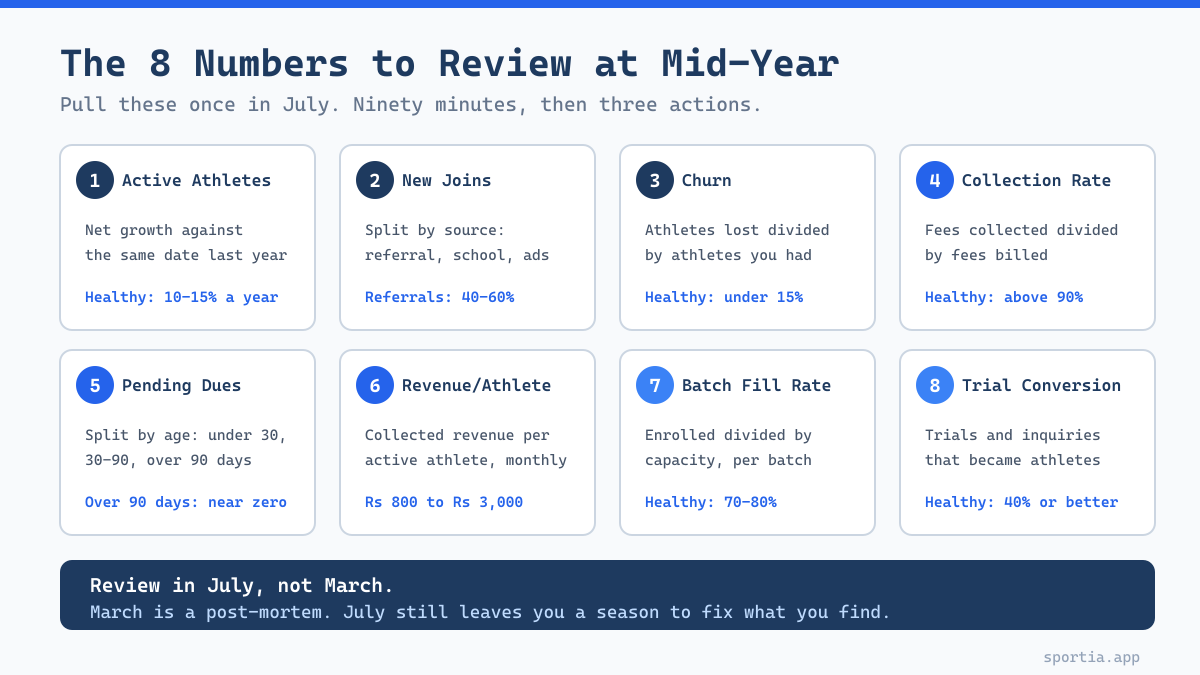
The sports academy metrics to track at mid-year are simple: active athletes, new joins, churn, collection rate, pending dues, revenue per athlete, batch fill rate, and trial conversion. Eight numbers, one afternoon, once a year. This guide shows you how to pull each one, what a healthy figure looks like for an Indian academy, and how to turn the review into three actions before the school games season starts.
Why July Is the Right Month to Look at the Numbers
Most academy owners review their business in March, when the financial year closes. That is far too late to change anything about this season.
July works better because of how the Indian sports year really runs. Schools reopened in June, so your fresh batches have now settled. The April to June enrollment rush is over and you can see who stayed. The October to January school games season has not started, which leaves you three months to fix problems.
Review in March and you are writing a post-mortem. Review in July and you can still change the result.
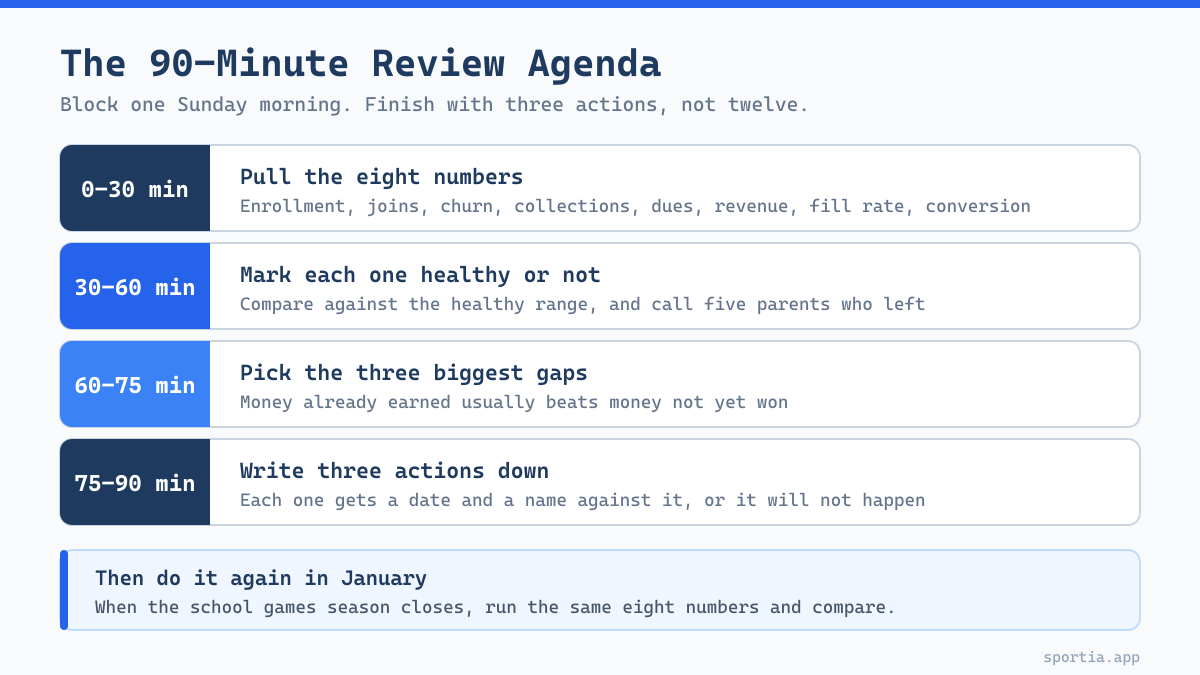
The rule that makes this work is a tight scope. Pull eight numbers, spend 90 minutes on them, and commit to exactly three actions. Owners who try to track twenty metrics often track none of them by August.
Number 1: Active Athletes and Net Growth
Start with the headline figure. How many athletes are training with you today, compared with the same date last year?
Count only active athletes. An athlete who has not attended in six weeks and owes two months of fees is not active, whatever your register says. Be honest here, because every other number depends on this one.
A well-run academy should grow roughly 10 to 15 percent a year. Flat numbers are not a disaster on their own, but flat numbers alongside heavy new joins mean you have a retention problem hiding underneath.
Number 2: New Joins and Where They Came From
Count the athletes who joined between January and June, then split them by source.
Most Indian academies find that referrals from current parents drive 40 to 60 percent of new joins. School tie-ups, Instagram, Google searches, and walk-ins make up the rest. If you have never tracked source, start by asking every new parent one question at enrollment.
This number changes where you spend money. An academy getting most of its joins from parent referrals should invest in a referral scheme, not in Instagram ads.
Number 3: Churn and Retention
Churn is the number that quietly decides whether you grow. Take the athletes who left in the last six months, divide by the athletes you had in January, and multiply by 100.
Under 15 percent a year is healthy for a membership business. Strong academies push retention above 85 percent.
Indian academies face two churn spikes. The first hits in February and March when board exams start. The second hits in April and May when families travel. Neither is easy to avoid, but both are much worse if you never ask why someone left.
Call five parents who withdrew. Ask one question: what would have kept you here? Five honest answers are worth more than any dashboard. Our guide on scaling an academy from 10 to 100 athletes covers the retention systems that matter most as you grow.
Number 4: Fees Billed Versus Fees Collected
This is the most useful number in the whole review, and most owners have never worked it out.
Take the total fees you should have collected between January and June. Then take what really landed in your account. Divide the second by the first.
Academies chasing fees through WhatsApp reminders often sit near 60 percent in the billing month. Academies with automated invoices and set reminders often cross 90 percent. That gap is not a small detail. On Rs 15 lakh of annual billing, it is Rs 4.5 lakh sitting in other people's bank accounts.
If your collection rate is below 85 percent, this is likely your best single action for the second half.
Number 5: Pending Dues and How Old They Are
The total dues figure matters less than its age. Split what is owed into three buckets: under 30 days, 30 to 90 days, and over 90 days.
Money under 30 days old is a timing issue and often arrives. Money over 90 days old is rarely paid, and chasing it costs you goodwill with families you want to keep.
Most academy owners are shocked by this split the first time they do it. The useful response is not a collection drive. It is a policy: a clear due date, an auto reminder before it, and a written rule about what happens after 60 days.
Number 6: Average Revenue Per Athlete
Divide your total fee revenue for the half year by your average active athlete count, then divide by six for a monthly figure.
Indian academies often land between Rs 800 and Rs 1,500 a month in tier-3 cities, and between Rs 1,500 and Rs 3,000 in tier-1 and tier-2 cities. Small-group and private coaching sit higher.
Here is why this number matters more than headcount. Raising revenue per athlete by Rs 200 across 120 athletes adds Rs 24,000 a month without a single new enrollment. That is often easier than finding 15 new families. Our breakdown of sports academy profit margins in India shows where that extra revenue really reaches the bottom line.
Number 7: Batch Fill Rate and Coach Utilization
Batch fill rate is your enrolled athletes divided by your batch capacity. Run it per batch, not as an academy average, because averages hide the problem.
A normal academy finds that two or three batches are full while some morning batches run at 30 percent. Those thin batches cost you the same coach fee and the same ground rent as the full ones.
Aim for 70 to 80 percent fill across your batches. Below 50 percent, you have three options: merge the batch, move it to a better time slot, or market that slot rather than the academy as a whole.
Coach utilization follows the same logic. Divide the sessions each coach really delivers by the sessions they are paid for. A coach at 40 percent utilization is not a coaching problem, it is a scheduling problem.
Number 8: Trial-to-Enrollment Conversion
Count the trial sessions and inquiries you got between January and June, then count how many became paying athletes.
Around 40 percent is a common conversion rate for trial-based businesses, and the best reach nearly 70 percent. If you are below 25 percent, the problem is almost never the coaching.
It is often one of three things: nobody followed up after the trial, the follow-up came three days late, or the parent never got a clear answer on fees and timings. Leads contacted within 15 minutes convert two to three times more often than leads left overnight.
Our guide to managing leads and trials in a sports academy covers the follow-up steps that close this gap.
A Worked Example: One Academy's Mid-Year Numbers
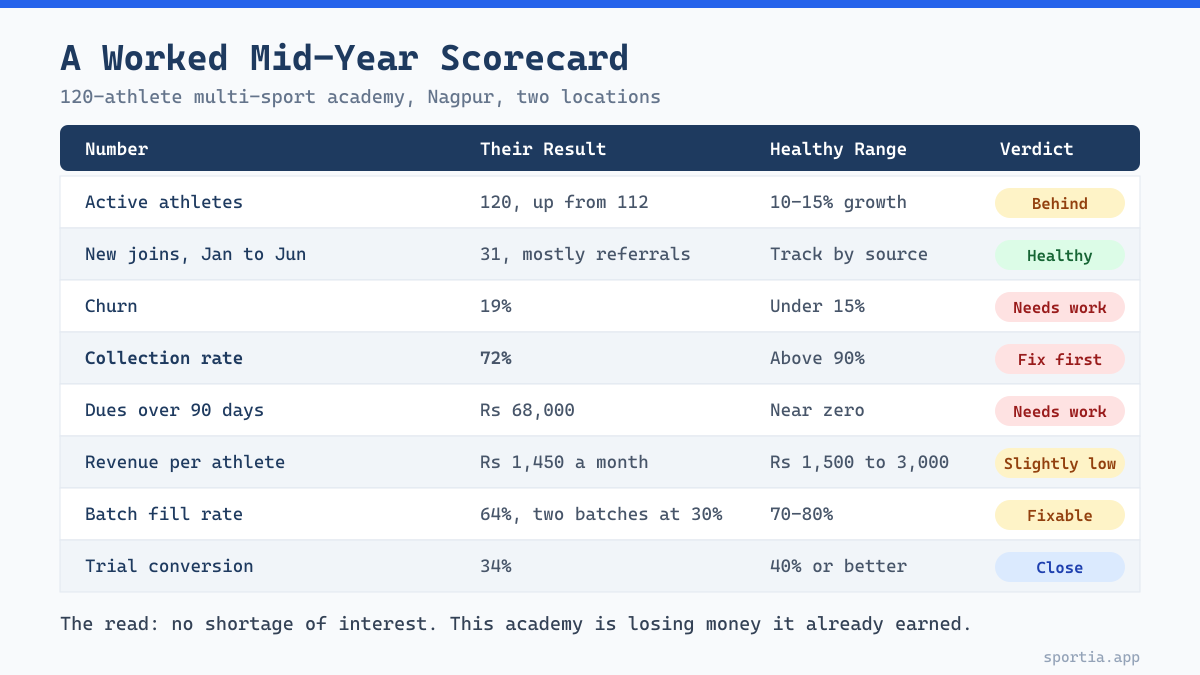
Take a 120-athlete multi-sport academy in Nagpur running cricket and badminton across two locations.
| Number | Their Result | Healthy Range | Verdict |
|---|---|---|---|
| Active athletes | 120, up from 112 | 10-15% growth | Slightly behind |
| New joins (Jan-Jun) | 31, mostly referrals | Track by source | Healthy |
| Churn | 19% | Under 15% | Needs work |
| Collection rate | 72% | Above 90% | Biggest problem |
| Dues over 90 days | Rs 68,000 | Near zero | Needs work |
| Revenue per athlete | Rs 1,450 a month | Rs 1,500-3,000 | Slightly low |
| Batch fill rate | 64%, two batches at 30% | 70-80% | Fixable |
| Trial conversion | 34% | 40% or better | Close |
Notice what the numbers show together. This academy is not short of interest, because 31 joins and a 34 percent trial conversion are solid. It is losing money it has already earned, and losing athletes it already had.
Adding more marketing spend here would be the wrong call.
Turning the Review Into Three Actions
Eight numbers will suggest a dozen fixes. Pick three, because three actions done beat twelve actions started.
For the academy above, the three clear picks are:
- Fix collection first. Move to auto invoices with a reminder three days before the due date. A jump from 72 to 90 percent brings back about Rs 31,000 a month on the same athlete base.
- Write off and reset old dues. Close the books on anything over 120 days, then set a clear fee policy from August so it does not build again.
- Merge the two thin batches. One combined batch at 60 percent beats two at 30 percent, and it frees a coach slot for a new evening batch.
Write the three actions down with a date and an owner. Then review the same eight numbers in January, when the school games season closes.
How to Make This a 90-Minute Job
The reason most owners skip this review is not laziness. It is that pulling the numbers from registers, notebooks, and six months of WhatsApp takes two days.
If your records live on paper, block a Sunday and do it once anyway. The first review is always the hardest, and even rough figures beat guesswork.
If your academy runs on software, all eight numbers are already sitting in the system. With Sportia , enrollment counts, invoices raised against payments received, pending dues by age, batch capacity against enrollment, and inquiry-to-enrollment tracking all come from the same records your coaches update daily. The review becomes reading, not rebuilding.
That is the real case for going digital. Not the attendance marking, but the fact that you can answer a hard question about your business in an afternoon rather than a fortnight.
Frequently Asked Questions
What are the most important sports academy metrics to track?
Collection rate, churn, and batch fill rate matter most for a small academy. Collection rate shows revenue you have already earned but not received. Churn and fill rate together explain almost every profit problem an academy has.
How often should a sports academy review its numbers?
Twice a year is enough for a full review, best in July and January. Track collection rate and active athlete count monthly, since both move fast enough to need attention. A quarterly review works well once you cross 200 athletes.
What is a good churn rate for a sports academy in India?
Under 15 percent a year is healthy, and strong academies keep retention above 85 percent. Expect spikes around February board exams and the April to May travel season. Compare each year against your own figure rather than an industry average.
How do I calculate revenue per athlete?
Divide total fee revenue for the period by the average number of active athletes, then divide by the number of months. Use collected revenue rather than billed revenue for a true figure. Most Indian academies land between Rs 800 and Rs 3,000 a month depending on the city.
What batch fill rate should an academy aim for?
Between 70 and 80 percent across batches is a fair target. Run the math per batch rather than as an average, because a full evening batch will hide an empty morning one. Anything below 50 percent should be merged or moved.
Is a mid-year review worth it for a small academy?
Yes, and even more so. A 40-athlete academy feels the effect of one fixed number at once, while a large academy absorbs it. The whole job takes 90 minutes if your records are in one place.
Review the Numbers, Not the Feeling
Most academy owners have a strong instinct about how the year is going. That instinct is often right about coaching quality and wrong about money.
Eight numbers, 90 minutes, three actions. Do it this week and you still have a full season to act on what you find.
Sportia gives you enrollment, invoicing, pending dues, batch capacity, and inquiry conversion in one place, so your next review is a read rather than a rebuild. Start your free 14-day trial and see your academy's real numbers.