

Volleyball for Beginners in India: Skills, Drills and Pathways for Young Players
Walk past a beginner volleyball session at almost any school ground in India and you will see the same picture. Twelve children stand in a line. One child gets a toss from the coach, swings at it, and walks to the back. The rest of the group simply waits. In a 60-minute session, a child might touch the ball 30 times. That is nowhere near enough repetition to develop real skill.
Volleyball is one of the cheapest team sports to start in India. One ball, one net and a flat patch of ground are enough to begin. But it is also one of the easiest to coach badly, because the ball dies the moment a beginner makes a mistake. This guide covers volleyball drills for beginners that fix that problem, along with jump safety, equipment costs, the pathways open to young players, and how to run a volleyball batch that keeps every child busy.
Volleyball in India: Where the Sport Stands in 2026
Volleyball has deep roots in India. It is played on mud courts in villages across Kerala, Tamil Nadu, Punjab, Haryana, Rajasthan and Andhra Pradesh, and in almost every school and college. For many young players, it is also a route to a government job through sports quotas in the railways, police, services and banks.
The professional side is growing too. The Prime Volleyball League will start its fifth season on 30 November 2026. In July 2026, the world body FIVB recognised it as India's first-division league, which means Indian clubs can now enter Asian and world club events. That gives a talented 14-year-old a genuine professional ambition.
There is one complication that coaches and parents should understand. The national federation's recognition was suspended by the sports ministry in April 2026, after FIVB withdrew its provisional recognition. In September 2026, the Railway Board clarified that national medals won while the federation was recognised, from October 2025 to April 2026, still count for sports quota jobs. If you coach players aiming for national events, check with your state association which events currently count before you plan the season.
The Five Core Skills: Serve, Pass, Set, Attack and Block
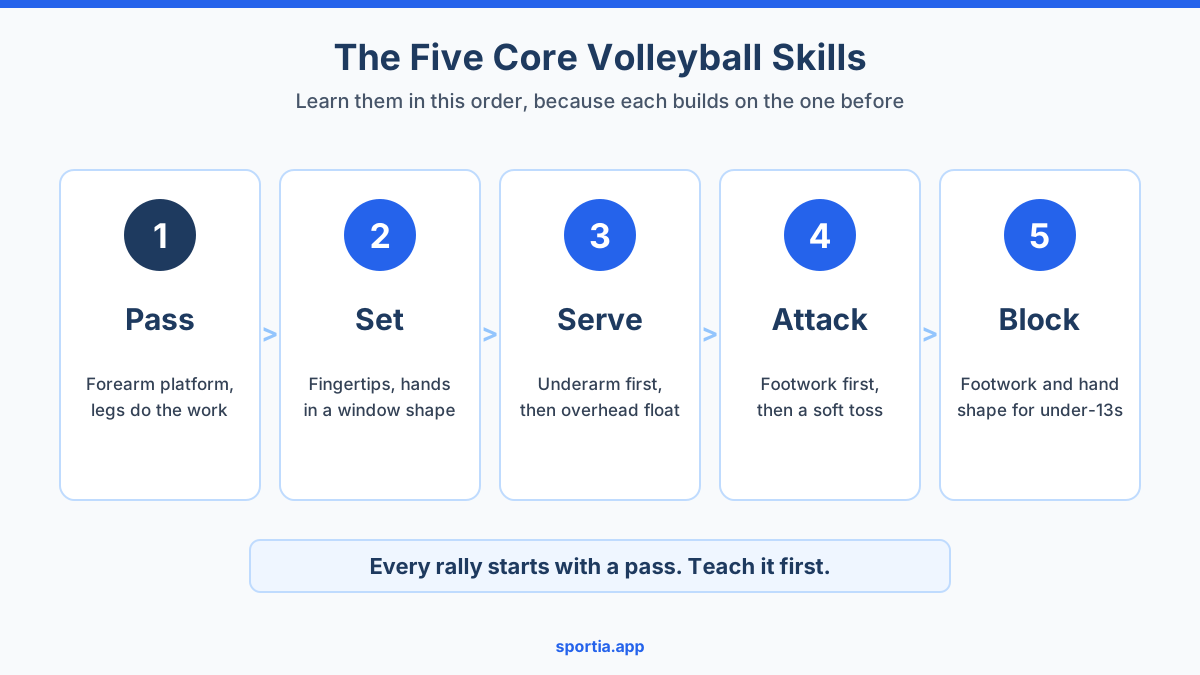
Every volleyball rally is built from five fundamental skills. Beginners should learn them roughly in this order, because each one depends on the one before it.
1. Pass (the forearm dig)
The pass is the most important skill in the game, and the least exciting to practise. The player joins both forearms into a flat platform and directs the ball with the legs and shoulders, not by swinging the arms. If your players cannot pass, nothing else works, because every rally starts with a pass.
2. Set (the overhead pass)
The set uses the fingertips of both hands to push the ball up for a teammate. Beginners usually slap the ball with their palms instead. Teach the "window" shape: hands above the forehead, thumbs and index fingers forming a triangle you can look through.
3. Serve
Start with the underarm serve from a few metres inside the court, then move back as players succeed. Most beginners can learn an overhead float serve by age 12 or 13. Avoid jump serves for young beginners, since they add a lot of jumping load for little gain.
4. Attack (the spike)
The attack is the exciting skill that attracts most children to the sport. Teach the approach footwork first, without a ball, using a simple four-step or three-step rhythm. Then add a soft toss from the coach before moving to a real set.
5. Block
Blocking is introduced last. It needs timing, footwork along the net and enough height to get the hands above it. For most players under 13, blocking is better taught as footwork and hand shape than as a full skill.
Volleyball Drills for Beginners Aged 10 to 14
The best volleyball drills for beginners share one goal: more touches per child per minute. Long queues are the biggest enemy of improvement. Here are drills that keep everyone moving, with a short note on what each one teaches.
Self-pass ladder
Each child has a ball and passes it to themselves, counting how many in a row they can keep up. Start with one bounce allowed between passes, then none. With 12 balls for 12 children, every child gets hundreds of touches in five minutes. It is the single best argument for buying additional balls.
Partner pass and set
Pairs stand three to four metres apart. One tosses, the other passes back. After ten good passes, they swap roles, and then both practise setting. Add a rule that the ball must go above head height, so players learn to control the height, not just the direction.
Target serving
Place hoops, cones or old tyres in different zones of the court. Players serve at a target and score a point for each hit. A small reward for the most points turns a boring drill into a competition.
Wall passing
If you only have one court and 20 children, send half of them to a wall. Passing or setting against a wall gives far more touches than waiting in a line, and it needs no partner.
Small-sided games: 2 vs 2 and 3 vs 3
This is where the real learning happens for beginners. Split one full court into two or three smaller courts using ropes, cones or a second net. Play 2 vs 2 or 3 vs 3 with a lower net. In a 6 vs 6 game between beginners, most children barely touch the ball. In 2 vs 2, every child plays almost every rally.
Start with simple, forgiving rules. Allow one bounce before each touch, or allow a catch and throw on the second touch. As players improve, remove the helper rules one at a time. Keep score, because children concentrate harder when the result matters.
Lower the net and lighten the ball
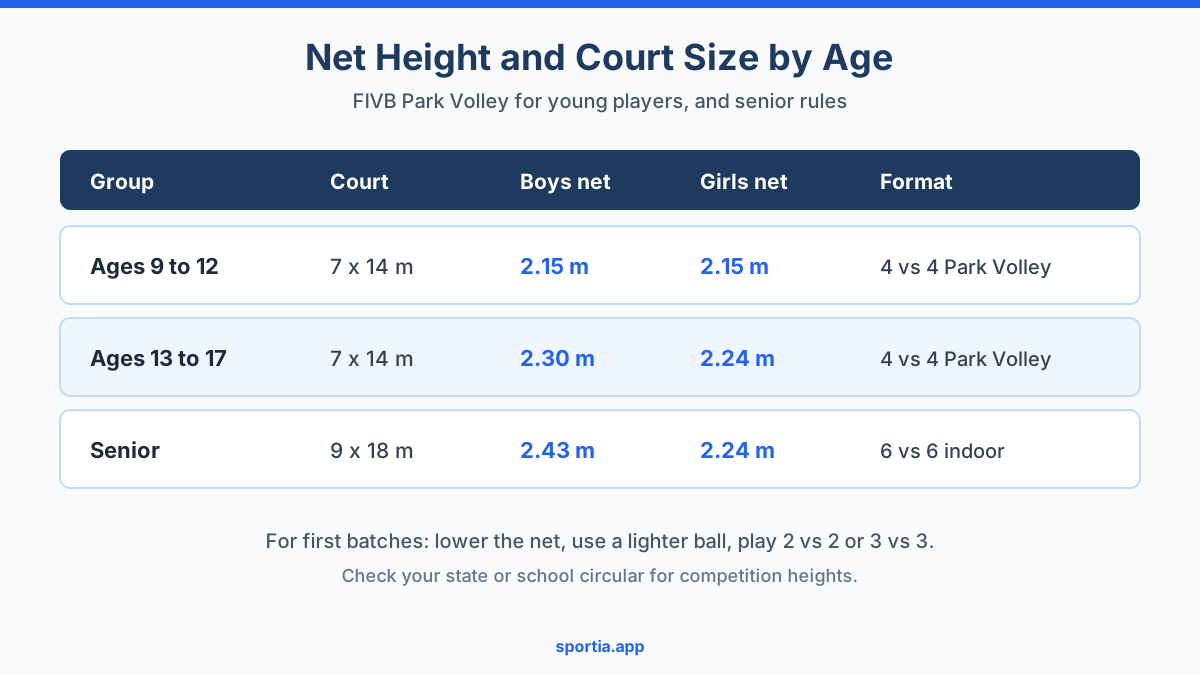
A regulation net is 2.43 m for men and 2.24 m for women. That is far too high for a 10-year-old. FIVB's own Park Volley format for young players uses a 7 m by 14 m court with a net at 2.15 m for ages 9 to 12, and 2.30 m for boys and 2.24 m for girls aged 13 to 17. For your first batches, a lower net and a lighter, softer ball mean fewer sore forearms and more rallies. Check your state or school circular for the exact heights used in competitions.
Jump Training and Landing Safety for Growing Knees
Volleyball is a jumping sport, and repeated jumping causes most of its injuries. Jumper's knee, or patellar tendinopathy, is the most common injury in the sport. A study in the British Journal of Sports Medicine put it at 40 to 50 percent among elite players. Research on young elite Norwegian players found that more training hours and more match sets per week were linked to a clearly higher risk.
For a coach of 10 to 14-year-olds, the lesson is simple: control how much they jump, and teach them how to land before you teach them how to jump high.
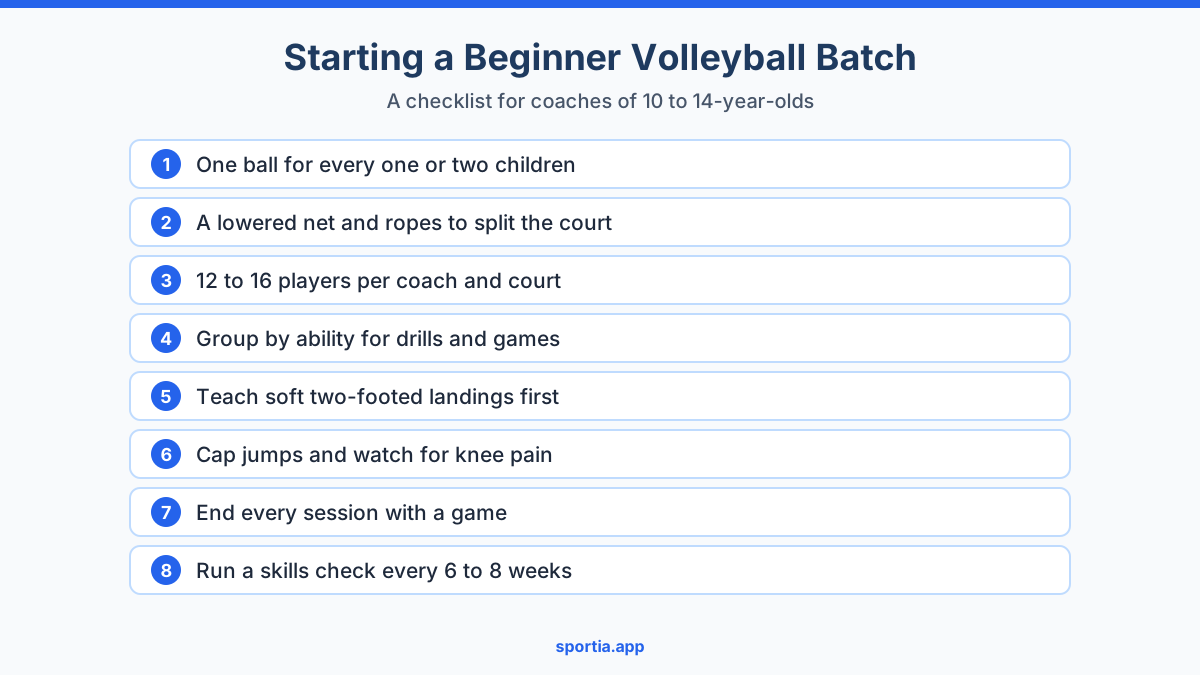
- Teach the soft landing first. Land on both feet, knees bent and pointing over the toes, and hold the position for two seconds. A stiff, straight-legged landing loads the knee tendon far more.
- Observe the knees carefully. If a child's knees cave inward on landing, fix it before adding more jumps. This matters most for girls going through growth spurts.
- Monitor the total number of jumps. Spike and block drills add up fast. A sensible rule of thumb is to start beginners with around 50 quality jumps a session and build slowly.
- Do not add extra days in a growth spurt. A child who has grown 6 to 8 cm in a year is more prone to knee pain. Hold the load steady during this phase.
- Treat knee pain as an important warning signal. Pain just below the kneecap after jumping is an early warning. Cut the jumping, not the whole session, and send the family to a physiotherapist if it lasts more than a week or two.
A 10-minute warm-up with skips, lunges and short hops also helps to prepare the tendons. Our guide to speed and agility training for young athletes has drills you can borrow for this.
Equipment and Court Needs
Volleyball needs less kit than most team sports, which is why it is so common in schools. Here is what to budget, using rough 2026 prices. Collect local quotations before you spend anything.
- Balls: a soft hobby ball for children under 12 costs around Rs 500 to 600. Match-grade balls cost more. Aim for one ball per two children, and ideally one each for the self-pass drills.
- Net: a standard net costs around Rs 1,500 to 2,500. Buy a spare, because outdoor nets deteriorate quickly in the sun and rain.
- Poles: fixed steel poles set in concrete are the most stable. A local fabricator can make a pair, and adjustable poles are worth the extra cost if you coach several age groups.
- Training aids: cones, hoops, ropes for splitting courts and a few knee pads for players who dive.
Outdoor court or indoor hall?
A full court is 18 m by 9 m, with clear space around it. Your options, from cheapest to most expensive:
- Mud or clay court: the traditional Indian court. Cheap to build, but it needs regular levelling and watering, and it is unusable after heavy rain.
- Outdoor synthetic or acrylic court: flooring vendors quote roughly Rs 3.5 lakh to Rs 12 lakh for a full court, depending on the surface and base work.
- Indoor hall with a PU or wooden floor: vendor quotes start around Rs 10 lakh and go well past Rs 25 lakh for the flooring alone.
Most new academies do well by renting a school court in the evenings and putting the money into balls and a second net instead. Indoor time matters most in the monsoon, so consider booking a hall only for June to September.
Pathways for Young Volleyball Players in India
Parents will eventually ask where volleyball can lead their child. Here are the main routes, roughly in the order a child meets them.
- School games: the School Games Federation of India runs national championships in under-14, under-17 and under-19 categories. Players qualify through zonal, district and state school meets. The 69th edition in 2025 drew 36 teams in the under-19 girls event alone.
- State championships: state associations run sub-junior, youth and junior events, which lead to state team selection.
- University volleyball: inter-university events run through the Association of Indian Universities. Many colleges offer sports quota admissions to strong players.
- Sports quota jobs: railways, police, the armed services and some public sector banks recruit volleyball players, usually based on state or national results.
- Professional league: the Prime Volleyball League holds a yearly player auction, and its new FIVB status opens up club competitions abroad.
For a family, scholarships can ease the cost along the way. Our guide to sports scholarships for young athletes in India lists the main schemes.
How to Start Volleyball Coaching: Running a Batch
If you are adding volleyball to an existing academy, or starting a volleyball academy in India from scratch, the way you run a batch matters as much as the drills.
Group size
With one coach and one court, 12 to 16 players is the sweet spot. That fills three small courts for 2 vs 2 or 3 vs 3, or two courts with a wall station. Above 18, the coach spends more time organising than coaching. Add an assistant coach or divide the batch into two.
Group by ability, not just age
A 13-year-old who has never played and a 13-year-old who plays for the school team should not be in the same small-sided game. Group by skill for drills and games, then mix for the final scrimmage.
A simple 75-minute session plan
- Warm-up with movement and landing practice: 10 minutes.
- Ball control, such as self-pass and partner pass: 10 minutes.
- Skill focus for the day, like serving or setting: 15 minutes.
- Small-sided games with a rule that rewards the day's skill: 25 minutes.
- A short scrimmage, then a cool-down and stretches: 15 minutes.
Keep every player involved
Rotate positions every few rallies, so nobody becomes "the one who only serves." Give quieter players a role, like keeping score or calling the ball. And end every session with a game, because that is what brings children back next week. Many of the same rules apply in our post on basketball drills for young players.
Track progress, not just attendance
Parents stay longer when they can see their child getting better. Run a simple skills check every six to eight weeks: consecutive self-passes, serves landed out of ten, and passing accuracy to a target. Record the numbers carefully and share them with families.
In Sportia, you can run volleyball batches with QR check-in for attendance, and apply a ready-made volleyball progress template with measures such as serve accuracy, passing rating and spike reach. Each assessment is saved against the athlete, and personal bests update on their own, so you have something concrete to show parents at the end of a term.
Common Mistakes in Beginner Volleyball Coaching
- Playing 6 vs 6 too early. It looks like real volleyball, but most children barely touch the ball.
- Too few balls. Ten extra hobby balls cost around Rs 6,000, roughly two or three monthly fees, and they can double the touches per session.
- Teaching the spike first. It is fun, but without passing and setting, there is nothing to spike.
- Ignoring landing. Sore knees are the most common reason young players drop out of volleyball.
- A full-height net for 10-year-olds. Lower it, and proper rallies start happening almost immediately.
Frequently Asked Questions
What is the right age to start volleyball?
Most children can begin learning basic volleyball skills at 8 to 10 years old, using a lighter ball and a lower net. Serious training with full jumping and a regulation net usually begins around 13 to 14. Starting with small-sided games keeps it fun at any age.
What are the best volleyball drills for beginners?
The best drills give each child as many touches as possible. Self-passing, partner passing and setting, wall passing, target serving and 2 vs 2 or 3 vs 3 games all work well. Avoid drills where children wait in long lines.
What net height should young players use?
FIVB's Park Volley format uses a net of 2.15 m for ages 9 to 12, and 2.30 m for boys and 2.24 m for girls aged 13 to 17. The senior heights are 2.43 m for men and 2.24 m for women. For school competitions, check the current circular from your state.
How much does it cost to start a volleyball academy in India?
If you rent a court, you can start with a few balls, two nets and some cones for well under Rs 25,000. Building your own outdoor synthetic court costs roughly Rs 3.5 lakh to Rs 12 lakh, while an indoor hall floor can go past Rs 25 lakh. Most new academies rent first.
Can volleyball lead to a career or a job in India?
Yes. Strong players can earn sports quota admissions to colleges and jobs in the railways, police, services and some banks. The Prime Volleyball League also offers a professional route for the best players.
How do I prevent jumper's knee in young volleyball players?
Teach a soft, two-footed landing with bent knees, limit the number of jumps per session, and avoid adding training load during growth spurts. Treat pain below the kneecap as an early warning and reduce jumping straight away.
Start Your First Volleyball Batch
You do not need a perfect court to start. A flat ground, a lowered net, plenty of balls and small-sided games will teach more volleyball in a month than a year of standing in lines.
When you are ready to run volleyball batches with proper attendance and progress records, try Sportia free for 14 days. Set up your batches, switch on QR check-in and give parents a clear picture of how their child is improving.