
Basketball Drills to Build Skills in Young Players
Most young basketball players in India learn the game by scrimmaging. They run up and down the court and copy the moves they see on television. It looks like fun, but it rarely builds real skill. The strongest kids take every shot while the rest simply watch.
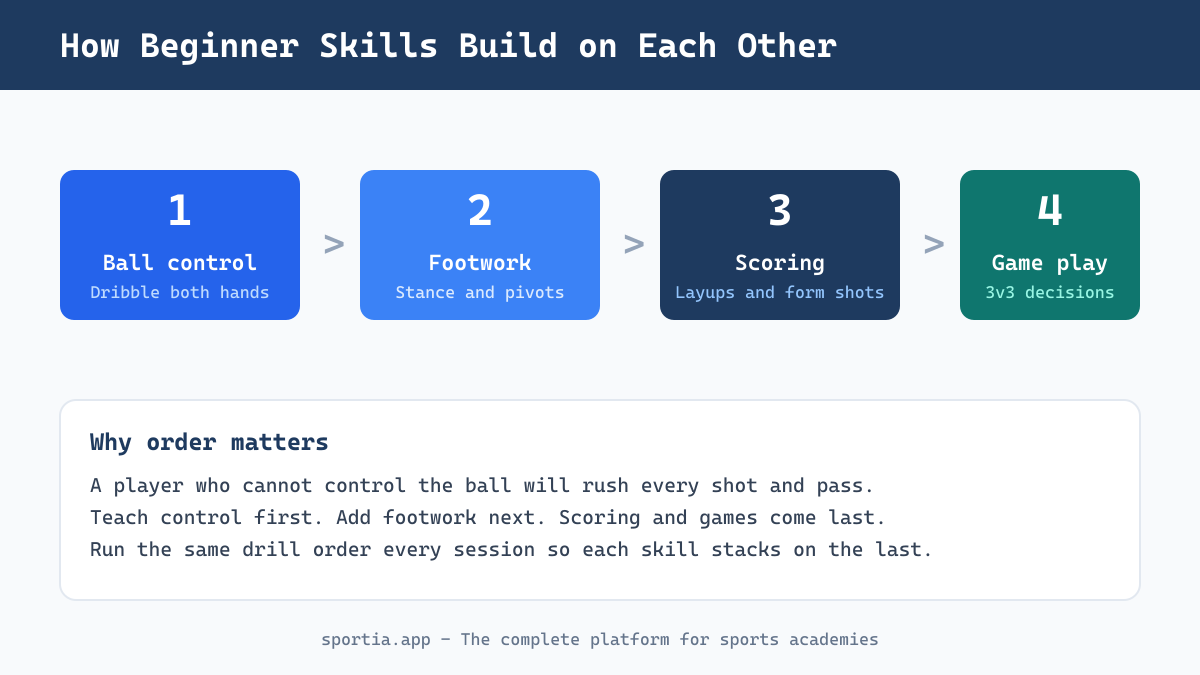
The fix is a focused set of basketball drills for beginners. Run them in the same order every session so each skill builds on the last. You start with ball control, then add footwork, and after that you progress to scoring, passing, and defense. When the skills stack this way, young players improve quickly and stay motivated.
This guide gives you 10 youth basketball training drills for ages 8 to 14. Each drill is simple to coach and needs very little space, and every one fits neatly into an academy batch. At the end, you get a ready-to-run 60-minute session plan.
Why drills beat scrimmages for beginners
A full scrimmage hides weak skills. The confident kids dominate the ball while everyone else stands around. Nobody fixes a clumsy dribble or sloppy footwork when the game moves that fast.
Focused drills do the opposite, giving every player dozens of repetitions of a single skill. Those repetitions build muscle memory, and that is how an awkward layup becomes a smooth, automatic one. This is real development, and it beats hoping skills appear during games.
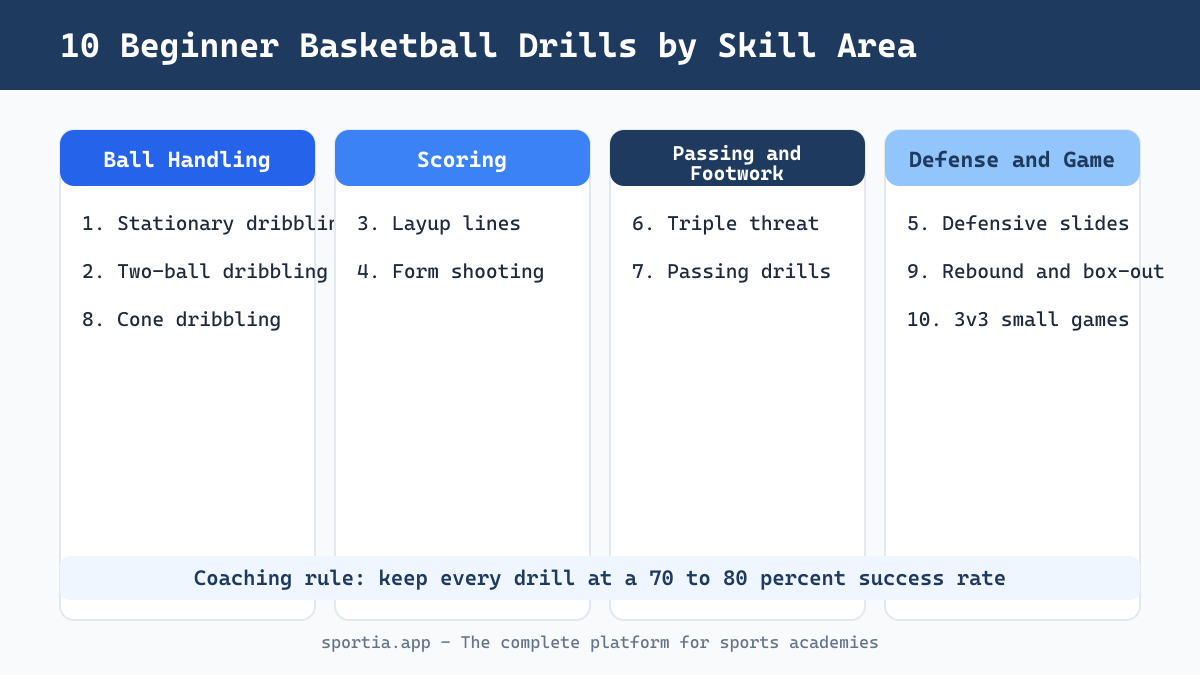
One coaching rule matters more than the drills themselves. Keep each drill at a 70 to 80 percent success rate. If a player misses far more than that, the drill is too hard, so slow it down, move closer to the basket, or simplify the pattern. Confidence grows from clean repetitions, not from constant struggle. The same principle drives our guide to table tennis drills for beginners , and it holds true for every sport.
Ball handling drills
Ball control always comes first, because a player who cannot handle the ball will rush every pass and shot. These three fundamental drills build soft hands and quiet confidence.
1. Stationary dribbling for ball control
Players stand in one place and dribble with the strong hand, then the weak hand. They begin waist-high and slow, then dribble low near the knee for tighter control.
Cue them to push the ball with their fingertips, not slap it with the palm. Tell them to keep their eyes up, not on the ball. A simple trick helps here. Hold up some fingers and ask players to call out the number while they dribble, which forces their heads up.
2. Two-ball dribbling for coordination
Give each player two basketballs to dribble at the same time, first together and then in an alternating rhythm. This drill builds coordination in both hands at once.
Weak-hand control is the single biggest gap in young players, and two-ball work closes it faster than any other drill. Keep each round short. Even 90 seconds of this is genuinely tiring for a beginner.
8. Cone dribbling for change of direction
Set five cones in a line, about two steps apart, and have players dribble through them using crossovers. They switch hands at each cone and stay low to protect the ball.
This drill adds movement to ball control, teaching players to keep the ball safe while their body shifts. Start everyone at walking pace, because real speed should only come once the hands are reliable.
Scoring drills
Once players can control the ball, they are ready to score, but keep them close to the rim for now. Long-range shots wreck a young player's form before it has even developed.
3. Layup lines (both hands)
Form two lines near the basket and have players take turns driving in for a layup. Run the right hand first, then switch the whole drill to the left. The weak-hand layup is where most beginners fall apart, so make both hands a firm rule.
Teach the rhythm clearly. The right-hand layup uses a right-foot then left-foot step and lifts the right knee, and you simply reverse the pattern for the left side. Patience here pays off for years.
4. Form shooting close to the basket
Players stand three to five feet from the rim and shoot at the backboard with full attention on technique. There is no jumping yet, because the goal is clean mechanics on every single attempt.
Teach the BEEF checklist: Balance, Eyes on the target, Elbow under the ball, Follow through. A young child often cannot reach a 10-foot rim with good form, so lower the hoop to 8 or 9 feet for under-10 batches when you can. Many Indian academies share school courts with fixed rims, so reduce the shooting distance instead.
Footwork and passing drills
Good footwork makes every other skill easier, and it also keeps players legal, since travelling is the most common beginner mistake. These drills build balanced, controlled movement.
6. Pivoting and the triple-threat position
The triple-threat is the basic ready stance, with knees bent, the ball held near the hip, and the eyes up. From here a player can shoot, pass, or drive, which keeps the defense guessing.
Teach the pivot from this stance, with players keeping one foot planted while they step with the other. Practice both forward and reverse pivots. This footwork stops travels and helps players protect the ball under pressure.
7. Passing drills (chest, bounce, overhead)
Pair players about two metres apart and have them pass back and forth. Cycle through the chest pass, the bounce pass, and the overhead pass, since each type has a clear purpose that beginners should learn early.
Cue a firm step toward the target and a sharp snap of the wrists. The bounce pass should hit the floor about two-thirds of the way to the partner. Once the basics look clean, add light defenders to make the passing realistic.
Defense and game drills
Defense and decision-making get ignored in most youth coaching, and that is a serious mistake. These final drills teach the effort and game sense that win matches.
5. Defensive slides and stance
Players get low in a wide, balanced stance and slide side to side without ever crossing their feet. The coach calls left or right, and players react quickly.
This builds the defensive base every player needs, and it also doubles as conditioning. Short, sharp slides train the quick feet that strong defense demands. You can read more in our guide to speed and agility training for young athletes .
9. Rebounding and box-out drill
Pair players near the rim and have the coach shoot. On every miss, each player turns, makes contact with their partner's chest or shoulder, and holds them back before chasing the ball. This teaches the box-out habit that wins possessions.
Box-out is about willpower, not height, so teach players to find their opponent first and then go after the ball. This simple habit wins more games than any fancy move.
10. Small-sided games (3v3)
Finish every session with 3 versus 3 on a half court, because small teams mean each player touches the ball often. They have to decide whether to pass, drive, or shoot, and this is where all the drills finally come together.
Use simple rules to teach inside the game. For example, require three passes before any shot, which stops ball-hogging and rewards teamwork. Keep score for excitement, but praise smart decisions over made baskets.
How to structure a 60-minute youth session
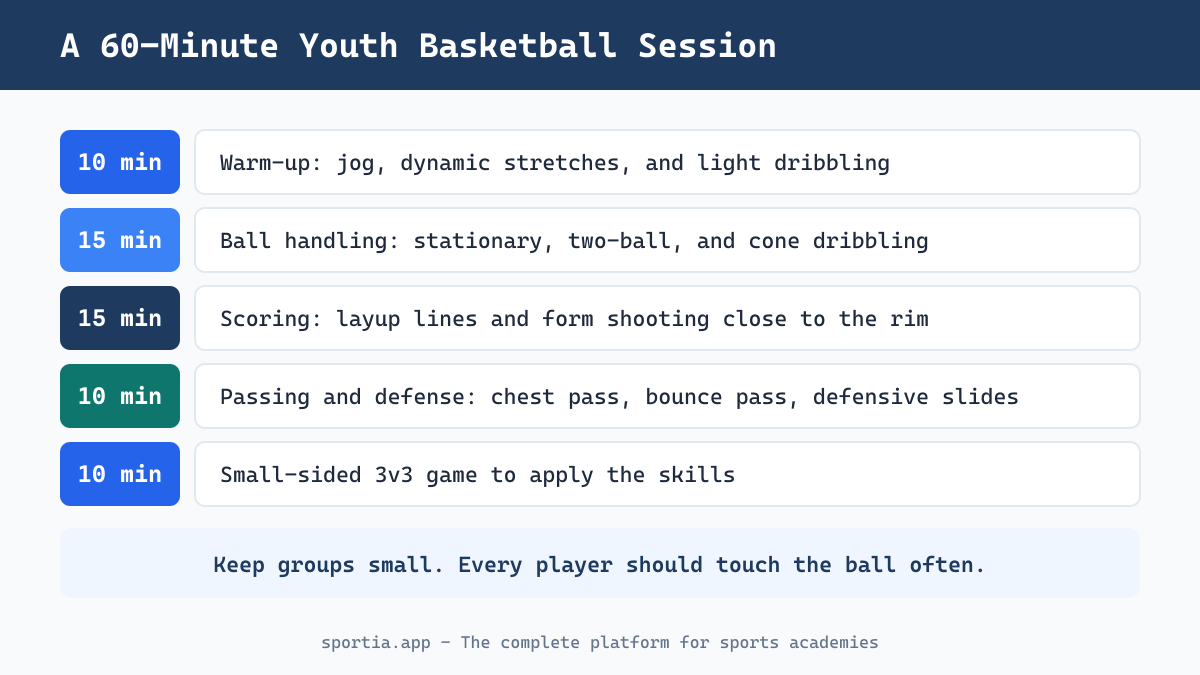
The order of activities is the real secret, because skills should run from simple to complex within a session. You should also end with a game every time, so players leave happy. Here is a plan for a batch of 8 to 12 beginners.
- 10 minutes - Warm-up: A light jog, dynamic stretches, and easy dribbling to get loose.
- 15 minutes - Ball handling: Stationary dribbling, two-ball dribbling, and cone dribbling.
- 15 minutes - Scoring: Layup lines with both hands and form shooting close to the rim.
- 10 minutes - Passing and defense: Paired passing drills and reactive defensive slides.
- 10 minutes - Small game: A 3v3 scrimmage that puts the new skills into a live setting.
Two coaching habits make this plan work. First, keep your groups small so nobody waits in long lines. Second, demonstrate each drill for about 20 seconds, then let players move, because less talking and more repetition is the fastest route to improvement.
Rotate the main focus each week, so one session can favour shooting while the next leans on defense. This keeps training fresh and covers every skill across a month. It also helps you avoid the errors in our guide on coaching mistakes that drive athletes away , like over-drilling and never letting children play.
Tracking drills and progress across batches
Planning a single session is easy, but running the same quality across many batches and coaches is the hard part. This is where a proper system earns its place.
With Sportia , you can save every drill in a shared coaching library, with the steps, the target repetitions, and a short demo video. Then assign a drill plan to a batch so each coach runs the same session, which means new coaches get up to speed in days, not months.
You can also track each athlete's progress across the season, logging layup success, free throws made, or a simple skill rating. Parents then see measurable improvement, not a vague "he is doing well." That kind of clear proof keeps families enrolled term after term.
Frequently Asked Questions
What age should kids start basketball training?
Children can start basic basketball drills around age 7 or 8, with the focus on fun, ball control, and footwork. Save serious shooting and game tactics for ages 10 and up, once players are stronger and better coordinated.
What are the most important basketball drills for beginners?
The most important beginner drills are stationary dribbling, form shooting, layups with both hands, and basic passing. These four cover the core skills, and players should master them before moving on to advanced moves or full-court play.
How long should a youth basketball practice be?
A youth basketball practice should last 60 to 75 minutes for beginners, because younger children lose focus after about an hour. Keep drills short, change the activity often, and always finish with a small-sided game.
What basketball equipment does a beginner academy need?
You need age-appropriate basketballs, a few cones, and access to a hoop. Junior players use a size 5 ball, while teenagers use size 6 or 7, and a lower rim of 8 or 9 feet helps under-10 players shoot with correct form.
How do I keep young basketball players motivated?
Keep your drills at a 70 to 80 percent success rate so players feel they are winning. Praise effort and smart decisions, not just made baskets, end every session with a game, and rotate the weekly focus to keep it fresh.
Can these drills be coached on a shared school court?
Yes, because every drill in this guide needs little space and only basic gear. Many Indian academies train on shared school or community courts, so adjust the shooting distance to match a fixed rim and use cones to mark out small drill zones.
Build skills your players and parents can see
Skill in young players is built one drill at a time. Run the drills in the right order, keep the success rate high, and finish with a game. Do this every week and your beginners will grow into confident players.
Want every coach in your academy to run the same proven sessions? Save these drills in Sportia's coaching library and assign them to your batches in a few clicks, then track each athlete's progress so parents see the results. Start a 14-day free trial and bring real structure to your academy this season.