
Training Through Pollution Season: An AQI Guide for Sports Academies
Every winter in North India, the same scene repeats. The sky turns grey, the AQI app turns purple, and a coach stands at the gate deciding whether to send forty children onto the ground. Most academies make that call on the day, by gut feel, while parents send anxious messages. There is a better way to handle AQI for outdoor sports, and it starts in October, before the first bad day arrives.
This guide explains what AQI for outdoor sports really means for a child who is running hard. It also gives you a simple policy your academy can adopt now, so the decision on a smoggy morning takes one minute instead of an argument.
Why October Is the Time to Plan
In Delhi-NCR, Punjab, Haryana and western Uttar Pradesh, air quality usually starts to slide in the second half of October. Crop burning, falling temperatures and still winds all arrive together. By November, "very poor" days are common and "severe" days are no longer rare.
Authorities do act, but late. In November 2025, Delhi told schools to stop outdoor sports once air quality reached the severe band. The air quality commission also asked for sports competitions to be postponed. By the time such orders come, your athletes have often trained through a week of poor air already.
An academy that plans in October has three advantages. Parents hear the policy before they are worried. Coaches know exactly what to do at each AQI level. And you can book indoor space before every other academy in your area wants the same hall.
What AQI Numbers Mean for a Child Who Is Exercising
India uses the National Air Quality Index from the Central Pollution Control Board. It has six bands:
| AQI | Category | What CPCB says about health |
|---|---|---|
| 0 to 50 | Good | Minimal impact |
| 51 to 100 | Satisfactory | Minor breathing discomfort for sensitive people |
| 101 to 200 | Moderate | Discomfort for people with asthma, children and older adults |
| 201 to 300 | Poor | Breathing discomfort on prolonged exposure |
| 301 to 400 | Very poor | Respiratory illness on prolonged exposure |
| 401 and above | Severe | Affects even healthy people |
Here is the catch for sport. These descriptions are written for people going about normal life, mostly sitting or walking. A child running shuttles breathes far more air than a child sitting in class. During hard exercise, breathing rate can rise several times over, and much of it shifts to the mouth, which skips the nose's natural filter. So an hour of football on a "poor" day delivers a much larger dose of fine particles than an hour in a classroom on the same day.
The main pollutant in winter is PM2.5, which means particles small enough to travel deep into the lungs. That is why a sensible sports policy needs to be stricter than the general public advice.
Why Young Athletes Are More Exposed Than Adults
Children are not just small adults when it comes to dirty air. Research consistently shows that children breathe roughly twice as much air per kilogram of body weight as adults. Their airways are narrower, and their lungs are still growing until the late teens.
Young athletes add a few more risks on top of that:
- They train at peak effort. Sprints, drills and matches push breathing to its highest level.
- They spend more time outdoors than most adults, often twice a day with school sport included.
- They rarely say they feel unwell, because no one wants to be dropped from the team.
None of this means children should stop playing sport all winter. It means the adults in charge need clear limits, because the children will not set them on their own.
A Simple Traffic-Light Policy for AQI and Outdoor Sports
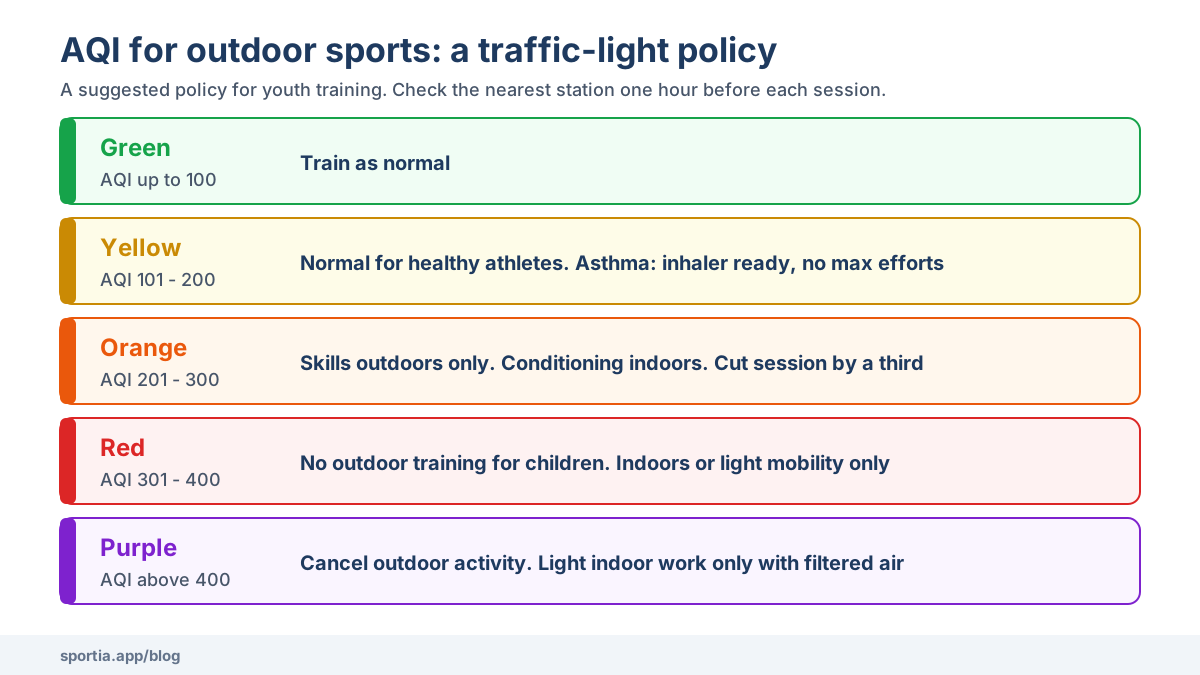
The policy below is a practical starting point for academies with young athletes. It is deliberately more careful than general public advice, for the reasons above. Discuss it with a local doctor if you can, and adjust it to your sport.
Green: AQI up to 100
Train as normal. This is the target for every session, and in most of India it is the default for most of the year.
Yellow: AQI 101 to 200
Healthy athletes can train normally. Athletes with asthma should carry their inhaler, warm up for longer and step back from maximum efforts. Coaches should watch for coughing or unusual breathlessness.
Orange: AQI 201 to 300
Cut both intensity and duration. Keep skill and technique work outdoors, but move hard conditioning, long runs and repeated sprints indoors. Shorten the session by about a third, and give more rest between drills.
Red: AQI 301 to 400
No outdoor training for children. Move to an indoor space, or switch to a light session of stretching, mobility and video review. Matches and trials should be postponed if at all possible.
Purple: AQI above 400
Cancel outdoor activity completely. Even indoor sessions should be light unless the hall has proper air filtration. On these days, a rest day is often the healthiest choice.
One practical rule makes the policy work. Decide which AQI reading counts, and when. Use the nearest monitoring station to your ground, checked one hour before the session. The CPCB's SAMEER app and the official AQI portal both show hourly readings by station.
Timing Matters: Why Early Mornings Are Often the Worst
Many academies run their main batches at 6 or 7 in the morning. In winter, that is often the dirtiest air of the day. On cold nights, a layer of warm air traps pollution close to the ground, and it only lifts once the sun has heated the ground for a few hours.
Studies of Delhi air show PM2.5 typically peaks around 8 to 10 in the morning and falls to its lowest in the mid to late afternoon, roughly 3 to 5 pm. On many days, the afternoon reading is around half of the morning one. Late evenings then climb again as the air cools.
For an academy, this suggests a simple change. If you can, shift the hardest sessions of the week to the afternoon from November to January. Keep morning batches for lighter technical work. A cricket academy in Gurugram, for example, might move its fitness block from 6:30 am to 4 pm and keep only batting nets in the morning.
Indoor Alternatives That Keep Training Going
Moving indoors does not mean losing a season. Most sports have useful work that fits in a hall, a gym or even a large classroom.
- Cricket: bowling action drills with soft balls, shadow batting, catching circuits and fielding footwork.
- Football: ball mastery, small-sided futsal, passing in tight spaces and core strength work.
- Athletics: sprint mechanics, hurdle mobility, plyometrics on mats and strength circuits.
- All sports: flexibility, balance work, injury prevention routines and match video sessions.
The indoor circuits in the guide to indoor fitness for athletes were written for monsoon weeks, and they work just as well in smog season. A word of warning, though. Indoor air is not automatically clean. A hall with open doors and no filtration can be nearly as polluted as outside, so keep the effort light unless the air is filtered.
Athletes With Asthma Need Their Own Plan
Every academy has a few athletes with asthma, and some parents never mention it. Poor air makes asthma symptoms more likely, especially during hard exercise.
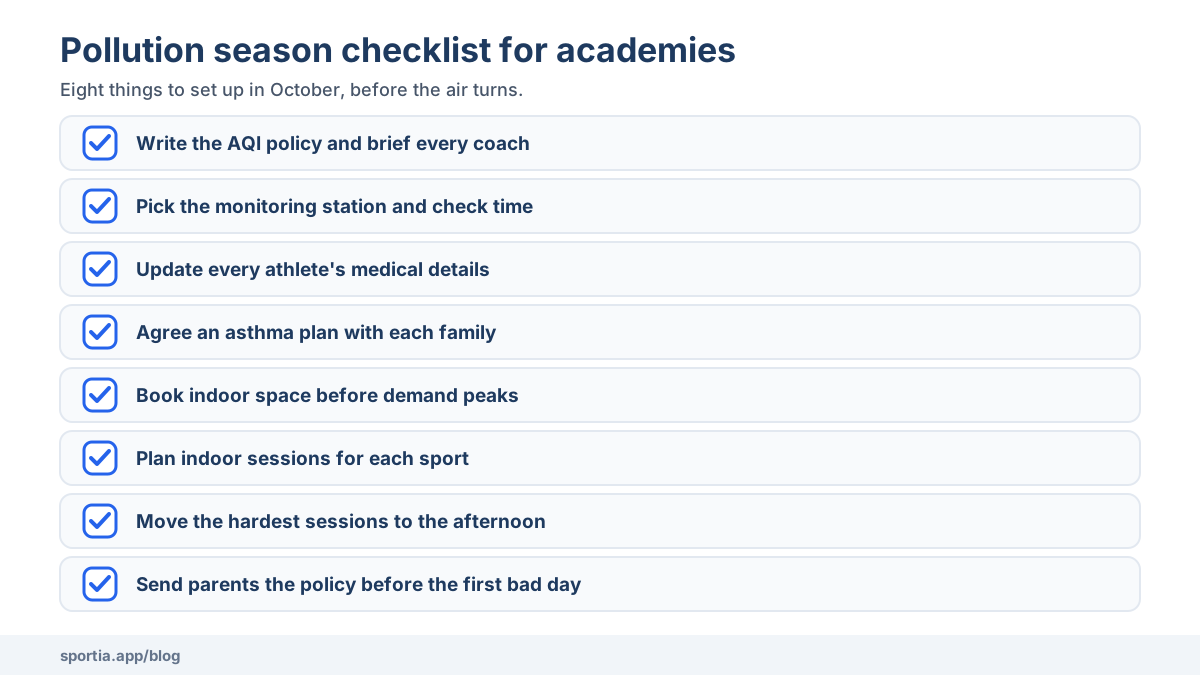
Before winter, ask every family to update medical details, including asthma and any inhaler use. For each athlete with asthma, agree three things with the parents. When the athlete should use their inhaler, where the inhaler is kept during sessions, and at which AQI the athlete sits out. Make sure every coach on that batch knows the plan, not just the head coach.
Masks and Air Purifiers: What Helps and What Is Mostly Marketing
Masks. A well-fitted N95 mask does filter fine particles, and it is useful for travel to and from the ground. But it is hard to breathe through during intense exercise, and children rarely keep it sealed. Cloth and surgical masks do very little against PM2.5. So masks are not a way to make hard outdoor training safe on a bad day.
Air purifiers. A purifier works well in a closed room that matches its rated capacity. Two home purifiers in a large sports hall with open doors will barely change the air. If you plan to rely on an indoor space, check its size and ventilation honestly before promising parents a clean environment.
Diet and supplements. You will see claims that certain foods or tablets protect against pollution. A balanced diet supports overall health, but no food cancels out a smoggy session. Reducing exposure is the only reliable protection.
Tell Parents Before the First Bad Day
The worst time to explain a pollution policy is at 6 am, through a cancellation message. Parents then read it as a sudden decision, and some will push back. Share the policy in October instead, while the air is still clear.
A good message is short and covers four points:
- The AQI levels at which sessions change, move indoors or are cancelled.
- Which monitoring station you use, and when you check it.
- How and when families will hear about a change, for example by 5 am for morning batches.
- How missed sessions are handled, whether by makeup sessions or package adjustments.
The last point matters for trust. If you sell session packages, decide in advance whether a pollution cancellation counts against the package. In Sportia, a session is only used from a package when the athlete is marked present, so cancelling a session does not eat into anyone's quota. You can then reschedule it or add an extra session later. The guide on parent communication beyond WhatsApp groups has more ideas on keeping these messages clear.
Academies that handled the monsoon well will recognise this approach. The guide to a monsoon-proof sports academy uses the same idea: write the rules before the weather turns, not during it.
Frequently Asked Questions
What AQI is safe for outdoor sports for children?
An AQI up to 100 is generally fine for normal training. Between 101 and 200, healthy children can usually train, but those with asthma should take care. Above 200, it is wise to reduce intensity, and above 300, children should not train outdoors.
Is it safe to play cricket or football when the AQI is poor?
Light skill work for short periods is a reasonable choice at a poor AQI of 201 to 300. Hard running, long sessions and matches should be moved indoors or postponed, because heavy breathing during exercise greatly increases the amount of polluted air taken in.
What is the best time of day to train during pollution season?
In North Indian winters, the mid to late afternoon usually has the cleanest air, roughly 3 to 5 pm. Early mornings and late evenings tend to be the most polluted, because cold air traps pollution near the ground.
Do masks help athletes train in polluted air?
A fitted N95 mask filters fine particles, but it is hard to wear during intense exercise. Cloth and surgical masks offer little protection against PM2.5. Masks are useful for travel, but they do not make hard outdoor training safe on a bad air day.
Should a sports academy cancel sessions when the AQI is very high?
Yes. When the AQI crosses 400, outdoor sessions for young athletes should be cancelled, and indoor sessions should stay light unless the space has proper filtration. Sharing this rule with parents in advance makes cancellations far easier to accept.
Plan Now, Decide Fast Later
Pollution season is not going away, and every winter tests how well an academy looks after its athletes. Write your AQI policy this month, update every athlete's medical details, book indoor space, and send parents a clear message before the air turns. When the first purple morning arrives, your coaches will already know what to do. Sportia helps you keep medical records, sessions and parent updates in one place, so the plan is easy to follow when it matters.