

Indoor Fitness Circuits for Athletes During the Monsoon
Indoor training drills for athletes let you run a full session even when rain shuts your ground. A school hall, an empty corridor, or a covered car park is usually adequate space. Bodyweight strength circuits, footwork drills, and core work keep young athletes developing through the monsoon. This guide gives you three ready circuits, a 40-minute session plan, and a practical rain-day system for your academy.
Why a Rained-Out Session Is Not a Lost Session
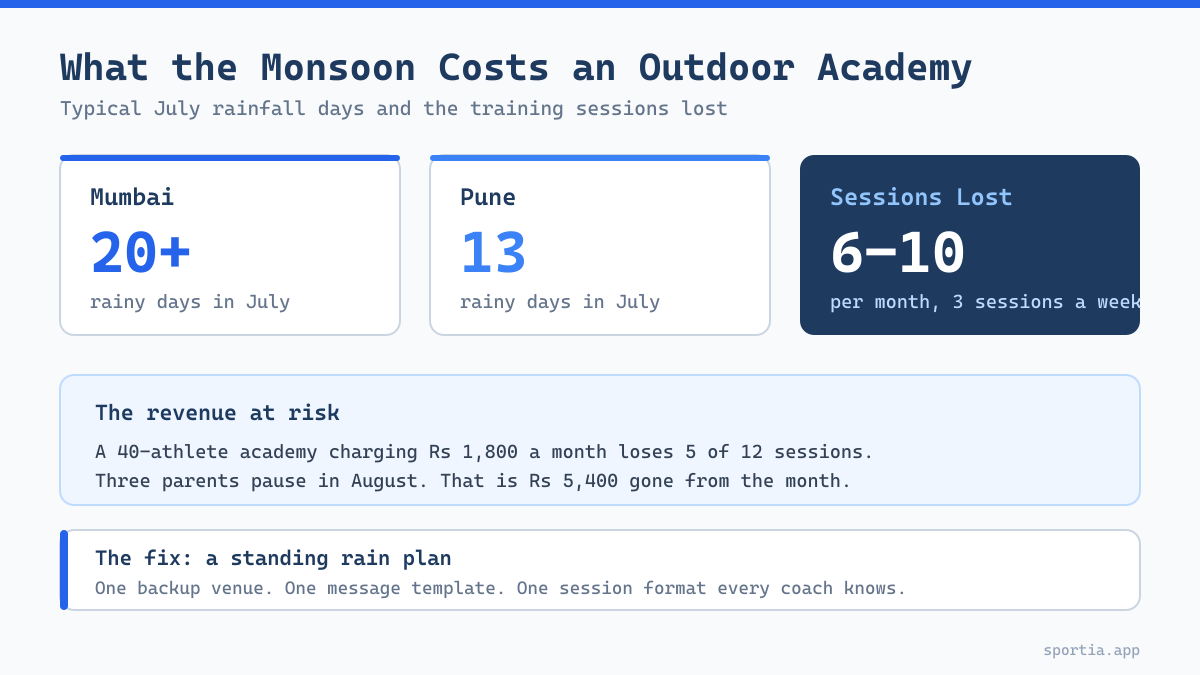
July is the wettest month in most of India, and the numbers are punishing for outdoor academies. Mumbai often sees more than 20 rainy days in July, while Pune averages about 13. An academy running three sessions a week can lose 6 to 10 of them in one month.
Here is the part that most coaches underestimate. Parents do not count value session by session, but they certainly notice when half a month disappears. They paid a monthly fee and expected a month of training.
Take a 40-athlete football academy in Pune charging Rs 1,800 a month for 12 sessions. Rain wipes out 5 of them, so the real cost jumps from Rs 150 a session to Rs 250. Parents calculate that quietly, and two or three of them pause in August. For a small academy, that single decision removes Rs 5,400 from the month.
The solution is not a better ground or an expensive turf upgrade. It is a standing rain plan you decide once in May and reuse all season: one backup venue, one message template, and one session format every coach knows. Run that, and a washed-out Tuesday turns into a strength day instead of a refund request.
The academies that grow through the monsoon treat these ten weeks as a training block, not a break. Skills stay warm, fitness improves, and parents see a team that shows up whatever the weather.
What You Can Actually Train Indoors
You clearly cannot play a full match or run a sprint session inside a hall. But most of what young athletes need at this age does not need a full ground.
Indoor sessions handle these areas well:
- Strength - squats, push-ups, lunges, and holds, all bodyweight and free.
- Agility and footwork - short shuffles, fast feet, skipping, and reaction starts.
- Core and balance - planks, dead bugs, and single-leg work.
- Flexibility - the quality that gets dropped first when outdoor time is short.
- Skill touches - wall passes, shadow batting, grip work, and racket swings.
- Team culture - video review, goal setting, and quizzes on the rules.
Leave these outside: top-speed sprints, hard jumps onto tile, full-range throwing, and drills that need a long run-up.
Finding Indoor Space Without Big Rent
Most academies do not need a gym, only a dry floor of about 400 to 600 square feet.
- The school you already coach at. Ask for the assembly hall on rain days, which is frequently free if you already run their sports program.
- Apartment clubhouses. Many of your parents live in gated societies, and one parent can book the clubhouse for your batch.
- Community and temple halls. Widely available in tier-2 and tier-3 cities, and rates run about Rs 300 to Rs 800 an hour.
- Covered parking or a basement. Free, dry, and perfectly adequate for footwork as long as the floor is not slick.
- Badminton or table tennis halls. Off-peak morning slots are affordable in most Indian cities.
Lock in one venue in May, before the rain starts, because chasing a hall on a wet Tuesday morning never works.
Circuit 1: Bodyweight Strength
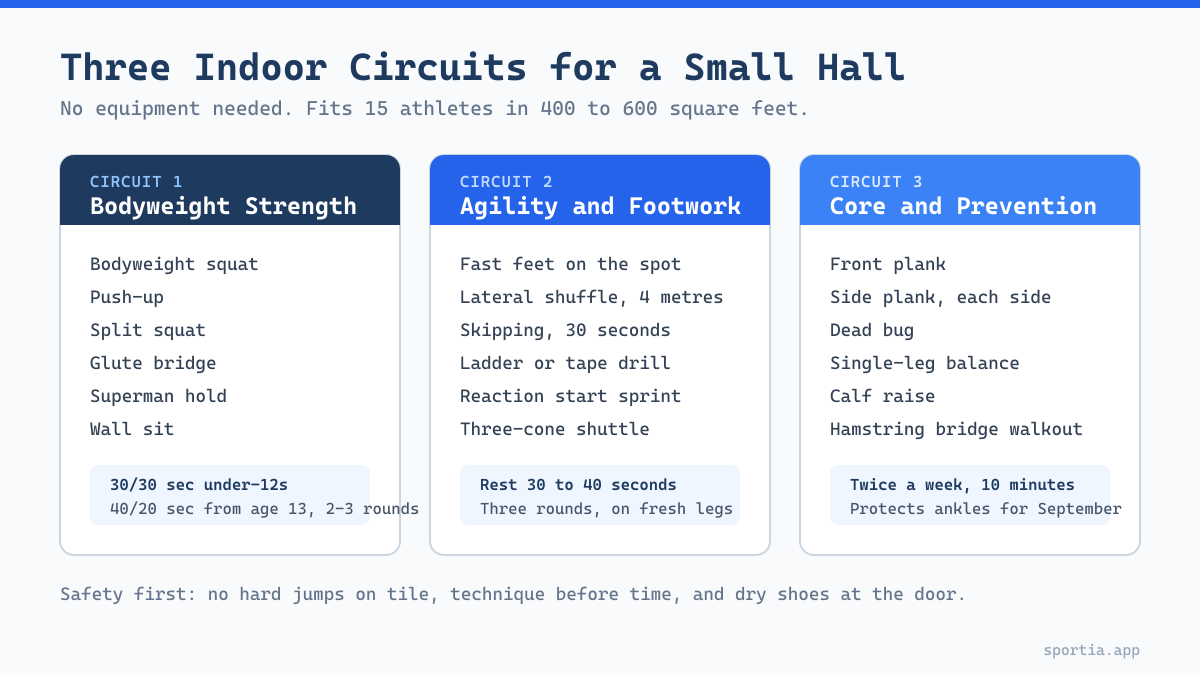
This is your base circuit. It requires no equipment at all and fits 15 athletes in a classroom-sized hall.
| Exercise | What It Builds | Coaching Cue |
|---|---|---|
| Bodyweight squat | Legs and hips | Chest up, knees track over toes |
| Push-up (knees for beginners) | Chest and shoulders | Body held in one straight line |
| Split squat | Single-leg strength | Back knee sinks straight down |
| Glute bridge | Hips and hamstrings | Squeeze at the top for one second |
| Superman hold | Back chain | Lift chest and thighs, eyes down |
| Wall sit | Leg endurance | Thighs level, back flat on the wall |
How to run it: use 30 seconds of work and 30 seconds of rest for under-12s, then move to 40 seconds of work and 20 seconds of rest from age 13 up. Do 2 to 3 rounds, which gives you 12 to 18 minutes of real work.
Form always beats speed in this circuit. If an athlete cannot hold shape, reduce the work time rather than drop the standard.
Circuit 2: Agility and Footwork for a Hall or Corridor
This is where an indoor session really beats a soaked field, because a dry floor provides cleaner footwork than mud ever will.
The equipment list is short. Chalk lines or floor tape work as well as a ladder, and a skipping rope at about Rs 150 is still the best value tool in youth sport.
- Fast feet on the spot - 20 seconds, staying quick and light on the forefoot.
- Lateral shuffle - 4 metres each way between two markers.
- Skipping - 30 seconds of steady single-bounce rhythm.
- Ladder or tape drill - in-in-out-out, then one foot per box.
- Reaction start - athletes hold a ready stance and sprint 3 metres on the coach's clap.
- Three-cone shuttle - 5 metres out, touch the marker, return, and repeat.
Keep rest short at about 30 to 40 seconds, and run three rounds. This is the same quality of work covered in our guide to speed and agility training for young athletes , just packed into a smaller space.
One safety point matters here. Smooth tile plus damp shoes is exactly how ankle injuries happen, so check the floor first and ask every athlete to bring a dry pair and change at the door.
Circuit 3: Core and Injury Prevention
This circuit pays you back in September, when athletes go back onto soft, uneven ground after weeks of lighter work. Ankles and hamstrings are almost always the first things to give way.
Steady balance and core work through July reduces that risk sharply.
| Exercise | Time or Reps | Why It Matters |
|---|---|---|
| Front plank | 20-40 seconds | Trunk control carries into every sport |
| Side plank (each side) | 15-30 seconds | Protects the lower back when twisting |
| Dead bug | 8 each side | Core control without loading the spine |
| Single-leg balance | 30 seconds each leg | Reduces the risk of ankle sprains |
| Calf raise | 15 slow reps | Ankle strength for landing and cutting |
| Hamstring bridge walkout | 8 reps | Guards against hamstring strain |
Run this circuit twice a week through the monsoon, because ten focused minutes is sufficient. Make the single-leg balance harder by asking athletes to shut their eyes or catch a ball while they hold it.
Keeping It Fun
No child joined your academy hoping to do wall sits in a school hall. If indoor days start to feel like a punishment, attendance falls and mood follows it down.
Five ways to stop that:
- Score cards. Athletes write down their reps each week and try to beat their own number.
- Team relays. Split the batch in two, where each athlete does one station and then tags the next.
- Coach versus academy. Do the circuit with them, because children genuinely love to watch a coach struggle.
- Music blocks. Athletes work while the song plays and rest when it stops.
- A monsoon leaderboard. Track plank time or skips per minute on a wall chart all month.
The leaderboard is easily the strongest of these, because it gives a hard season a story and a finish line. You crown a winner in August, and nobody quite remembers that the ground was flooded for six weeks.
Scaling by Age and Ability
The same circuit cannot serve an 8-year-old and a 16-year-old, so adjust the work time, the rounds, and the objective.
| Age Group | Work / Rest | Rounds | Main Focus |
|---|---|---|---|
| 6-9 years | 20 sec / 40 sec | 2 | Games, movement skill, fun |
| 10-12 years | 30 sec / 30 sec | 2-3 | Technique and coordination |
| 13-15 years | 40 sec / 20 sec | 3 | Strength base and core |
| 16 and above | 45 sec / 15 sec | 3-4 | Conditioning and power |
Three safety rules hold across every age group:
- Avoid hard jumps or drop landings on tile and concrete floors.
- Put technique first, and reduce the work time before you lower the standard.
- Monitor fatigue closely, because sloppy reps at the end of a round mean stop, not push. Our post on overtraining in young athletes covers the warning signs in detail.
A Ready-to-Run 40-Minute Indoor Session
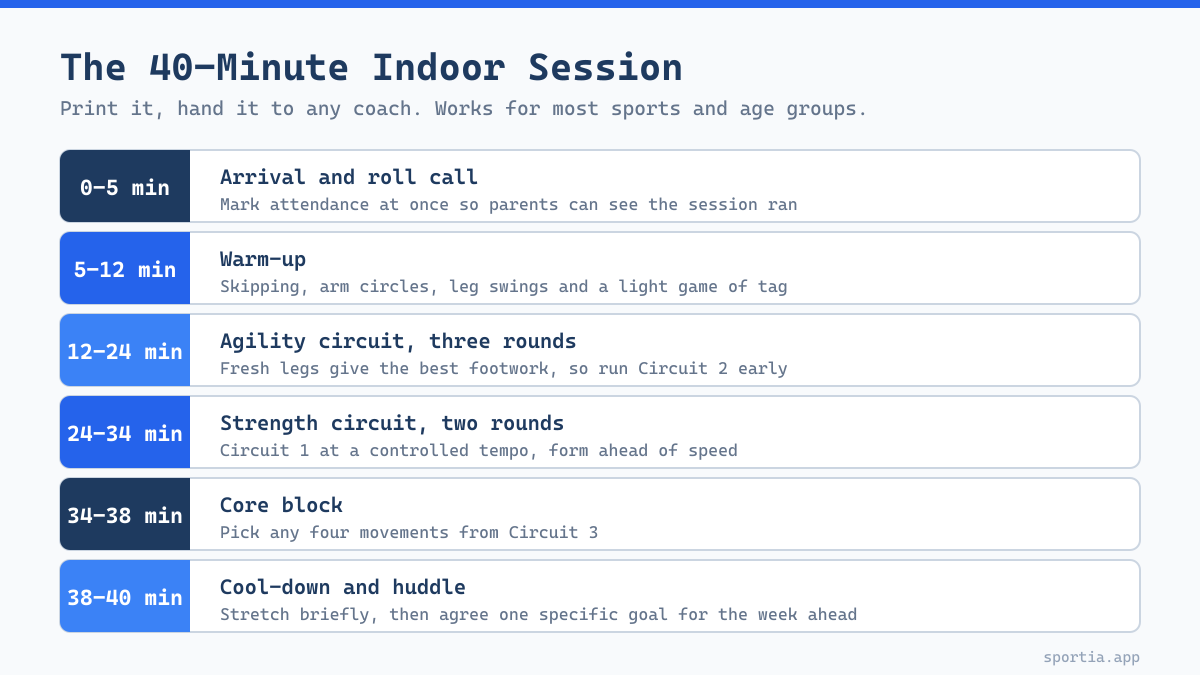
Print this page and hand it to any coach, because the shape works for most sports and most age groups.
- 0-5 min: Arrival and roll call. Mark attendance at once so parents can see the session ran.
- 5-12 min: Warm-up. Skipping, arm circles, leg swings, and a light game of tag.
- 12-24 min: Agility circuit. Circuit 2 for three rounds, because fresh legs give the best footwork.
- 24-34 min: Strength circuit. Circuit 1 for two rounds at a controlled tempo.
- 34-38 min: Core block. Pick any four moves from Circuit 3.
- 38-40 min: Cool-down and huddle. Stretch briefly, then agree one specific goal for the week ahead.
Swap the middle block for skill work whenever the space allows, since wall passes, shadow batting, and racket swings fit the same slot.
Turning Rain Days Into a System
A good circuit is only half the solution, because the other half is running it without confusion every time the sky opens.
Four steps turn guesswork into a reliable routine:
- Set a cut-off time. Decide by 8 am whether the evening batch moves indoors, and tell parents at the same hour every time.
- Use one message. Save a WhatsApp template with the venue, the timing, what to bring, and dry shoes.
- Mark attendance anyway. An indoor session is still a session, so it belongs in the record that parents actually see.
- Log what you ran. By September you will know which circuits your athletes liked and which ones flopped.
This is where management software earns its cost. With Sportia , you can move a session to a new venue and time, notify the whole batch, and still mark attendance with a QR scan at the door. The coaching library stores these three circuits once and assigns them to any batch, so a stand-in coach knows exactly what to run.
For the wider picture, from ground care to fee collection in a slow month, read our guide to monsoon-proofing your sports academy . And once the rain clears, our post on heat safety in Indian training conditions covers the opposite problem.
Frequently Asked Questions
What are the best indoor training drills for athletes during the monsoon?
Bodyweight strength moves, footwork patterns, and core work give you the most value indoors. Squats, push-ups, skipping, lateral shuffles, and planks require no equipment at all. Three short circuits cover strength, agility, and injury prevention in about 30 minutes.
How much space does an indoor circuit session need?
About 400 to 600 square feet is enough for a group of 15 athletes. A school assembly hall, apartment clubhouse, or covered car park all work well. A dry, non-slippery floor matters considerably more than a large room.
Should sports academies charge full fees during the monsoon?
Yes, as long as you keep delivering sessions indoors. Parents accept the full monthly fee when training goes on and attendance stays visible to them. Resentment builds only when sessions are cancelled with nothing offered in their place.
How often should young athletes do circuit training?
Two to three sessions a week is enough during the monsoon. Keep one day for skill work and protect at least one full rest day. Young athletes gain far more from steady weeks than from occasional punishing sessions.
Is circuit training safe for children under 12?
Yes, as long as it stays bodyweight-based and technique-led. Use shorter work times, longer rest, and games in place of strict timed rounds. Avoid hard jumps on tile floors and stop as soon as movement quality deteriorates.
What equipment should an academy buy for indoor sessions?
Start with skipping ropes, floor tape, and a set of cones, which covers all three circuits for under Rs 3,000. Add resistance bands and a few mats later if your budget allows. Nothing here requires a gym membership or machines.
Keep Training Through the Rain
The academies that keep growing through July are rarely the ones with the best drainage. They are the ones that show up, and three circuits with one backup hall and a message sent on time will do that.
Sportia helps you reschedule sessions, notify parents, record indoor attendance, and store your circuits inside a single coaching library. Start your free 14-day trial and keep your entire season on track through the rains.