
10 Kabaddi Training Drills for Raiding, Defence, and Conditioning
Most kabaddi academies in India train the same way. Two teams, one court, and ninety minutes of match play. Everyone goes home tired, but tired is not the same as better.
Match play tests what a player already knows, and it rarely builds anything new. A raider who cannot escape an ankle hold in practice will not discover the trick mid-match with three defenders hanging off him. He will just get caught, week after week, until he stops trying to raid at all.
That gap is why structured kabaddi training drills matter. The ten drills below cover raiding, defence, and conditioning, and each one isolates a single skill, so young players get enough reps to own it. Every drill works on prepared mud or a mat, and none needs more than cones and a whistle.
Before You Start: The First Four Seconds Decide the Raid
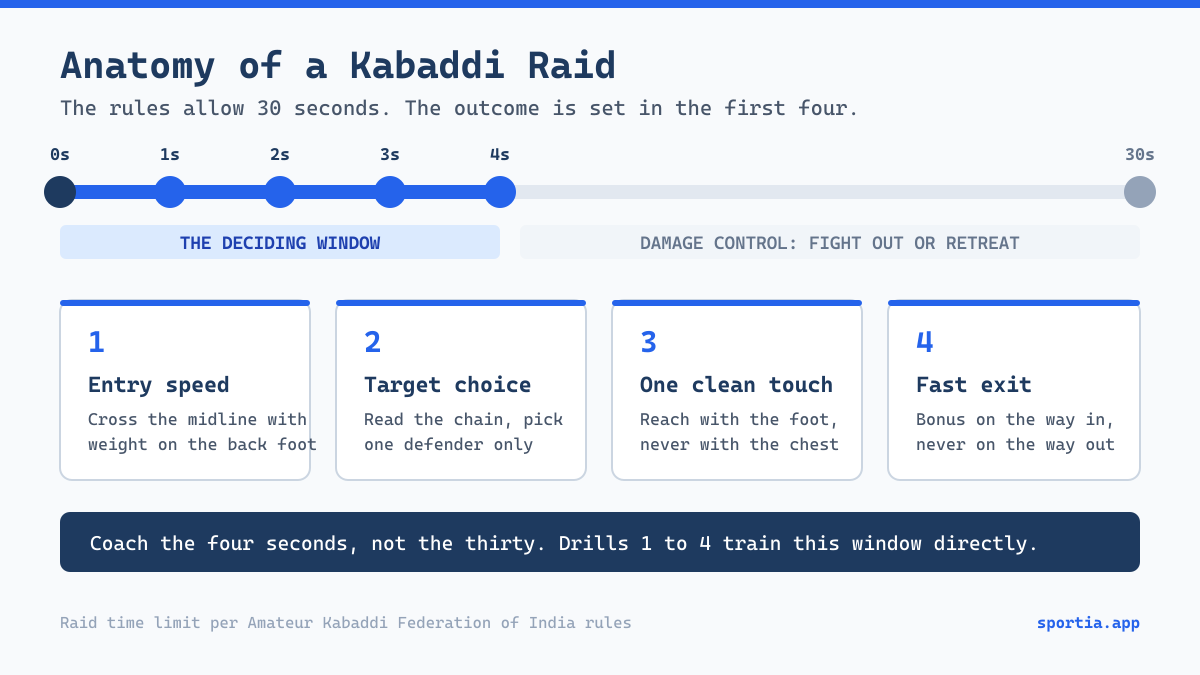
A raid can legally last 30 seconds under Amateur Kabaddi Federation of India rules, but watch any junior match and you will see something very different. Most raids are decided in the first four seconds after the raider crosses the midline.
In that window he picks a target, reads the defensive shape, and either commits or retreats. What follows is usually damage control, whether he is fighting out of a hold or scrambling back to the line.
So build your drills around that window, not around the full raid. Entry speed, target choice, one clean touch, and a fast exit make up almost the whole job.
Drill 1: Toe-Touch and Hand-Touch Accuracy
The touch is the point of the raid, yet young raiders lunge with the whole body and miss by a few inches.
Setup: One raider and one defender inside a two-metre box. The defender holds a normal ready stance and does not tackle.
How to run it: The raider enters and attempts a touch, but he must call his target out loud before he moves, either "toe" or "hand". Give each player ten attempts, then swap. Score a point only for a clean touch on the target he called.
Coaching cue: "Reach with the foot, not the chest." A good raider stays tall through the spine and extends the trailing leg.
Common mistake: Leaning forward into the touch. Once a raider tips his chest over his knees, he has lost his balance and cannot pull himself back across the line.
Drill 2: Bonus-Line Timing and Retreat
The bonus point is free when the timing is right, but most junior raiders take it far too late and get held on the way back.
Setup: Mark the baulk line and the bonus line clearly, then place six defenders in a normal chain.
How to run it: The raider must cross the bonus line with one foot while the other foot stays off the ground. He then returns past the midline. Start each raid on a whistle. Blow a second whistle at a random point four to seven seconds later. He has to be back before it sounds.
Coaching cue: "Take the bonus on the way in, never on the way out." Collecting it late means turning your back on defenders who are already moving.
Common mistake: Standing flat-footed at the line. The raider needs his weight on the back foot so he can push off the instant his front foot lands.
Drill 3: Escaping the Ankle Hold
The ankle hold ends more junior raids than any other tackle, and it is also the most coachable escape in the sport.
Setup: One defender grips the raider's ankle with both hands. Start from a static hold, not a live diving tackle.
How to run it: The defender holds firm for six to eight seconds while the raider works one escape at a time. Cycle through the sit-and-roll, the kick-and-turn, and the reverse pivot, giving five reps of each on both legs.
Coaching cue: "Sit down, do not stand up." Dropping the hips changes the angle of the grip and loosens it, whereas pulling upward only locks the hold tighter.
Common mistake: Panic kicking. Wild kicks burn the raider's air and help the defender drag him deeper into the court.
Drill 4: Escaping the Thigh Hold and Body Block
Thigh holds arrive from the side, while body blocks come from the front. Both need the raider to make space before he runs anywhere.
Setup: Two defenders working in rotation. One applies a thigh hold, the other a front block.
How to run it: The raider gets three seconds to break free before the rep is dead. Against a thigh hold he drops the near shoulder and spins out, and against a block he plants a hand-off on the chest and steps around the outside. Run eight reps against each hold.
Coaching cue: "Break the grip first, then move the feet." Sprinting with a grip still attached only drags the defender along with you.
Common mistake: Trying to overpower a bigger defender. Technique beats size here, and young players need to feel that before they believe it.
Drill 5: Chain Defence Formation and Communication
A kabaddi defence is not seven players defending on their own. It is one shape that moves as a unit. Chain work is where most Indian academies improve fastest, because it costs nothing and almost nobody drills it properly.
Setup: A full defensive line of seven, with a single raider entering again and again.
How to run it: Defenders link hands and hold the chain while shuffling sideways to track the raider, and nobody breaks it until the corner calls the tackle. Run ten raids in a block. Score the defence, not the raider.
Coaching cue: "One voice." Name a single caller, usually a corner defender, and let nobody else call the tackle.
Common mistake: Two defenders going at the same moment. That opens a hole in the line and hands the raider a bonus point plus an easy touch.
Drill 6: Block-and-Dash Reaction
Defenders need to read the raider's hips, not his eyes, and this drill trains that read under real time pressure.
Setup: Three defenders in a triangle against one raider. The coach stands behind the raider with a whistle.
How to run it: On the whistle the raider drives hard at one defender of his choice. That defender holds the block while the other two close in and finish the tackle within two seconds. Rotate every player through all three spots after five reps.
Coaching cue: "Watch the belt line." Hips cannot lie about direction, whereas shoulders, head, and eyes fake all the time.
Common mistake: Reaching with the arms while the feet stay planted. Defenders move their feet first and let their hands arrive second.
Drill 7: Cant and Breath Control
The cant is not decoration. It is the proof that the raider still holds one breath. Junior raiders lose it the moment they tire, and under AKFI rules that ends the raid.
Setup: No court needed, so this works indoors during monsoon weeks when the ground is unusable.
How to run it: Each player takes one breath and chants while jogging on the spot, and you record how long he lasts. Repeat three times with a full minute of rest. Then run the same test right after a hard conditioning block. Players can see for themselves what fatigue does to their breath.
Coaching cue: "Steady rhythm, not loud." A shouted cant empties the lungs much faster.
Common mistake: Holding the breath in silence instead of chanting. The habit has to be automatic, because a raider who forgets under pressure loses the point outright.
Drill 8: Mat Agility and Change of Direction
Kabaddi is a game of stopping and restarting, so straight-line speed matters far less than the ability to change direction sharply.
Setup: Six cones in a zigzag across the width of the court. An agility ladder helps but is not required.
How to run it: Players sprint the zigzag and touch each cone with the near hand, then finish with a five-metre backward retreat towards the midline. Give six reps with ninety seconds of rest between each. Record every time.
Coaching cue: "Low hips at the turn." Standing tall through a cut is exactly how ankles and knees get hurt.
Common mistake: Running the drill as fitness work instead of quality work. Once times fall away by more than ten percent, stop the drill, because it is no longer building speed.
Drill 9: Wrestling-Base Strength for Raiders and Defenders
Kabaddi grew out of Indian wrestling, and the strongest players in the country still train with a wrestler's base. Useful kabaddi strength training needs no gym and no equipment at all.
Setup: Open mat or floor space. Pair players by body weight, not by age or batch.
How to run it: Rotate through four stations of forty seconds each, using bear crawls, partner drags, neck bridges for older players only, and Hindu squats. Complete three rounds with two minutes of rest between them.
Coaching cue: "Grip, hips, then legs." Every hold in kabaddi starts with the hands and finishes with the legs driving.
Common mistake: Loading young players with heavy weights too early. Under-14 athletes should build their base with body weight and a partner first.
Drill 10: Small-Sided Match Simulation
This is the only drill here that looks like a real match, and it comes last on purpose.
Setup: Four against four on a half court, with short raids and a shortened raid clock.
How to run it: Add a scoring condition that forces the skill you trained that day. Bonus points might count double, a touch might score only if it is a toe touch, or every raid might be a do-or-die raid. Play eight minutes, then change the condition.
Coaching cue: "Same rules, new problem." Conditions make players solve situations the open game never forces often enough.
Common mistake: Letting it drift back into an ordinary match. The moment the condition stops shaping decisions, change it or end the game.
How to Structure a 60-Minute Kabaddi Session
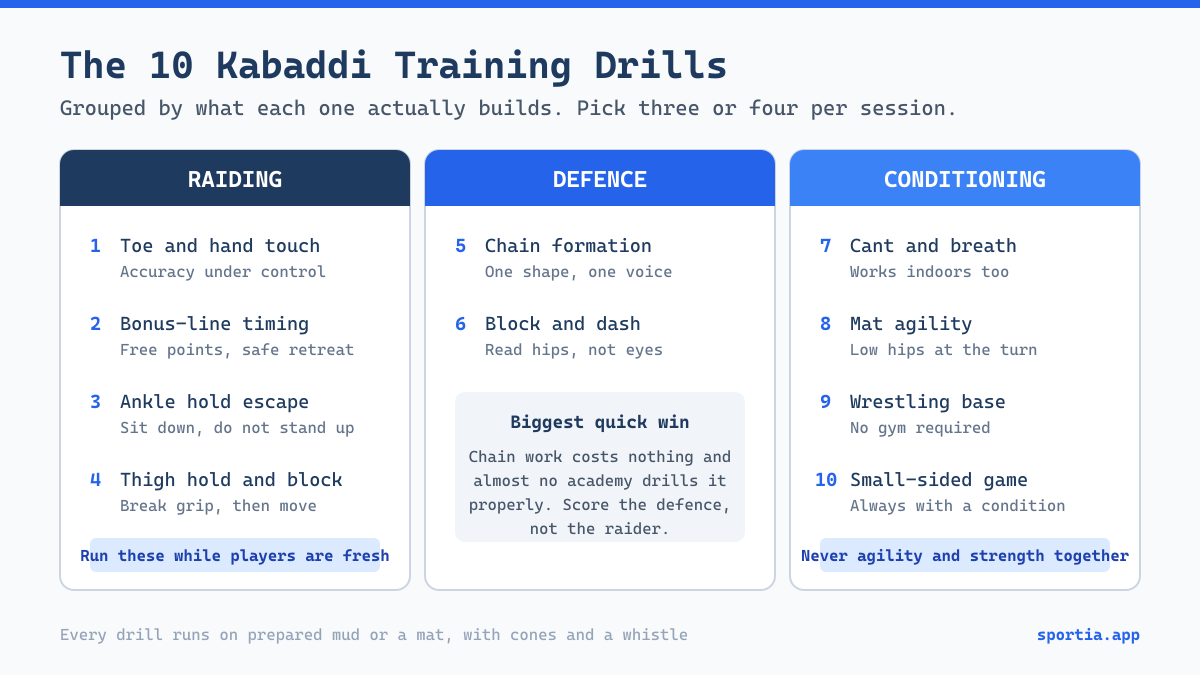
Ten drills is a menu rather than a session plan, so pick three or four on any given day. A structure that works for most academy batches looks like this.
- 0 to 12 minutes: Warm-up with joint mobility, light cant work, and progressive sprints.
- 12 to 25 minutes: One skill drill at full quality. Drills 1 to 4 belong here.
- 25 to 38 minutes: One unit drill, either chain defence or block-and-dash reaction.
- 38 to 50 minutes: Conditioning through agility or wrestling-base work, never both in one session.
- 50 to 60 minutes: Small-sided game with a condition, then a proper cool-down.
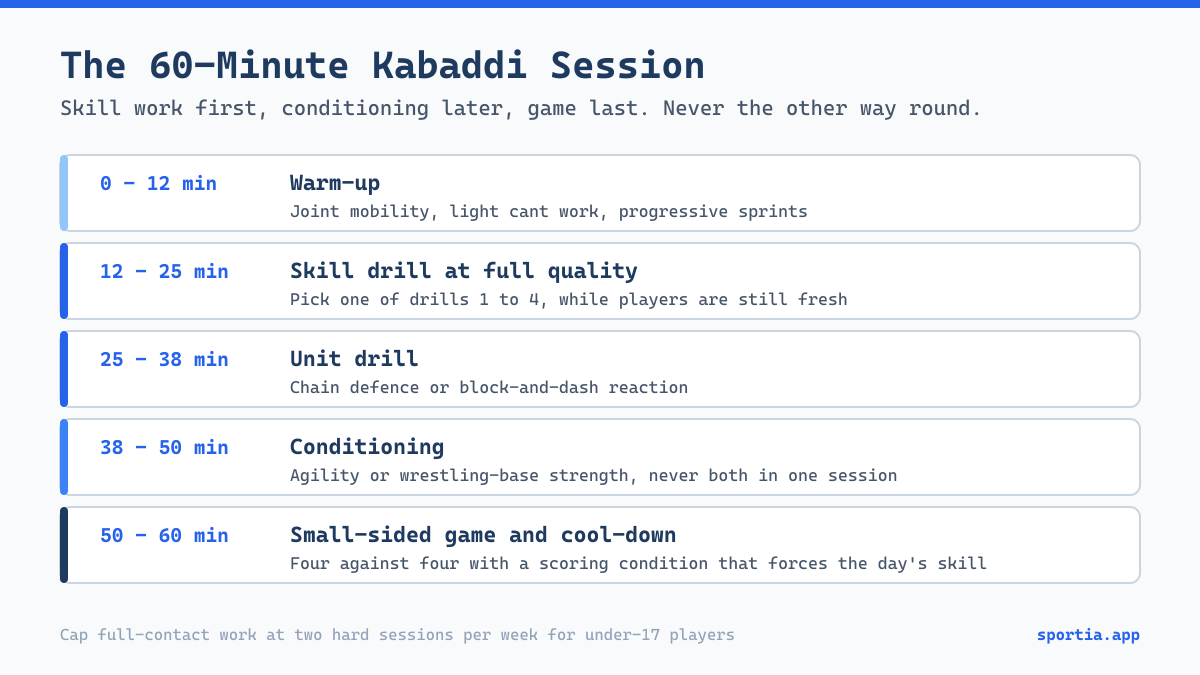
Run skill work while players are fresh rather than saving it for the end of the session. A tired raider practising escapes is only rehearsing bad technique, and those habits are hard to unpick later. For a fuller template of those opening twelve minutes, the guide to a proper warm-up routine before training breaks the sequence down step by step.
Protecting Young Bodies
Kabaddi is a full-contact sport played on hard ground, and the injury profile shows it. Published reviews of kabaddi injuries put the knee and the shoulder at the top of the list. Each accounts for roughly a fifth of all recorded injuries, with the ankle following close behind.
Three coaching habits cut that risk sharply.
- Strengthen the quadriceps, hamstrings, and glutes twice a week. Knee stability comes from muscle, not from a brace.
- Teach the safe landing before you teach the dive, because a raider who cannot fall properly should not practise ankle hold escapes at full speed.
- Cap full-contact work at two hard sessions a week for under-17 players. Fill the rest with skill and conditioning.
Mouthguards are cheap and badly underused in Indian academies. Facial and dental injuries are common in kabaddi, and a decent guard costs less than one month of fees. For the conditioning side of injury prevention, the post on speed and agility training for young athletes covers the movement work behind it.
Use the PKL Season as a Recruitment Window
Kabaddi interest in India is seasonal, and the Pro Kabaddi League drives the spike. Reports suggest the Season 13 auction will land around October 2026, with the season itself expected to follow later in the year.
That timeline gives academies a clear run-up to plan around. Parents and children start paying attention to kabaddi weeks before the first match, and enrolments follow that attention closely.
- Open a free trial batch in the fortnight after the auction, when local interest peaks.
- Film short drill clips during your own sessions. Drills 1, 3, and 5 all look good on a phone camera.
- Approach nearby schools ahead of the school games cycle, which runs Under-14, Under-17, and Under-19 categories nationally and leaves teachers actively hunting for players.
- Explain the Khelo India Youth Games pathway to parents, because kabaddi has been part of that programme since the games began in 2018.
Building a kabaddi academy from scratch is a much bigger project than running good sessions. The complete guide to starting a kabaddi academy in India covers registration, mat costs, and fee structures in detail.
Keep Your Drills Where Your Coaches Can Find Them
There is a practical problem with almost every academy drill library in the country. It lives inside one person's head, usually the head coach's, and it walks out of the door the day he takes leave or moves on.
Write each drill down once. Capture the setup, the reps, the coaching cue, and the common mistake. Then assign specific drills to specific batches, so every coach delivers the same session in the same way.
Sportia's coaching library is built for this. You store drills and training plans in one place, assign them to batches, and track which sessions were actually delivered. New coaches pick up your method in their first week instead of their sixth month.
Frequently Asked Questions
How long should a kabaddi training session be?
Sixty to seventy-five minutes suits most academy batches. Quality falls away quickly beyond that in a contact sport, though groups under 14 do better with fifty to sixty minutes of focused work.
What are the most important kabaddi drills for beginners?
Begin with toe-touch accuracy, ankle hold escapes, and basic chain defence. Those three cover the raid, the escape, and the team shape, and every other skill builds on that base.
Can kabaddi be practised without a mat?
Yes. Most academies in India still train on prepared mud with no real loss of skill transfer. A mat matters mainly for competition safety and joint protection. Interlocking tiles start at roughly 625 rupees each, and a full court needs well over a hundred, so treat it as a staged purchase.
How many raids should a young raider do in one session?
Twenty to thirty live raids is a sensible ceiling for under-17 players. Count them. Raiders quietly absorb far more load than defenders, and that is where overuse injuries begin.
What is the standard kabaddi court size in India?
Under AKFI rules the senior men's court measures 13 metres by 10 metres. The women's court is smaller, and junior categories use further reduced sizes. Mark your practice court to the size your players will actually compete on.
How do I make kabaddi training competitive without full matches?
Use small-sided games with scoring conditions. Four against four on a half court, with a rule that forces the day's skill, produces far more useful reps than a full match. Change the condition every eight minutes to keep players solving new problems.
Run Your Academy the Way You Run Your Sessions
Good coaching is systematic. Your drills follow a plan, your sessions have a repeatable structure, and nothing important rests on memory alone.
Academy operations deserve the same treatment. Sportia brings attendance, batches, fees, and the coaching library into one platform, so the hours you save on paperwork go back into court time. Start a free 14-day trial at sportia.app and get your drill library written down this week.