

The Warm-Up Routine Every Sports Academy Should Run Before Training
A good warm-up routine before sports takes about 12 minutes and follows four steps: raise the body temperature, activate the key muscles, mobilise the joints, and finish with something fast. Structured warm-ups of this kind have cut injury rates in youth football by roughly 30 to 48 percent in controlled trials. This guide gives you the structure, a 12-minute template, sport-specific additions, and a way to make every coach run the same one.
The Warm-Up Most Academies Actually Run
Walk into a typical academy session in India and the warm-up looks like this. Two laps of the ground, then the squad sits in a circle and holds a hamstring stretch for thirty seconds a side while the coach sets up cones.
It takes four minutes, everyone has done it since school, and it does very little.
The laps are not the problem. The problem is what follows: a long, static, seated stretch that lowers arousal right before a child is asked to sprint.
Here is the nuance that most coaching content gets wrong. Static stretching is not banned, and short holds are close to harmless. The research shows holds of 60 seconds or less per muscle group cause only a trivial dip in strength and power, around one to two percent. Push past 60 seconds and the drop becomes real, in the range of four to seven percent, and it can last up to an hour.
So the fix is not to ban stretching. It is to stop using long static holds as the warm-up itself.
What a Warm-Up Is Actually For
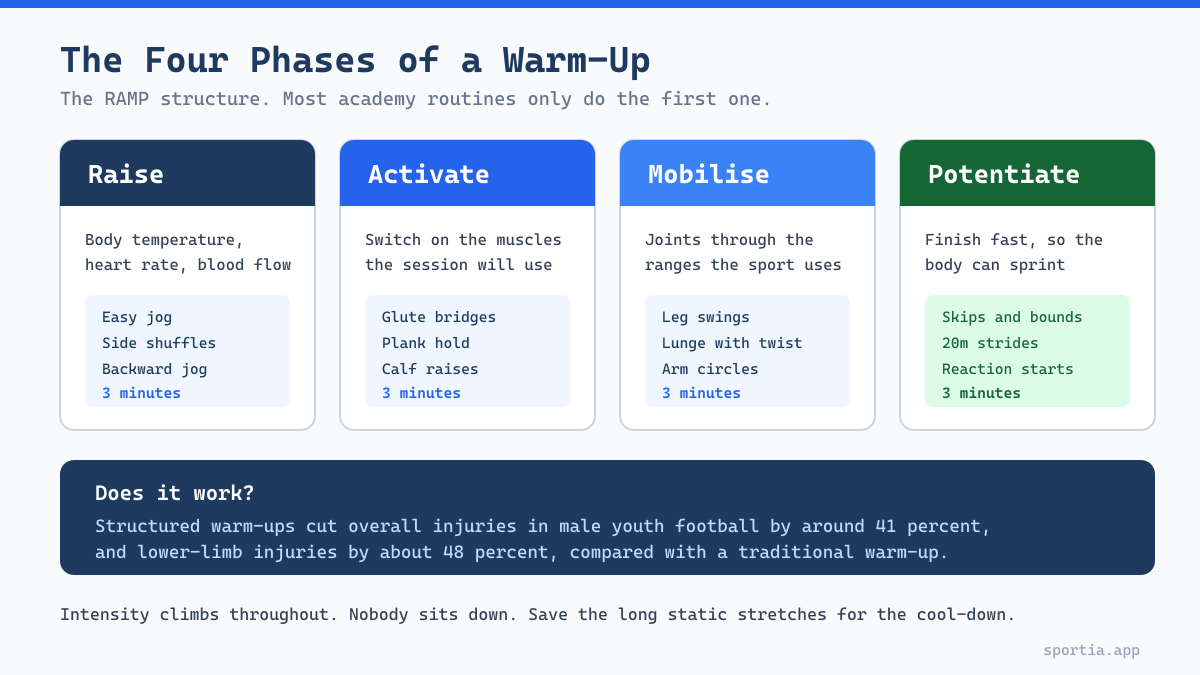
A warm-up has four jobs, and most academy routines only do the first one.
- Raise body temperature, heart rate, and blood flow.
- Activate the muscles the session will demand.
- Mobilise the joints through the ranges the sport uses.
- Potentiate, meaning finish with fast, sharp movement so the body is ready for full speed.
That structure is called RAMP, developed by Dr Ian Jeffreys, and it is now the standard framework in strength and conditioning. The strength of it is that a coach can remember it without a manual.
Does It Really Prevent Injuries?
This is worth answering with numbers, because coaches are asked to give up training time for it.
The FIFA 11+ warm-up is the most studied structured warm-up in sport. Across trials, teams using it have shown reductions in injured players ranging from about 30 to 70 percent.
In male youth football specifically, it cut overall injuries by around 41 percent and lower-limb injuries by about 48 percent. A large trial of nearly 1,900 young female footballers found a 32 percent reduction in overall injury risk. A separate version for under-14s reduced overall, severe, knee and ankle injuries.
The effect comes from better neuromuscular control, hip and trunk stability, and cleaner landing and cutting mechanics. That transfers well beyond football, because those are the same movements that hurt badminton, kabaddi, and basketball players.
Twelve minutes a session, for roughly a third fewer injuries, is one of the best trades available to a coach. Our guide to common sports injuries in children covers what you are trying to avoid.
The 12-Minute Template
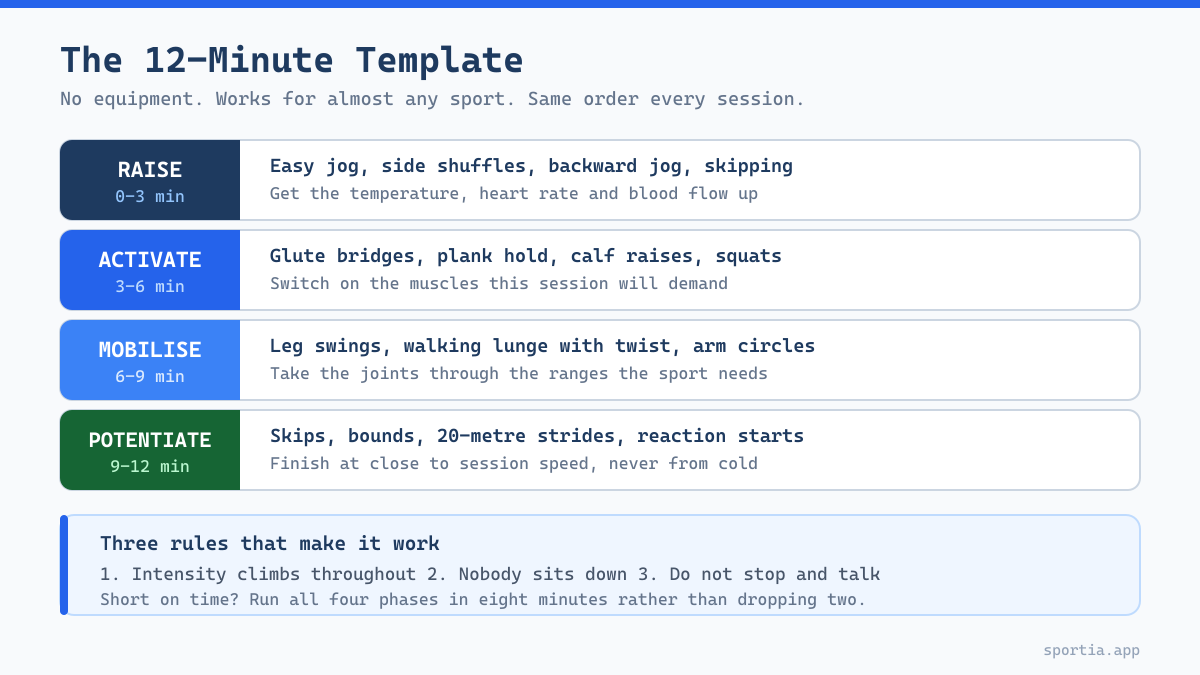
This needs no equipment and works for almost any sport. Run it in the same order every time.
| Phase | Time | What to run |
|---|---|---|
| Raise | 3 min | Easy jog, side shuffles, backward jog, skipping |
| Activate | 3 min | Glute bridges, plank hold, calf raises, bodyweight squats |
| Mobilise | 3 min | Leg swings, walking lunge with twist, arm circles, hip openers |
| Potentiate | 3 min | Skips, bounds, two or three 20-metre strides, reaction starts |
Three rules make it work:
- Intensity climbs throughout. The last two minutes should look nearly like the sport itself.
- Nobody sits down. The moment a squad sits, temperature drops and you have undone the first phase.
- Do not stop and talk. Coach while they move, or save the instruction for after.
If your session is only 45 minutes, run the same four phases in eight minutes rather than skipping two of them. A short RAMP beats a long jog.
Sport-Specific Additions
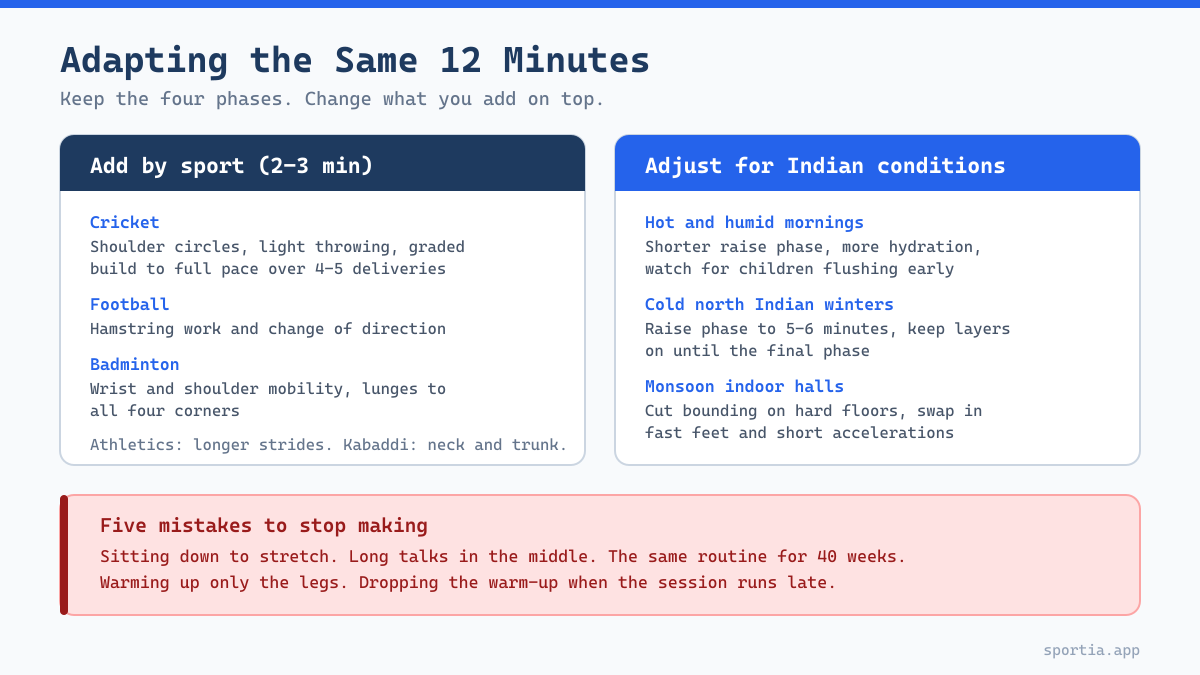
Keep the same 12-minute base, then add two or three minutes tailored to the session.
- Cricket: shoulder circles and light throwing before any bowling. Fast bowlers need a graded build to full pace across four or five deliveries, never straight into a spell. See our guide to cricket bowling techniques for young players.
- Football: add hamstring work and change-of-direction drills. Hamstrings and ankles account for most of what you will see.
- Badminton: add wrist and shoulder mobility, plus lunge patterns in all four corners. The lunge is the movement that injures badminton players.
- Athletics: longer potentiate phase with proper strides, and ankle stiffness work before any jumping.
- Kabaddi and wrestling: add neck and trunk work, and rehearse the landing positions the sport forces.
Adjusting by Age
The same four phases work for every age group. What changes is how you deliver them.
Under 10. Make it a game. Tag, follow-the-leader, animal walks and shadow drills raise temperature just as well as a jog, and children stay interested. Skip formal activation work here. At this age the aim is movement skill and fun.
Ages 10 to 13. Start naming the phases out loud. Children can learn the words raise, activate, mobilise and potentiate. A squad that knows the order can run it alone while you set the session up.
Ages 14 and above. Add real activation work and a full potentiate phase. Teenagers in a growth spurt are the group most at risk, because bones lengthen faster than muscles and tendons adapt to them.
One habit pays off at every age. Rotate the job of leading the warm-up among your senior athletes. They learn it properly, and you get 12 minutes back to set up.
Five Mistakes to Stop Making
- Sitting down to stretch. Body temperature drops within a minute or two, and the raise phase is wasted.
- Long talks in the middle. Coach while they move, or hold the point until the end.
- The same routine for 40 weeks. Children switch off. Change the exercises and keep the four phases.
- Warming up only the legs. Shoulders, wrists and trunk matter in cricket, badminton and swimming.
- Dropping it when you are late. A late session should lose a drill, never the warm-up.
Warming Up in Indian Conditions
Most warm-up advice online is written for a mild European climate. India is not that, and the same routine needs adjusting three ways.
Hot, humid mornings. In coastal cities like Mumbai and Chennai, athletes reach working temperature fast. The raise phase can be shorter, but hydration matters more, and you should watch for children who look flushed early. Our post on heat safety in Indian training conditions covers the warning signs.
Cold north Indian winter mornings. A 6 am session in Delhi or Punjab in December can start near single-digit temperatures. Extend the raise phase to five or six minutes, keep tracksuits on until the potentiate phase, and never start with static work.
Monsoon indoor sessions. On a hard hall floor, cut the bounding and jumping in the potentiate phase and replace it with fast feet and short accelerations. Our indoor circuits guide covers the wider rainy-season setup.
The Cool-Down Almost Nobody Runs
Sessions in Indian academies usually end when the last drill ends. Parents are waiting, the next batch is arriving, and everyone leaves.
Five minutes is enough to change that:
- Two minutes of easy movement to bring the heart rate down.
- Two minutes of static stretching, which is exactly where long holds belong.
- One minute in a huddle to name one thing that went well and one goal for next session.
The static stretching you removed from the warm-up has a home here, and this is where a real flexibility habit gets built.
Getting Every Coach to Run the Same One
A warm-up only prevents injuries if it happens every session, with every batch, including the ones a stand-in coach takes.
That is an operations problem rather than a coaching one. Four things fix it:
- Write it down once. One page, four phases, the exercises listed in order.
- Put it where coaches already look. A page nobody can find will not be used.
- Give it a slot in the session plan. If the plan starts at drill one, the warm-up gets squeezed.
- Check it, quietly. Turn up unannounced to two sessions a month and watch the first 12 minutes.
With Sportia, you can store the warm-up as a training plan in the coaching library and assign it to every batch, so a substitute coach opens the session and sees exactly what to run. Track loading alongside it, because a good warm-up does not protect an overloaded athlete. Our post on overtraining in young athletes covers those warning signs, and speed and agility training builds the athletic base underneath.
Frequently Asked Questions
What is the best warm-up routine before sports?
A four-phase RAMP warm-up: raise temperature with easy movement, activate key muscles, mobilise the joints, then finish with fast strides. Twelve minutes covers it for most sports, with two or three minutes added for sport-specific work.
Is static stretching bad before sport?
Not in short holds. Under 60 seconds per muscle group causes only a trivial dip in strength and power. Holds beyond 60 seconds cut strength by four to seven percent, and that effect can last an hour, so save the long holds for the cool-down.
How long should a warm-up be for young athletes?
About 12 minutes for a standard session, extended to 15 or more on cold winter mornings. If the session is short, shorten each phase rather than dropping phases entirely.
Does a warm-up actually prevent injuries?
Yes, and the evidence is strong. Structured warm-ups such as the FIFA 11+ have reduced injuries in male youth football by around 41 percent overall and 48 percent for lower-limb injuries, with a 32 percent reduction found in a large trial of young female players.
What warm-up should young cricketers do before bowling?
Run the standard 12-minute base, add shoulder circles and light throwing, then build to full pace across four or five deliveries. A fast bowler should never start a spell at full effort from cold.
Should the warm-up change in hot weather?
Yes. In hot, humid conditions athletes reach working temperature faster, so the raise phase can be shorter while hydration and monitoring matter more. In cold weather, extend the raise phase and keep layers on until the final minutes.
Twelve Minutes, Every Session
The warm-up is the cheapest injury prevention available to an academy, and the easiest thing to let slide when a session is running late.
Write your four phases down, give them a slot in every session plan, and check occasionally that they are actually happening. Start your free 14-day Sportia trial to store your warm-up and training plans where every coach can find them.