
Protein-Rich Indian Foods for Young Athletes (On a Real Budget)
Ask most parents at an Indian academy why their child is not eating enough protein and you get the same answer. It is too expensive.
That answer is wrong, and it is costing young athletes their recovery. Protein is one of the cheapest things in an Indian kitchen. What is expensive is buying protein in the wrong form.
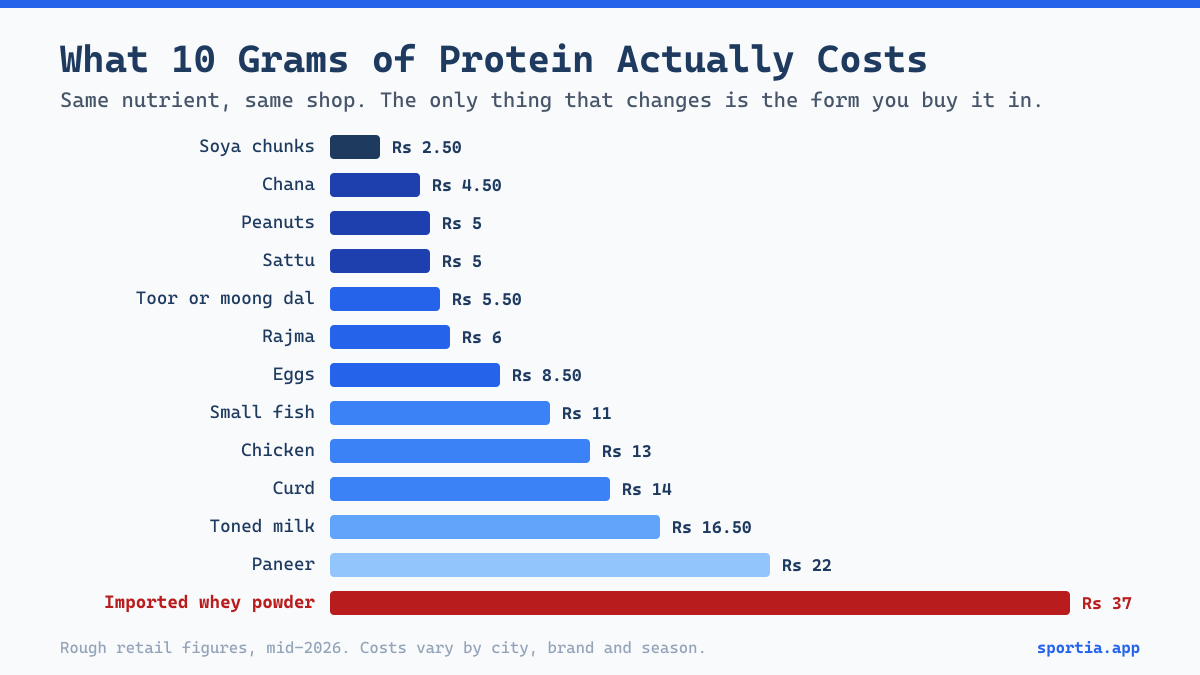
Soya chunks deliver protein at roughly 2 to 3 rupees for every 10 grams. A tub of imported whey delivers the same 10 grams for somewhere between 30 and 45 rupees. Paneer sits closer to 22 rupees. The nutrient is identical. Only the packaging changed.
This guide covers what a growing athlete actually needs, twelve protein-rich Indian foods with real numbers attached, and a full day of protein for under 100 rupees.
How Much Protein Does a Young Athlete Actually Need?
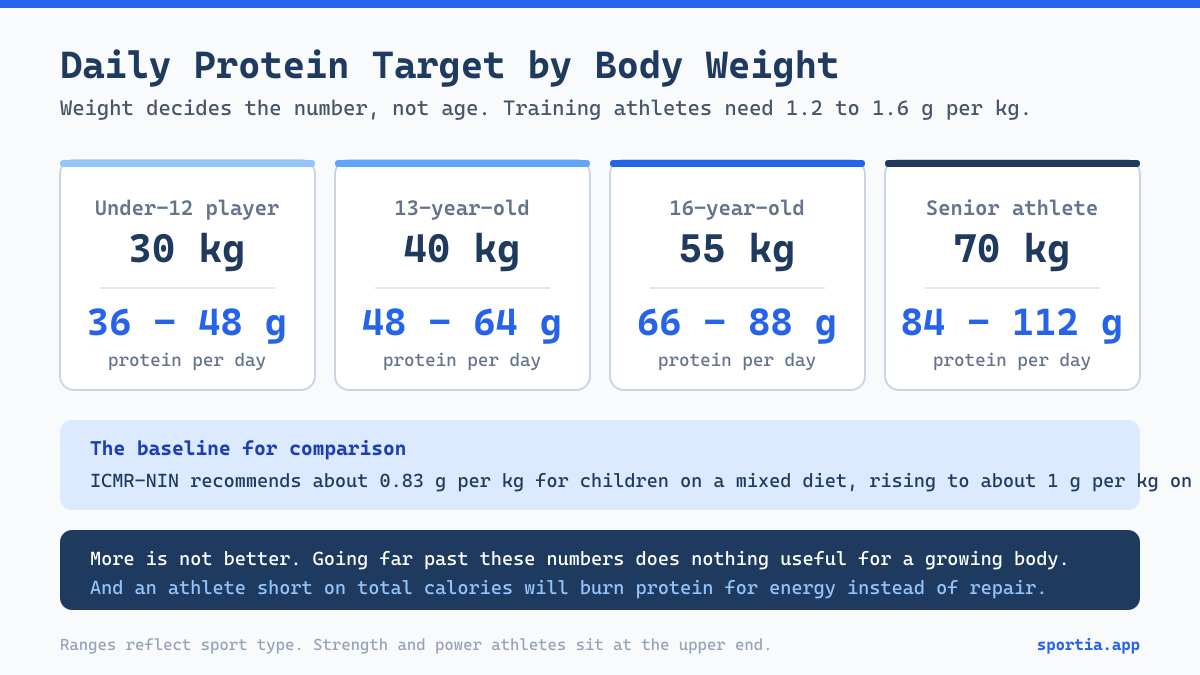
Start with the baseline. The ICMR-NIN recommended allowance for Indian children sits at roughly 0.83 grams per kilogram of body weight on a mixed diet. For children eating a mostly cereal-based diet, which describes a large share of Indian households, the recommendation rises to about 1 gram per kilogram.
Athletes need more than that. Sports nutrition guidance for adolescent athletes generally lands between 1.2 and 1.6 grams per kilogram per day. Power and strength athletes sit at the upper end, sometimes higher. Endurance athletes sit lower.
Run the numbers for real children and the target becomes clear.
- A 30 kg under-12 player: roughly 36 to 48 grams a day.
- A 40 kg 13-year-old: roughly 48 to 64 grams a day.
- A 55 kg 16-year-old: roughly 66 to 88 grams a day.
- A 70 kg senior athlete: roughly 84 to 112 grams a day.
Two warnings before you go further. More protein is not automatically better, and going far past these numbers does nothing useful for a growing body. And a child who is not eating enough total calories will burn protein for energy instead of using it for repair. Fix the overall food first.
The Part Almost Everyone Gets Wrong: Dry Weight Versus Cooked Weight
This single mistake distorts more diet charts than anything else. Protein tables list dal at 22 to 24 grams per 100 grams. Parents then assume a bowl of cooked dal delivers that much.
It does not. Those figures are for the dry, uncooked pulse. Once dal absorbs water and cooks, the same 100 grams of finished dal carries only 6 to 9 grams of protein.
So measure your pulses dry, before they go in the pot. A katori of thin dal at dinner might contain 20 grams of dry dal and 4 grams of protein. That is a snack, not a protein source.
Twelve Protein-Rich Indian Foods, With Numbers Attached
The table below uses ordinary household servings. Costs are rough retail figures from mid-2026 and will move with your city and season.
| Food | Serving | Protein | Rough cost per 10g protein |
|---|---|---|---|
| Soya chunks (dry) | 50 g | 26 g | Rs 2 to 3 |
| Chana, whole (dry) | 50 g | 10 g | Rs 4 to 5 |
| Peanuts | 40 g | 10 g | Rs 4 to 6 |
| Sattu (roasted chana flour) | 40 g | 8 g | Rs 5 |
| Toor or moong dal (dry) | 50 g | 11 g | Rs 5 to 6 |
| Rajma (dry) | 50 g | 11 g | Rs 5 to 7 |
| Eggs | 2 eggs | 12 g | Rs 8 to 9 |
| Small fish (sardine, mackerel) | 100 g | 20 g | Rs 10 to 12 |
| Chicken | 100 g raw | 20 g | Rs 12 to 14 |
| Curd | 1 large katori | 8 g | Rs 13 to 15 |
| Toned milk | 250 ml | 8 g | Rs 15 to 18 |
| Paneer | 50 g | 9 g | Rs 20 to 24 |
Look at the spread. The cheapest source on this list costs roughly one tenth of the most expensive, and both are sold in the same shop. Nothing about the top of the table is exotic or hard to cook.
The Vegetarian Backbone
Most Indian academy athletes eat vegetarian at least some days of the week. These seven foods will carry almost all of the load.
Soya chunks are the single cheapest protein in India at roughly 50 grams of protein per 100 grams dry. Soak them, squeeze them out, and cook them into any regular curry. Keep servings sensible rather than enormous, and rotate them with other sources.
Dal is the everyday base. Toor, moong, masoor and urad all sit around 22 to 25 grams per 100 grams dry. Make the dal thicker than usual and the protein per bowl roughly doubles.
Rajma and chana bring both protein and fibre. Chana is cheaper. Soaked overnight and boiled, a bowl of chana is one of the best evening snacks an academy can recommend.
Paneer is excellent food and poor value per rupee. Treat it as a treat rather than the plan.
Curd and milk matter for more than protein. They carry calcium, which growing bones in a contact sport genuinely need.
Peanuts are the most underrated item in this list. Cheap, portable, and easy to send to training in a small box.
One more point on vegetarian diets. Individual pulses are short on some amino acids and cereals are short on others. Eat them together and the gap closes. Dal chawal, rajma chawal, idli, khichdi and roti with chole are all doing this quietly. The ICMR-NIN guidance on diet quality points the same way, suggesting a cereal, pulse and milk pattern rather than any single food. For a deeper treatment, see the vegetarian diet plan for Indian athletes.
If Your Athlete Eats Non-Vegetarian
Eggs are the best value animal protein in the country. At the NECC rate through August 2026, an egg sits near 5 rupees and carries about 6 grams of protein. Two boiled eggs after training is a complete recovery snack for around 11 rupees.
Small fish such as sardine and mackerel are cheaper than chicken in most coastal and eastern markets. They also carry omega-3 fats and, when eaten with the bones, useful calcium.
Chicken is convenient and well liked, but it is not the cheap option many families assume. Compare it against eggs and soya before building meals around it.
A Rs 100 Protein Day
Here is a full day of protein for a 50 kg academy athlete, who needs roughly 60 to 80 grams. Everything below is bought in an ordinary kirana shop.
- Morning, 250 ml toned milk: 8 g protein, about Rs 14
- Breakfast, 2 boiled eggs: 12 g protein, about Rs 11
- Lunch, 50 g dry dal in a thick dal: 11 g protein, about Rs 6
- Pre-training snack, 40 g peanuts: 10 g protein, about Rs 5
- Dinner, 60 g dry soya chunks in curry: 31 g protein, about Rs 8
- Night, 250 ml toned milk: 8 g protein, about Rs 14
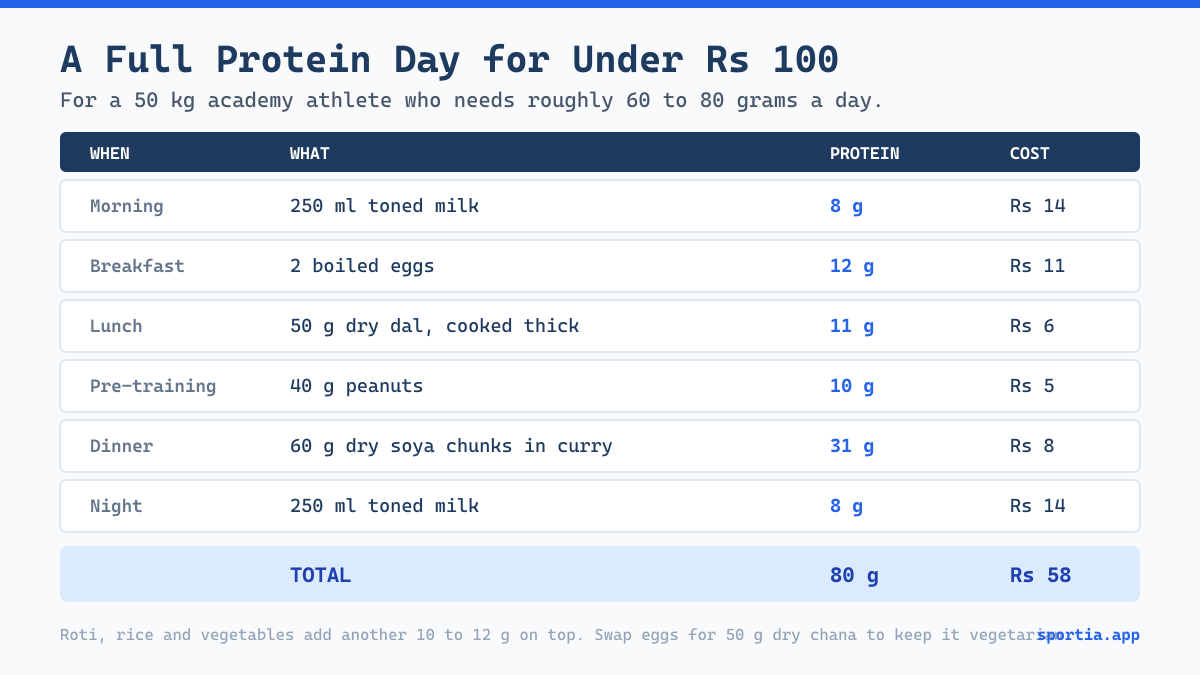
That comes to roughly 80 grams of protein for about 58 rupees, before you count the roti, rice and vegetables that add another 10 to 12 grams. The 100 rupee budget is not tight. It is generous.
Swap the eggs for 50 grams of dry chana and the day stays vegetarian at a similar cost. Nothing here needs a supplement, a specialist shop, or a nutritionist on retainer.
Spread It Across the Day, Not Into One Dinner
Most Indian families eat their protein in one heavy evening meal. The body handles protein better when it arrives in steady portions instead.
Aim for 15 to 25 grams at each main meal, plus a smaller amount around training. A young athlete who eats 70 grams spread across four points in the day will use it better than one who eats 70 grams at 9 pm.
The window after training matters most. Something with roughly 15 to 20 grams of protein within an hour of finishing is the simplest habit to build. Two eggs, a glass of milk with a banana, or a bowl of chana all do the job. For the fuller picture on meal timing, see the guide to pre-match and post-match nutrition.
Protein Powder for Teenagers: What the Evidence Actually Says
Parents ask about this constantly, usually after a supplement shop has told them their child is falling behind.
The honest position is that most teenage athletes do not need protein powder. Reviews of supplementation in adolescents have not found that powders build more muscle or power than the same protein from ordinary food. Paediatric guidance leans consistently towards whole foods for this age group.
There are real concerns as well. Supplement quality control in India is inconsistent, contamination and mislabelling have both been documented, and most products are formulated and tested for adults rather than for growing teenagers.
Then there is the arithmetic. Protein from soya chunks or dal costs a few rupees per 10 grams. The same protein from a tub of whey costs ten to fifteen times more.
A powder is a convenience product, not a performance product. If a family is genuinely struggling with appetite or a punishing training schedule, that is a conversation for a paediatrician or a registered dietitian, not for the shop counter.
Regional Swaps for Indian Kitchens
No academy has one type of family. Use whichever version fits the kitchen.
- North: Rajma chawal, chole, sattu sharbat in the heat, lassi and paneer for families who can afford it.
- South: Idli and dosa already pair rice with urad dal, which is a complete protein by accident. Add sambar made with generous toor dal, plus curd rice.
- East: Small fish such as mourala, ghugni made with white peas, and chana dal.
- West: Besan chilla, matki and moth bean usal, dal dhokli, and the peanuts that Gujarati and Maharashtrian kitchens already keep stocked.
The Parent Shopping List
Give this to families at the start of a season. It is one week of protein for one athlete.
- Soya chunks, 500 g
- Toor or moong dal, 1 kg
- Chana or rajma, 1 kg
- Peanuts, 500 g
- Eggs, 1 tray of 30
- Toned milk, 500 ml daily
- Curd, made at home from the same milk
- Optional: paneer 250 g, chicken or small fish once or twice a week
That basket runs to roughly 600 to 800 rupees a week in most cities. It covers a teenage athlete comfortably and feeds the rest of the family alongside.
What Academies Should Actually Track
Handing out a diet chart changes very little on its own. What changes things is noticing which athletes are not recovering.
Watch for the signals that show up at training. Persistent tiredness, no strength gain over months, frequent minor illness, and slower recovery between sessions all point the same way. Nutrition is often the cause, and it is often the cheapest thing to fix. If illness is the pattern you are seeing, the guide to immunity foods for young athletes covers that side separately.
Sportia's athlete development and wellness tracking lets coaches log these observations against each athlete over time. A pattern across six weeks is far more useful than a hunch on any single day. It also gives you something concrete to show a parent who is about to spend 3,000 rupees on a supplement tub.
Frequently Asked Questions
What is the cheapest protein food in India?
Soya chunks, by a wide margin. At roughly 50 grams of protein per 100 grams dry and around 120 to 145 rupees a kilogram, they deliver protein at about 2 to 3 rupees per 10 grams. Chana and peanuts come next.
How much protein does a 14-year-old athlete need per day?
It depends on body weight rather than age. At 1.2 to 1.6 grams per kilogram, a 45 kg fourteen-year-old training regularly needs roughly 54 to 72 grams a day. Strength-based sports sit at the higher end.
Can Indian vegetarian athletes get enough protein without supplements?
Yes, comfortably. Soya chunks, dal, chana, rajma, peanuts, curd and milk can cover 80 grams a day for under 60 rupees. Pair pulses with cereals at the same meal so the amino acid profile stays complete.
Is protein powder safe for teenage athletes?
Most teenagers do not need it, and the evidence does not show extra muscle or power compared with the same protein from food. Quality control on supplements in India is inconsistent. Speak to a paediatrician or registered dietitian before starting any product.
How much protein is in one katori of dal?
Far less than most charts suggest. A typical thin dal serving uses 20 to 25 grams of dry dal, which works out to only 4 to 6 grams of protein. Making the dal thicker is the easiest fix available.
When should a young athlete eat protein around training?
Aim for 15 to 20 grams within an hour of finishing a session. Two eggs, a glass of milk with a banana, or a bowl of boiled chana all work. Spreading protein across the whole day matters more than any single meal.
Feed the Athlete, Then Watch What Changes
Good nutrition in an Indian academy is not about imported tubs or complicated charts. It is dal measured dry, eggs after training, and peanuts in the kit bag.
The harder part is knowing whether it worked. Sportia helps academies track attendance, progress and athlete wellness in one place, so patterns become visible instead of anecdotal. Start a free 14-day trial at sportia.app and share this shopping list with your parents this week.