
How to Send Fee Reminders to Parents Without the Awkward Conversation
To send fee reminders to parents without the awkwardness, use four scheduled touches: three days before the due date, on the due date, at day seven, and at day thirty. Send them individually rather than in a group, keep the tone factual, and automate the sequence so no single person has to decide whether to chase. This guide gives you the timeline, ready-to-use message templates, and the WhatsApp rules that changed in India this year.
Why Owners Put Off the Fee Conversation
Almost every academy owner in India has done this. A parent is two weeks late, you see them at drop-off, and you say nothing.
The reason is rarely poor admin. It is that you know this family. Their child is in your batch four days a week, the parent volunteers at your tournament, and asking for money feels like it damages something.
So the reminder waits. Then it waits again. By the time you do send it, the amount is larger, the conversation is harder, and the delay itself has made it worse.
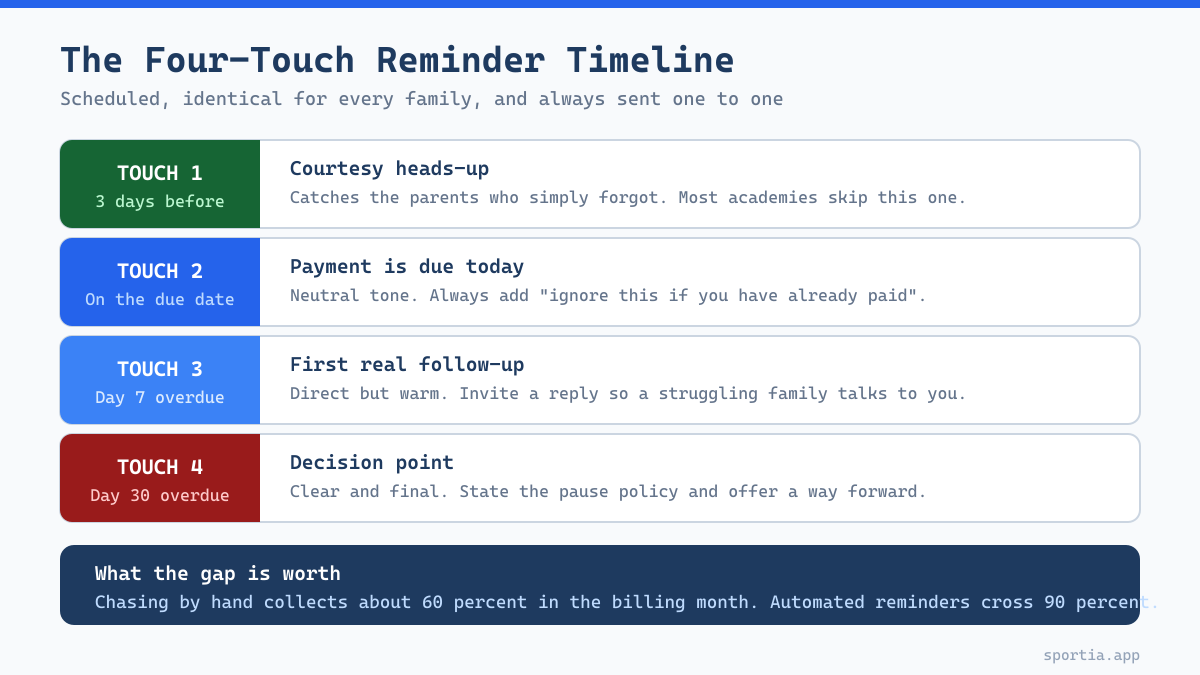
Here is what that costs. Academies chasing fees by hand over WhatsApp often collect around 60 percent within the billing month. Academies with scheduled invoices and auto reminders often cross 90 percent. On Rs 15 lakh of annual billing, that gap is roughly Rs 4.5 lakh sitting in other people's accounts.
The fix is not to become tougher. It is to remove yourself from the decision entirely.
Set the Expectation at Enrollment
A reminder only feels awkward when it arrives as a surprise. If a parent has never been told the due date or what happens after it, the first reminder reads as an accusation.
Cover four things during enrollment, in writing:
- The exact due date each month, such as the 5th.
- How they will be reminded, and that the system sends them, not you.
- How to pay, with the link or UPI details.
- What happens if fees go unpaid past a stated point.
Say plainly that reminders go to every family alike, so nobody is being singled out. That one sentence removes most of the sting later. Our guide to building a fee structure covers how to set the terms themselves.
The Four-Touch Timeline
Most collection problems are timing problems. Send too few reminders and you look sloppy, send too many and you become noise.
Four touches works for a monthly academy fee:
| When | Purpose | Tone |
|---|---|---|
| 3 days before due | Courtesy heads-up | Helpful |
| On the due date | Payment is due today | Neutral |
| Day 7 overdue | First real follow-up | Direct but warm |
| Day 30 overdue | Decision point | Clear and final |
The pre-due reminder is the one most academies skip, and it is the one that does the most work. It catches the parents who simply forgot, which is most of them. Every family you collect from before the due date is a family you never have to chase.
Four Templates You Can Use Today
Keep these factual. The moment a reminder sounds angry, it invites an angry reply.
Touch 1, three days before:
Hello [Parent name], a reminder that [Child name]'s fee of Rs [amount] for [month] is due on [date]. You can pay here: [link]. Thank you.
Touch 2, on the due date:
Hello [Parent name], [Child name]'s fee of Rs [amount] for [month] is due today. Payment link: [link]. Please ignore this message if you have already paid.
Touch 3, day seven:
Hello [Parent name], [Child name]'s fee of Rs [amount] for [month] is still showing as pending. If you have already paid, please share the reference so we can update our records. If something has come up, reply here and we will sort it out.
Touch 4, day thirty:
Hello [Parent name], [Child name]'s fee for [month] has been pending for 30 days and the total outstanding is now Rs [amount]. As per our policy, enrollment is paused after [X] days of non-payment. Please clear it by [date], or reply so we can work out a plan.
Two details make these work. The line "please ignore this message if you have already paid" removes the sting of a wrongly-sent reminder, which is the fastest way to damage trust. And the offer to reply in touches three and four keeps the door open, so a struggling family talks to you instead of disappearing.
Never Send Fee Reminders in a Group
This is the single most common mistake in Indian academies, and it is worth being blunt about.
Posting "the following parents have not paid" in a batch group does get results. It also shames the family, and it teaches every other parent in that group that your academy will name them publicly if money is tight.
The families hit hardest are often the ones under real money pressure. Those are also the families most likely to leave quietly rather than explain.
Send every fee message one to one. Use groups for schedules, results, and event notices only. Our post on parent communication beyond WhatsApp groups covers where the line sits.
The WhatsApp Rule That Changed This Year
If you send reminders through the WhatsApp Business API, this affects what you pay.
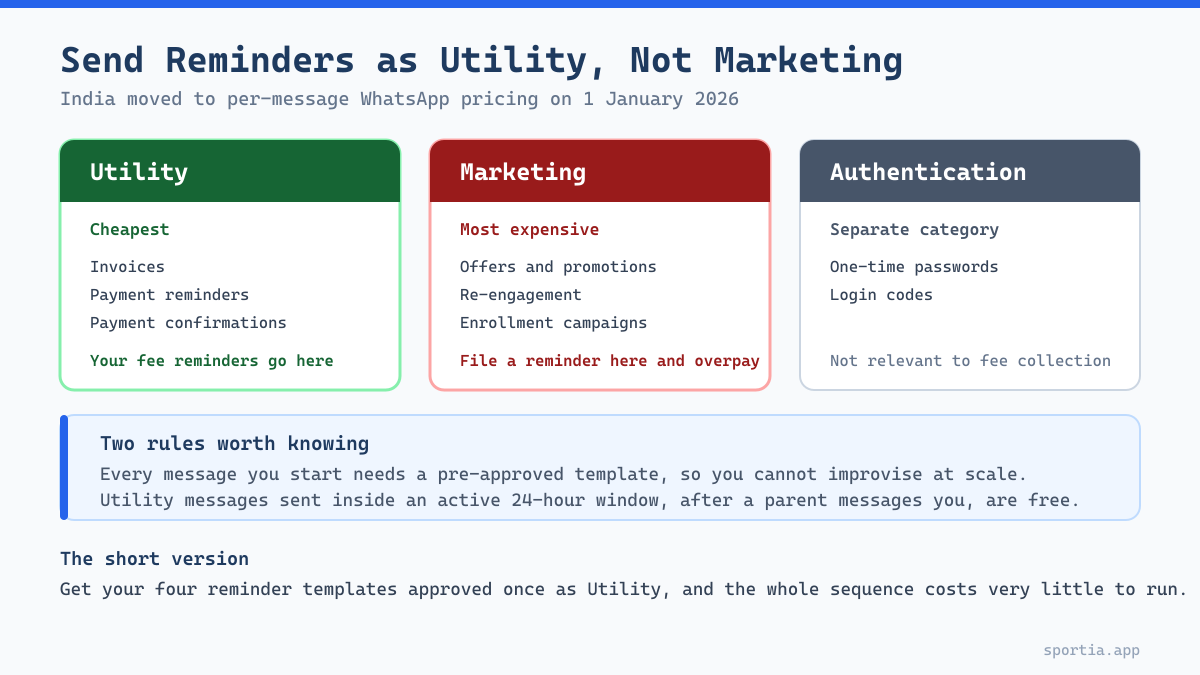
India moved to per-message pricing on 1 January 2026. Every message you start now falls into one of three types, and the price differs sharply between them.
- Utility - order updates, invoices, payment reminders and confirmations. Cheapest.
- Marketing - offers, promotions, re-engagement. Most expensive.
- Authentication - one-time passwords.
A fee reminder is a Utility message, because it is tied to something the parent already did: enrolling their child. File it as Marketing and you pay a lot more for the same text. Get it wrong and Meta may reject the template at review.
Two more things worth knowing. Every message you start needs a pre-approved template, so you cannot make up wording at scale. And utility messages sent inside an active 24-hour window, meaning after a parent has messaged you, are free.
The short version: get your four reminder templates approved once as Utility, and your entire collection sequence costs very little to run.
When to Pause an Athlete, and How to Say It
Every academy needs a line, because a policy nobody enforces is not a policy.
Somewhere between 30 and 60 days is fair for a monthly fee. What matters far more than the exact number is that the line was written down at enrollment and applies to everyone.
When you do pause, say it to the parent and never to the child. A child turned away at the gate in front of their batch will remember it for years, and so will every other parent watching.
Frame it as a pause rather than an exit:
Hello [Parent name], since the fee for [month] is still pending, [Child name]'s place is on hold from [date] as per our policy. The spot is kept for two weeks. Please reply and we can sort out a way forward.
Handling Genuine Hardship
Some families are not avoiding you. A job was lost, a parent fell ill, or a medical bill arrived.
You will meet this every year, so decide the approach in advance instead of case by case at the gate.
- Have a quiet option. A payment plan across two or three months, or a part-fee deal for a set period.
- Put a time limit on it. "Half fees until December, then we review" works. An open-ended deal does not.
- Write it down. Both sides should know what was agreed, or it becomes a dispute later.
- Keep it private. No coach or other parent needs to know.
Academies that handle one hard year well often keep that family for the next six. It is good business, not just decency.
Automate It So You Never Decide Again
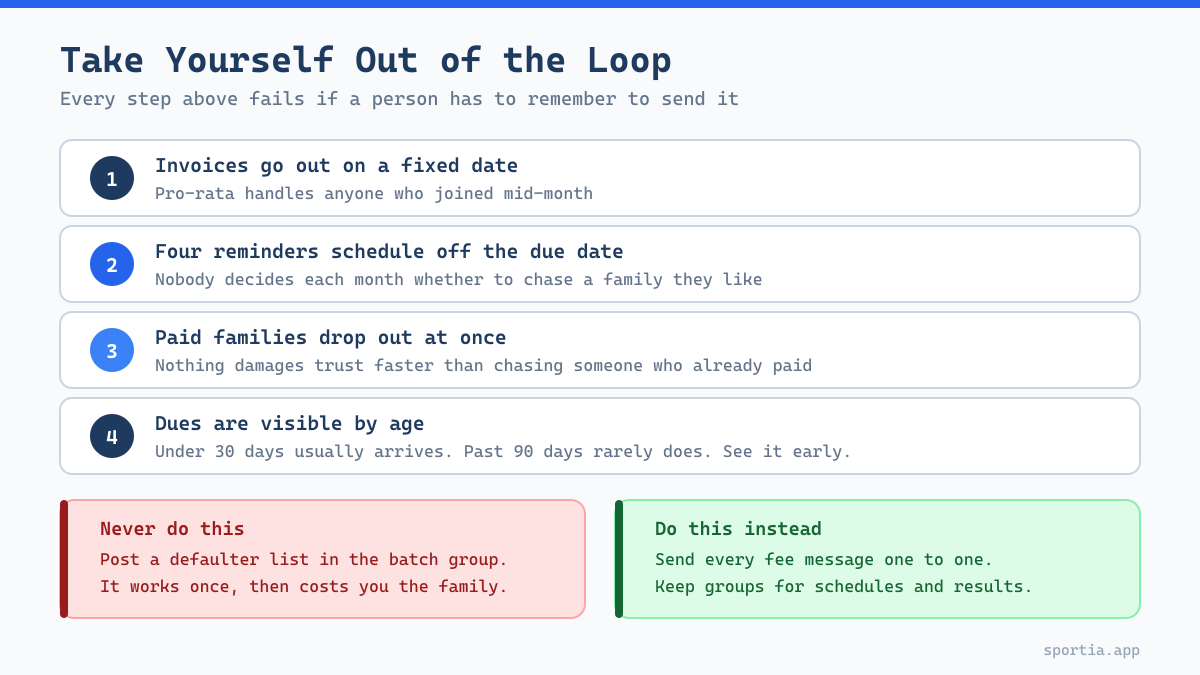
Everything above still fails if a person has to remember to send each message. On a busy week, that person is you, and you will skip it.
The setup that works:
- Invoices go out on a fixed date each month.
- The four reminders are scheduled against the due date, not sent by hand.
- Paid families drop out of the sequence the moment payment lands.
- Pending dues are visible by age, so you see 90-day debt before it becomes permanent.
That fourth point matters more than owners expect. Money under 30 days old often arrives, while money past 90 days rarely does. Our mid-year academy health check covers how to read those numbers.
With Sportia, invoices raise on their own with pro-rata for mid-month joiners, reminders go out over WhatsApp through Wamafy or WATI, and payments collect through Razorpay. Once a parent pays, they stop receiving the sequence. For the full billing setup, see our guide to online fee collection and invoicing.
Frequently Asked Questions
How do I send fee reminders to parents without sounding rude?
Keep the message factual and short: child's name, amount, month, due date, payment link. Add "please ignore if you have already paid". Reminders feel rude when they are random or personal, not when they are scheduled and the same for everyone.
How many fee reminders should an academy send?
Four works well: three days before the due date, on the due date, at day seven, and at day thirty. The pre-due reminder is the most useful because it catches parents who just forgot.
Should I put fee reminders in the parents WhatsApp group?
No. Group reminders shame the families who are struggling and tell everyone else that you will name them publicly. Send fee messages one to one, and keep groups for schedules and results.
What WhatsApp template category is a fee reminder in India?
Utility, not Marketing, because it ties to something the parent already did. Since India moved to per-message pricing in January 2026, using the right type costs much less, and a wrongly filed template can be rejected at review.
When should an academy pause a student for unpaid fees?
Between 30 and 60 days is a common line. The exact number matters less than writing it into your enrollment terms and using it the same way each time. Always tell the parent, never turn the child away at the gate.
What should I do when a family genuinely cannot pay?
Offer a short payment plan or lower fee, put the deal in writing, and keep it private. Decide your approach in advance so you are not haggling at the gate.
Take Yourself Out of the Loop
The awkwardness of fee reminders comes from you having to decide, every single month, whether to chase a family you like. Remove that choice and the discomfort goes too.
Write the terms into enrollment, schedule four touches, send them one to one, and let the system handle the rest. Start your free 14-day Sportia trial to automate invoices, reminders, and dues tracking in one place.