
Should You Franchise Your Sports Academy? A Realistic Look for Indian Owners
Once an academy fills its batches and builds a name in its city, the calls start coming. A parent in another suburb asks when you will open near them. A businessman offers to "take your brand" to his town. Or you see a famous cricket name selling franchises and wonder if you should buy one instead of building your own.
Franchising sounds like the fast route to growth. Sometimes it is. But most owners who ask about a sports academy franchise in India are really asking a simpler question: how do I grow without losing control of quality? This guide looks at both sides, buying a franchise and selling one, with real costs, the questions to ask, and the systems you need before your name goes on someone else's ground.
Two Sides of Franchising: Buying One and Selling One
Franchising is an agreement where one business (the franchisor) lets another (the franchisee) use its name, methods and support, in return for fees. In sports, it usually covers:
- The brand name and logo, often tied to a well-known player or club.
- A coaching curriculum, such as age-group plans, drills and assessment criteria.
- Coach training and certification.
- Marketing material, kit suppliers and sometimes software.
- The right to operate in a defined area, called the territory.
As a buyer, you pay for a head start: a known name, a ready curriculum and fewer early mistakes. As a seller, you earn fees from other people's capital and effort, but your reputation now depends on academies you do not run. Both sides can work. Both can go badly wrong.
What a Sports Academy Franchise Typically Costs
Very few sports franchisors in India publish their fees, so treat every number as a starting point for negotiation. The money usually comes in four parts.
- Franchise fee: a one-time payment for the brand and setup support. For kids' activity and education franchises, listings commonly show anything from about Rs 2 lakh to well over Rs 10 lakh.
- Setup cost: your ground, nets, turf, kit and furniture. This is often the biggest cost. One cricket academy franchise listing puts total investment at Rs 20 to 30 lakh, with 40,000 to 45,000 sq ft of space.
- Royalty: an ongoing share of revenue, paid monthly or quarterly. Across Indian education and kids' franchises, royalties range from zero to 20 percent or more. A minimum monthly royalty is common, even if your revenue is low.
- Other fees: marketing fund contributions, coach training fees, software fees and renewal fees after the first term.
Remember GST. Franchise fees and royalties generally attract 18 percent GST, which adds to your real cost unless you can claim input tax credit.
A worked example: how royalty eats margin
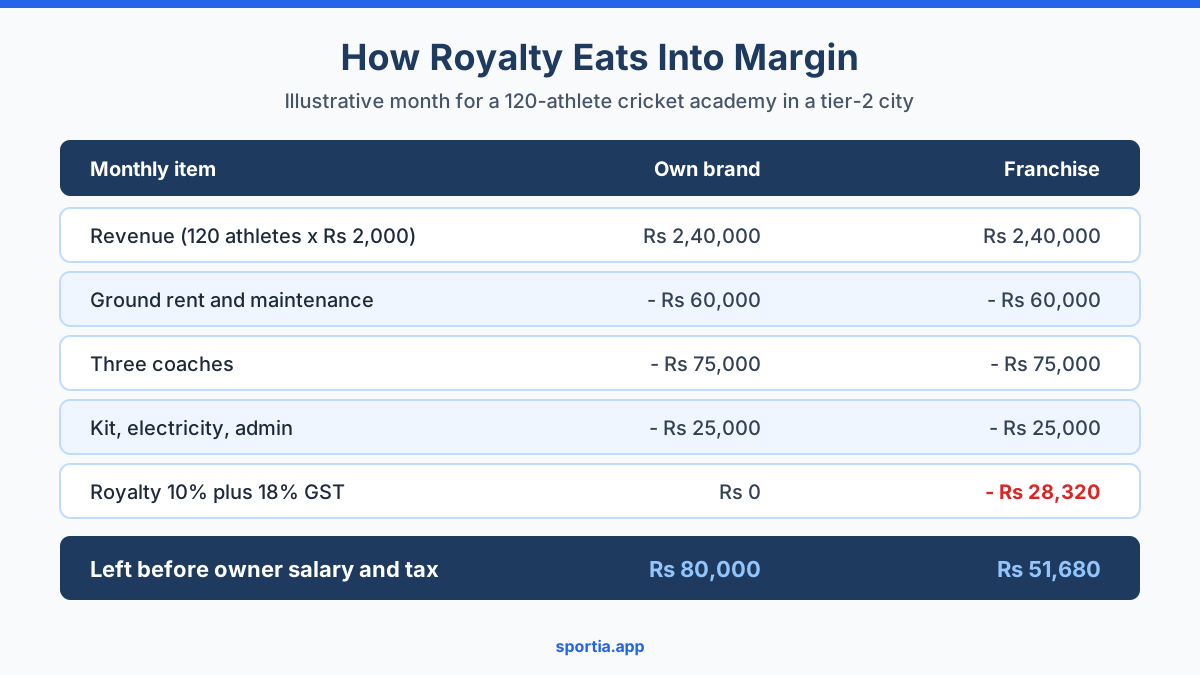
Picture a franchised cricket academy in a tier-2 city like Nagpur or Lucknow, with 120 athletes paying Rs 2,000 a month. That is Rs 2.4 lakh of monthly revenue. Here is a rough month:
- Ground rent and maintenance: Rs 60,000
- Three coaches at Rs 25,000 each: Rs 75,000
- Kit, balls, electricity and admin: Rs 25,000
- Royalty at 10 percent: Rs 24,000, plus GST of about Rs 4,300
That leaves about Rs 51,700 before your own salary, loan repayments and tax. Without the royalty, it would be about Rs 80,000. So the brand has to bring in enough extra athletes, or justify higher fees, to cover roughly Rs 28,000 a month. If it does, the deal works. If parents in your town care more about the coach than the logo, it does not. For a deeper look at the numbers, read our guide to sports academy profit margins in India.
Questions to Ask Before Buying a Franchise
A good franchisor will answer these clearly and in writing. A weak one will talk about the famous name instead.
Territory
- Exactly what area is exclusive to you, marked on a map, not "the city"?
- Can the franchisor open its own branch or sell another franchise nearby?
- What happens to your territory if you miss a sales target?
Royalty and fees
- Is the royalty a percentage of total revenue, or of fees only? Does it apply to kit sales and camps?
- Is there a minimum monthly royalty, and what happens in a bad month, such as during exams or the monsoon?
- What does the marketing fund actually pay for, and do you see the accounts?
Coach supply
This is the question most buyers forget, and it matters most. The brand does not coach your athletes. Your coaches do.
- Does the franchisor supply or train coaches, and at what cost?
- If a trained coach leaves, how fast can they help replace them?
- Will the famous name on the brand ever visit, and how often? Get it in writing.
Exit terms
- How long is the term, and what does renewal cost?
- Can you sell the franchise to someone else, and does the franchisor have to approve the buyer?
- If you leave, how long is the non-compete? Under Indian contract law, restrictions on trade after the agreement ends are often hard to enforce, but a long legal fight still costs money.
- Who owns the athlete and parent data when the agreement ends?
Talk to at least three existing franchisees, including one who left. Ask what they earn, not what the brochure says they could earn.
When Franchising Your Own Academy Makes Sense
Now flip the view. You run a successful academy and people want your name. Should you sell franchises?
Franchising sells your system, not your coaching. If the quality of your academy lives in your head and in your personal presence on the ground, it cannot be franchised yet. You would be selling a logo, and the first poorly run franchise will damage the name you spent years building.
Franchising starts to make sense when most of these are true:
- Your academy runs well for weeks without you on the ground.
- You have a written curriculum: session plans by age and level, with skill checks every term.
- You train your own coaches using a set method, not just by shadowing you.
- Fees, attendance and parent communication follow written processes that anyone can learn.
- You have at least one branch beyond the first, and it performs close to the original.
- Your brand means something to parents beyond your own face.
If you are still growing your first location, read our guide to scaling a sports academy from 10 to 100 athletes first. Franchising is a stage after that, not instead of it.
Franchise vs Company-Owned Branch vs Licensing Your Curriculum
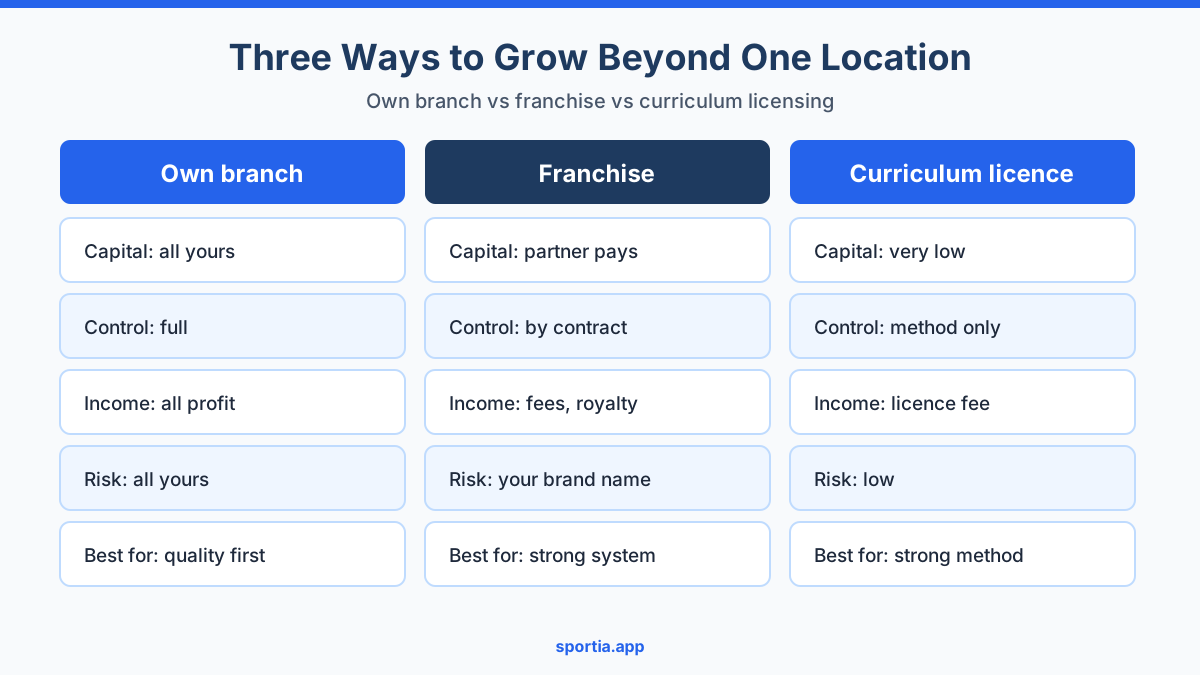
Franchising is only one way to grow. Many owners do better with one of the other two.
Company-owned branch
You open and run the second location yourself. You keep all the profit and all the control, but you also put up all the money and carry all the risk. This suits owners who care most about quality and have the capital, or can rent a school ground to keep costs low.
Franchise
A partner puts up the money and runs the site under your brand and rules. You grow faster with less capital, but you earn only a royalty and lose day-to-day control. This suits owners with a strong brand and a well-documented system.
Curriculum licensing
You license your coaching programme to schools or other academies, without your brand on their gate. They pay a yearly or per-athlete fee for session plans, coach training and assessment tools. Your risk is lower, because a weak partner does not damage your public name. This suits owners whose real strength is their method, such as a well-designed under-10 programme.
Quality Control: Why Franchised Academies Drift
Franchises rarely fail in one dramatic moment. They drift. A franchisee cuts a coach to save money and puts 30 children in a batch built for 15. Session plans get skipped. Parent complaints go unanswered. Two years later, the brand means something different in every city.
Here is how to stop drift before it starts:
- Set hard standards in the agreement. Maximum batch size, coach-to-athlete ratio, coach qualifications and minimum session length.
- Measure the same things everywhere. Attendance rate, athlete retention, skill test results and parent complaints. If you cannot compare branches with the same numbers, you cannot manage them.
- Visit without warning. A surprise visit each quarter tells you more than any report.
- Retrain coaches every year. Methods fade. A yearly coach camp keeps everyone close to the original.
- Keep the right to step in. The agreement should let you warn, fine and finally end the franchise if standards keep slipping.
One system across every branch
Drift is much easier to spot when every branch runs on the same system. If you grow through company-owned branches, Sportia lets you run them all inside one academy account. Each location has its own sports, facilities and check-in QR code. The dashboard shows attendance, active athletes, outstanding dues and fees collected for all branches together, or for one branch at a time. You can assign staff to specific branches, so a branch manager sees only that branch's athletes and enquiries.
Your drill library, training plans and progress assessments are shared across every location, so a child in your second branch is coached and tested against the same standard as one in your first. Our guide to managing multiple sports academy locations covers the day-to-day side of this.
Legal Basics: Agreement, Trademark and Brand Standards
India has no dedicated franchise law. Franchise deals are governed mainly by the Indian Contract Act, 1872, and the Trade Marks Act, 1999, along with tax and competition rules. That means the agreement is everything. Whatever is not written down is hard to enforce.
The franchise agreement
At a minimum, it should cover the territory, all fees and how they are calculated, the term and renewal, training and support, quality standards, audit rights, data ownership, exit and transfer terms, and how disputes are settled, usually through arbitration. Have a lawyer who works on franchise deals draft or review it. Expect to pay for this. It is far cheaper than a dispute.
Trademark
If you plan to franchise, register your academy name and logo first. Coaching and sports training fall under Class 41. The official fee is Rs 4,500 per class for individuals, startups and small businesses, and Rs 9,000 for companies. Without a registered mark, you are licensing something you may not fully own, and a franchisee could register a similar name before you do.
Brand standards manual
This is a practical document, not a legal one. It covers logo use, kit colours, signage, social media rules, how coaches dress and how phones are answered. It sounds minor, but it is what makes ten academies feel like one brand.
This section is general information, not legal advice. Talk to a lawyer before you sign or sell any franchise.
A Franchise Readiness Checklist
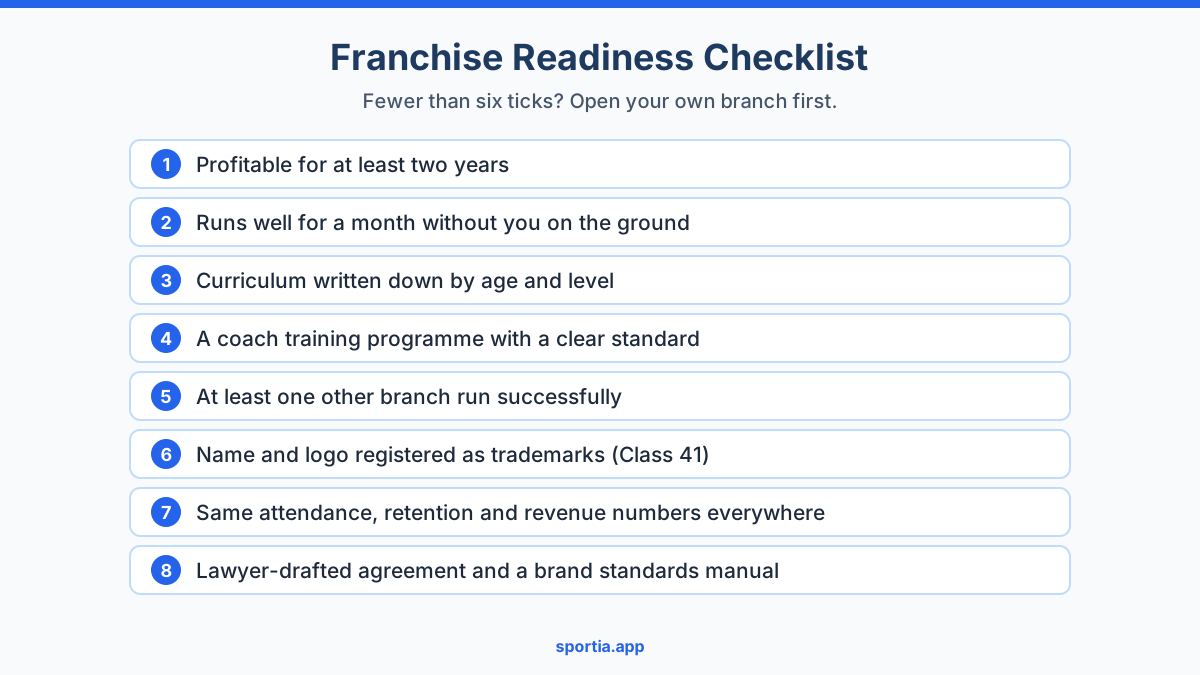
Before you sell a franchise, or sign up as a franchisee, run through this list honestly.
- Your academy has been profitable for at least two years.
- It runs well for a month without you on the ground.
- Your curriculum is written down by age and level.
- You have a coach training programme with a clear standard.
- You have run at least one other branch successfully.
- Your name and logo are registered trademarks.
- You track attendance, retention and revenue the same way at every site.
- A lawyer has drafted a franchise agreement and you have a brand standards manual.
If you tick fewer than six, open another company-owned branch first. If you are buying, ask the franchisor to show you evidence for each point.
Frequently Asked Questions
How much does a sports academy franchise cost in India?
Costs vary widely and few franchisors publish them. Expect a one-time franchise fee, setup costs for the ground and kit, and an ongoing royalty on revenue. One cricket academy franchise listing puts total investment at Rs 20 to 30 lakh, and GST of 18 percent applies to franchise fees and royalties.
Is a cricket academy franchise profitable?
It can be, if the brand brings in enough extra athletes or higher fees to cover the royalty. Work out your monthly costs with and without the royalty, and talk to existing franchisees about their real earnings. In many towns, parents choose the coach over the logo.
Should I franchise my sports academy or open my own branch?
Open your own branch first if you have the capital and want full control of quality. Franchise only when your academy runs without you and your curriculum, coach training and processes are written down. Curriculum licensing is a lower-risk middle option.
Is there a franchise law in India?
No. India has no dedicated franchise law, so deals are governed mainly by the Indian Contract Act and the Trade Marks Act. The franchise agreement sets out almost all the rights and duties of both sides, so get it reviewed by a lawyer.
Do I need a trademark before franchising my academy?
Yes, you should register your academy name and logo first. Sports coaching falls under Class 41, and the official fee is Rs 4,500 per class for individuals and small businesses. Without it, you may struggle to stop others using your name.
What royalty do sports franchises charge in India?
Royalties for education and kids' activity franchises in India range from zero to 20 percent of revenue or more, and many set a minimum monthly amount. Check whether it applies to total revenue or only to coaching fees.
Grow on Systems, Not on Hope
Whether you buy a franchise, sell one or open your own branch, the same rule applies: growth only works when quality can be measured and repeated. Write down your methods, track the same numbers at every site, and grow at the pace your coaches can keep up with.
If you are opening a second or third branch, try Sportia free for 14 days. Set up each location, share one curriculum across all of them, and see every branch on one dashboard.