
The State of Sports Academies in India: 7 Shifts Owners Should Plan For
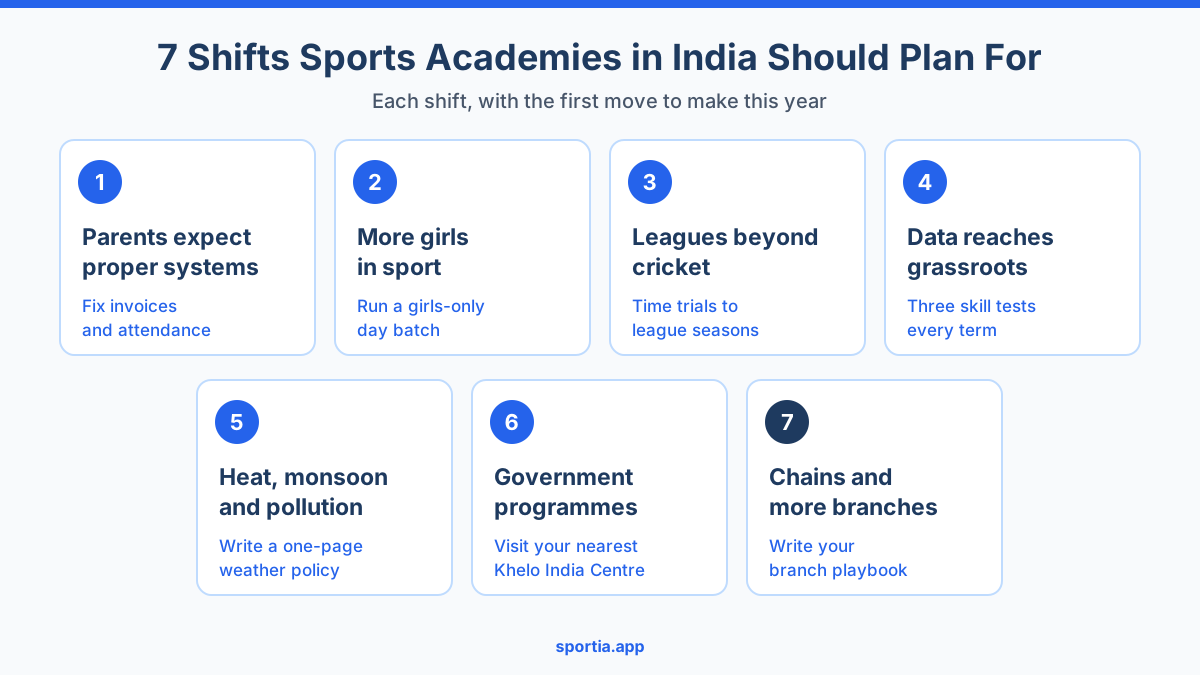
Most sports academy trends India articles list the same things: more money, more apps, more leagues. That is true, but it does not tell you what to change in your own academy next year. This guide takes a different view. It looks at seven shifts that already show up in fee registers, batch sizes and parent questions. Then it turns each one into a decision for the next twelve months.
Some of these shifts are good news. Others will hurt academies that ignore them. A few are mostly hype, and the guide says so where that is the case.
Where Indian Sports Academies Stand After the Asian Games
India finished fourth at the 2026 Asian Games in Aichi-Nagoya with 85 medals, including 21 gold. The men's hockey team beat Malaysia 5-1 in the final, which also secured a place at the Los Angeles 2028 Olympics. That is fewer medals than the record 106 from Hangzhou in 2023, but it is still India's second-best haul at the Games.
For an academy owner, the medal count matters less than what happens around it. Every big result brings a short rush of enquiries. Parents who never thought about archery or hockey suddenly ask about trial classes. Most of that interest fades within a few months unless the academy turns it into regular enrolment.
Money is moving too. A Deloitte and Google report says the Indian sports market was worth about $52 billion in 2023. It could reach $130 billion by 2030. Much of that is sports goods and media, not coaching. Still, the government has backed grassroots sport more strongly than before. The National Sports Policy 2025, called Khelo Bharat Niti, replaced the 2001 policy. In mid-2026 the Cabinet approved Rs 36,441 crore for the Khelo India Scheme and support for national federations from 2026-27 to 2030-31.
So the demand is real. The question is which academies will capture it. Our guide on turning Asian Games interest into enrolments covers the short-term side. The seven shifts below cover the longer game.
Shift 1: Parents Pay More, and Expect Professional Operations
Fees have climbed steadily in metro and tier-2 cities. A group badminton batch that cost Rs 1,000 a month a few years ago now often costs Rs 1,500 to Rs 3,000. Private cricket coaching with nets and a turf can run far higher. When parents pay school-level fees, they start to expect school-level systems.
In practice, that means a few simple things:
- Proper receipts and invoices, not a thumbs-up on WhatsApp after a UPI transfer.
- A clear schedule that does not change by message an hour before class.
- Attendance they can check, so they know their child actually trained.
- Progress they can see, at least once a term, in numbers and not just "doing well".
- Care with their child's data. India's DPDP Rules, notified in November 2025, need verifiable parental consent before you process data of anyone under 18.
The common mistake is to treat this as a "big academy" problem. It is not. A 40-athlete academy in Nagpur or Coimbatore competes with the polished chain that just opened nearby. Parents compare the experience, not just the coaching.
What to do this year: pick one gap from the list above and fix it properly before the next fee cycle. Most owners start with invoices and attendance, because that is where disputes come from.
Shift 2: Girls' Participation Is Growing, but Many Academies Are Not Ready
The Khelo India ASMITA programme runs women-only leagues across many sports. For 2025-26, it planned around 852 leagues in 15 sports, aimed at more than 70,000 women athletes. The under-13 ASMITA football leagues alone were planned for about 8,000 players across 26 states and union territories.
Those leagues create a pipeline. Girls who play a league want a place to train afterwards. But many academies lose them within a year, for reasons that have little to do with coaching:
- No female coach or staff member at the ground
- No safe changing space or clean toilet
- Batches timed late in the evening, when parents worry about travel
- Mixed batches where girls get fewer touches of the ball
What to do this year: run one girls-only batch at a daytime slot, with at least one female staff member present. Track retention after three months. Our guide on growing girls' participation has a step-by-step plan.
Shift 3: Leagues Beyond Cricket Are Driving Enrolments
Cricket still dominates sports business in India, with nearly 90 percent of the industry's money by one estimate. But for academies, the growth story is spreading to other sports.
- Football: the Indian Super League moved to a club-led commercial model for 2026-27, with a full home-and-away season after a disrupted year. A stable league gives young players a clearer path to aim for.
- Kabaddi: Pro Kabaddi has made kabaddi a TV sport, and children now copy raids in school grounds. It is cheap to start, since you need only a mat or a flat ground.
- Volleyball: the Prime Volleyball League earned FIVB recognition, and Season 5 starts on 30 November 2026.
Each league season brings a spike in interest from children who watched a match on TV. The trade-off is that a league-driven rush is seasonal. Add a sport only because of a league, and you need a plan for the months when it is off air.
What to do this year: time your trial-class drives for the first two weeks of each league season. If you are thinking of adding a second sport, test it as a weekend batch first, before you hire a full-time coach.
Shift 4: Data and Wearables Are Moving From Elite to Grassroots
Ten years ago, GPS vests and heart-rate straps were only seen in national camps. Now basic versions cost a few thousand rupees, and some parents buy smartwatches for their children anyway. Video analysis is free on most phones.
This is where some caution helps. For most academies, the useful data is not from a device. It is the simple, regular record that coaches already have in their heads but never write down:
- Attendance over the term
- Two or three skill tests repeated every few months, such as a 30-metre sprint or serve accuracy
- Personal bests, so each child can see their progress
Expensive wearables for under-12 batches are mostly hype. They produce numbers that few coaches have time to read. Start with consistent skill tests, and add devices only for older, competitive groups where load management really matters. Our guide on wearables and athlete monitoring explains when they are worth it.
What to do this year: choose three tests for your sport. Run them each term and share the results with parents.
Shift 5: Heat, Monsoon and Pollution Are Reshaping the Training Calendar
Weather used to cost a few days a year. Now it shapes the whole year in many cities:
- Heat: in summer 2026, several states asked schools to move outdoor sport earlier in the day or stop it during heat alerts. Uttar Pradesh, for example, moved school sport to before 10 AM. Parents now expect academies to follow similar rules.
- Monsoon: in Mumbai, Kerala and the north-east, outdoor grounds can be unusable for weeks at a stretch.
- Pollution: in Delhi-NCR and much of north India, poor air in November and December stops outdoor training for days at a time.
Academies that treat these as surprises lose sessions, money and goodwill. Those that plan for them keep fees coming in. The difference is a written plan: shifted summer timings, an indoor backup for the monsoon, and a clear AQI rule for winter.
What to do this year: write a one-page weather policy and share it at enrolment. In a high-risk city, budget for an indoor backup space too.
Shift 6: Government Programmes Are Creating New Openings
Government sport used to feel far away from private academies. That is slowly changing. By July 2025 there were 1,045 Khelo India Centres and 306 accredited academies. Khelo Bharat Niti also plans sports hubs at block and district level, and links sport more closely with schools under NEP 2020.
For a private academy, this brings both openings and competition:
- Openings: school partnerships, coaching roles at government centres, and talent pathways for your best athletes.
- Competition: free or low-cost government centres near you may draw price-sensitive families away.
The academies that do well alongside government centres are the ones offering something extra. That might be smaller batches, better coaches, flexible timings or more contact with parents.
What to do this year: visit the nearest Khelo India Centre to see what it offers. Then ask two local schools if they want a coaching partner.
Shift 7: Consolidation, Franchising and Multi-Location Chains
The single-ground academy is not going away, but more owners are opening a second or third branch. Some buy into franchises. Others run chains across a city. This brings scale, but it also exposes weak systems very quickly. A process that works when the owner is on the ground every evening often breaks at a second location.
The usual problems are predictable. Fees get collected differently at each branch, and coaches work to different standards. The owner also cannot see which branch is making money. Before you expand, our guide on whether to franchise your academy walks through the trade-offs.
What to do this year: even if you have one branch, write down how you run fees, attendance and coach checks. If you cannot write it down, you cannot copy it to a second location.
What a Well-Run Academy Looks Like in 2030
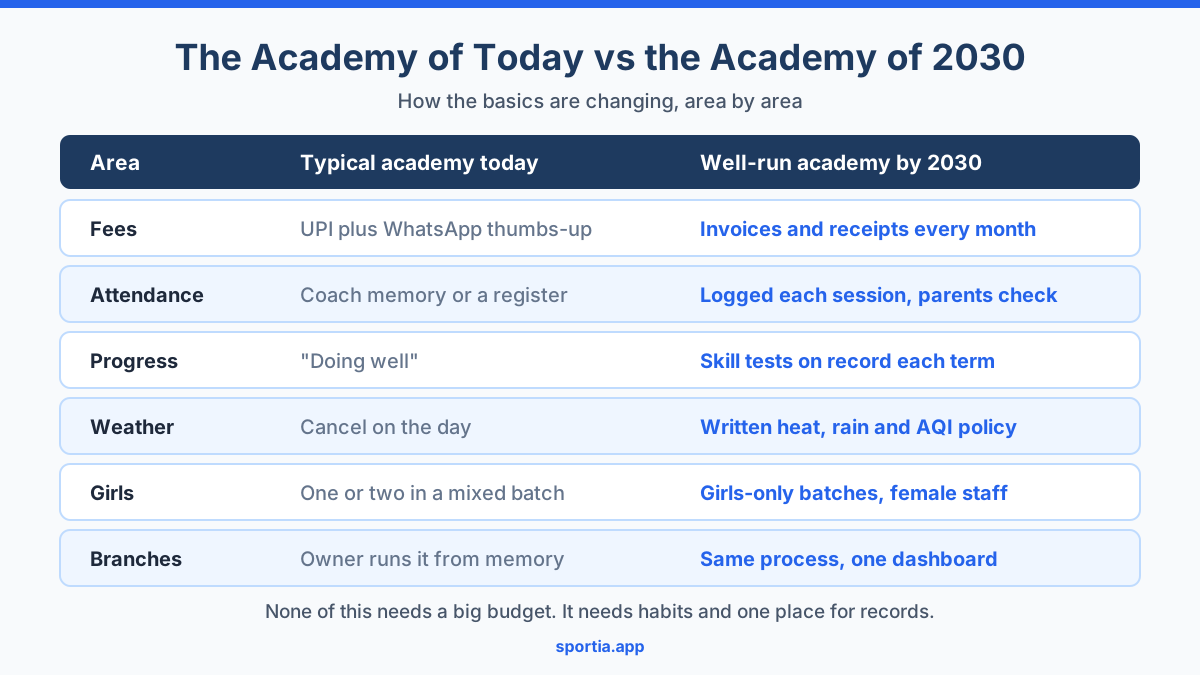
Put the seven shifts together and a clear picture appears. The academy that does well in 2030 is not the one with the fanciest equipment. It is the one with steady systems:
- Fees are invoiced and collected the same way every month, with receipts.
- Attendance is recorded every session, and parents can check it.
- Each athlete has a few skill tests on record, repeated each term.
- There is a written weather and safety policy.
- Girls' batches and female staff are normal, not an experiment.
- Every branch runs on the same process, and the owner sees them all in one place.
None of this needs a large budget. It needs habits, and usually one place to keep the records. Tools like Sportia bring fees, QR attendance, progress tests and a parent login together, and show every branch on one dashboard.
A Twelve-Month Plan for Sports Academy Trends in India
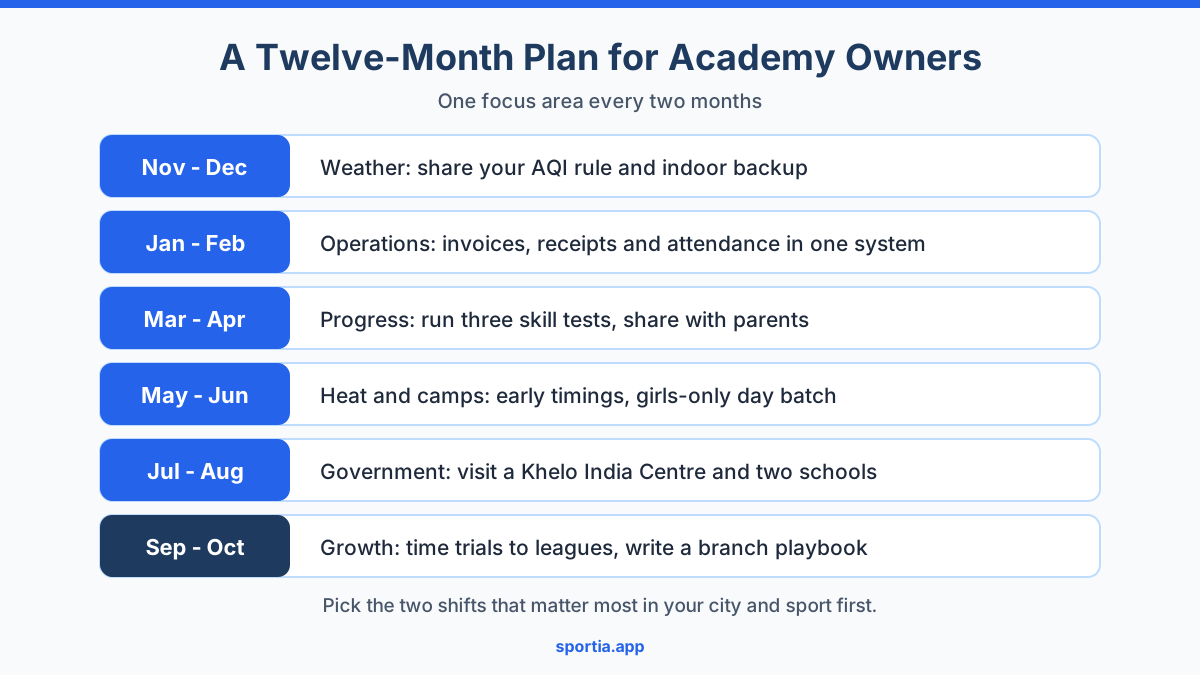
You do not need to act on all seven shifts at once. Spread them across the year:
| When | Focus | First step |
|---|---|---|
| November - December | Weather and pollution | Write and share your AQI and indoor backup rule |
| January - February | Professional operations | Move invoices, receipts and attendance to one system |
| March - April | Progress data | Run three skill tests and share results with parents |
| May - June | Heat and summer camps | Shift timings early and launch a girls-only day batch |
| July - August | Government links | Visit the nearest Khelo India Centre and two schools |
| September - October | Leagues and growth | Time trial drives to league seasons and write your branch playbook |
Frequently Asked Questions
What are the biggest sports academy trends in India right now?
There are seven big ones. They are higher parent expectations, more girls in sport, leagues beyond cricket, cheap data tools, weather disruption, government programmes and multi-branch chains. Each one changes how academies run fees, batches and communication.
Is the sports academy industry in India growing?
Yes. A Deloitte and Google report projects the wider Indian sports market to reach about $130 billion by 2030. The government has also approved Rs 36,441 crore for Khelo India and federation support from 2026-27 to 2030-31.
What is the future of sports academies in India?
The future favours academies with steady systems: clear fees, recorded attendance, regular skill tests and good parent communication. Small academies can compete with chains if they run these basics well.
How can a small academy compete with Khelo India Centres?
Offer what a free centre often cannot: smaller batches, flexible timings, closer contact with parents and regular progress updates. Some academies also partner with schools or government programmes rather than competing head on.
Do grassroots academies need wearables?
Most do not. For young athletes, simple skill tests repeated each term are more useful than device data. Wearables make sense for older competitive groups where training load really matters.
Build an Academy That Is Ready for the Next Five Years
The next five years will reward academies that run like small, well-organised businesses. You do not need to chase every trend. Pick the two shifts that affect your city and sport most, and act on them before your competitors do.
If scattered records hold you back, try Sportia free for 14 days. See how fees, attendance and progress look in one place.