
Supplements for Young Athletes in India: What They Need and What They Do Not
Walk into any gym store in Pune or Ludhiana and you will see it. A parent holds a 2 kg tub of whey, and a 12-year-old cricketer stands beside them. Someone at the academy said protein builds muscle, so the tub goes into the cart. It costs more than a month of coaching fees.
This guide is about supplements for young athletes in India. It covers what children who train hard actually need, and what is mostly expensive marketing. The short version is simple. Most young athletes need better meals, a blood test and more sleep, and they rarely need a powder. A few do need a supplement, but only after a doctor finds a real gap.
If you are a coach, this matters to you too. Parents ask you before they ask anyone else. What you say in a 30-second chat after practice can shape what a child swallows for years.
The Supplement Aisle Problem: Why Parents of 12-Year-Olds Buy Whey
Parents buy supplements for young athletes for three reasons. They want their child to get stronger, they worry the home diet is not enough, and they see older players posting about protein shakes. None of these reasons is foolish, but the product is usually the wrong answer.
Here is what the marketing leaves out. A growing child who eats three proper meals and two snacks usually gets enough protein already. Supplement labels are written for adults, and the tubs are sized for adults. And the industry in India has a quality problem that most parents never hear about.
In 2024, doctors published a study in the journal Medicine after testing 36 protein supplements sold in India. Close to 70 percent did not contain the protein promised on the label, and some held far less. About 14 percent contained aflatoxins, a toxin made by fungi, and around 8 percent carried pesticide traces. So the tub on the shelf may not even be what it says.
Food First: What a Young Indian Athlete Gets From the Kitchen
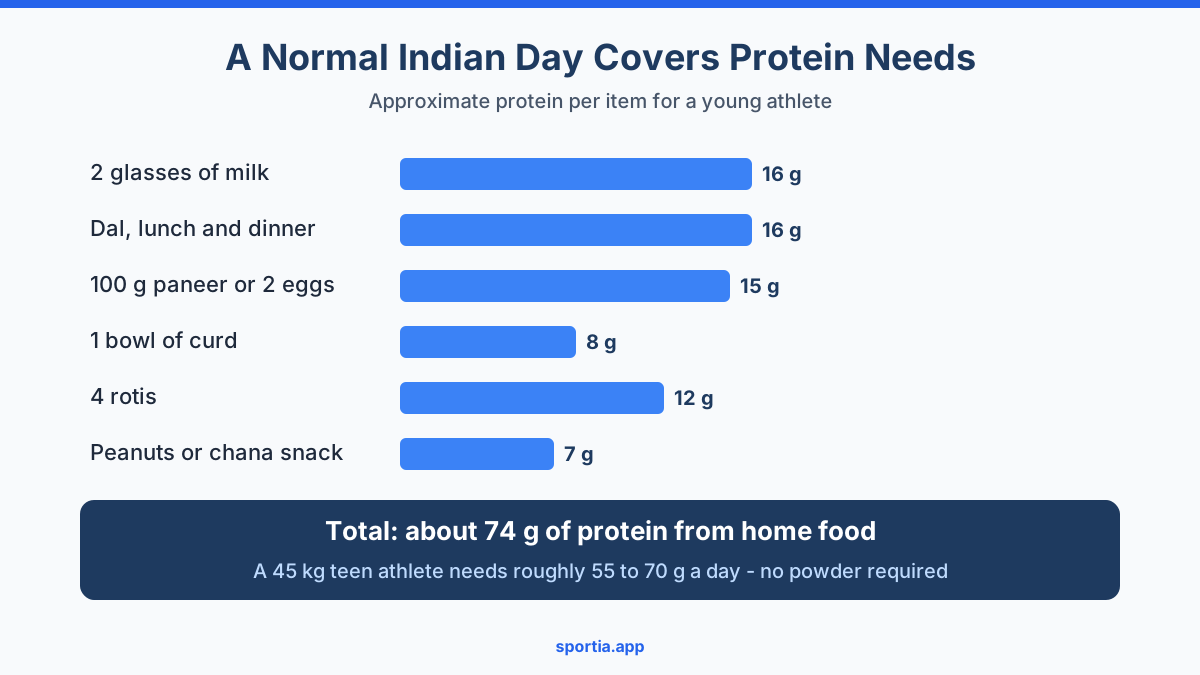
A common guide for active teenagers is about 1.2 to 1.5 grams of protein for every kilo of body weight each day. Take a 14-year-old footballer who weighs 45 kg. That child needs roughly 55 to 70 grams of protein a day.
Now look at a normal Indian day of eating:
- Two glasses of milk: about 16 grams
- One katori of dal at lunch and dinner: about 14 to 18 grams
- 100 grams of paneer or two eggs: about 12 to 18 grams
- One bowl of curd: about 8 grams
- Four rotis: about 12 grams
- A handful of peanuts or chana as a snack: about 7 grams
That adds up to 70 to 80 grams with no powder at all. And 100 grams of paneer costs roughly Rs 45, whereas one scoop of a branded whey costs Rs 80 to 150.
The real gap is usually timing, not total protein. Many children skip breakfast, train at 6 AM on an empty stomach, and then eat little until lunch at school. A banana and a glass of milk before practice, plus curd rice or poha after it, fixes more than any shake. For meal ideas, see our guide to protein-rich Indian foods for young athletes.
The Deficiencies That Are Genuinely Common in India
This is where the story changes. Indian children are often short of a few specific nutrients, and these shortages affect performance. They are not solved by protein, so a tub of whey can hide the real problem.
Iron
Anaemia is widespread among Indian teenagers. The National Family Health Survey (NFHS-5) found that about 59 percent of girls aged 15 to 19 were anaemic. Boys are affected too, though less often. Low iron means the blood carries less oxygen, so a child feels tired, breathless and slow to recover. Coaches often read this as laziness, but it is not.
Girls who have started their periods and train hard are at the highest risk. Vegetarian athletes are also at higher risk, because iron from plants is harder to absorb. Many schools already run the weekly iron and folic acid programme under Anemia Mukt Bharat. Parents should know whether their child is on it.
Vitamin D
It sounds strange in a sunny country, but vitamin D is often low. The Comprehensive National Nutrition Survey (CNNS, 2016 to 2018) found roughly 24 percent of adolescents were deficient. Children who train indoors, wear full kit, or train only before sunrise get little sun on their skin. Vitamin D matters for bones, so a shortage raises the risk of stress fractures in runners and fast bowlers.
Vitamin B12
The same survey found about 31 percent of adolescents were short of B12. It is found mainly in animal foods, so children from vegetarian families face the most risk. Milk and curd help, but they may not be enough. Low B12 causes tiredness and poor focus, and both can look like a motivation problem on the ground. Our vegetarian diet plan for Indian athletes explains how to cover these gaps through food.
A test-confirmed iron, vitamin D or B12 supplement is the one kind of supplement most young Indian athletes might genuinely need. It is also the kind parents buy least often.
Protein Powder for Teenagers: When It Is Reasonable
Protein powder is not poison. It is simply food in a different form, and sometimes it is useful. The question is whether a particular child needs it.
A powder can make sense in a few cases:
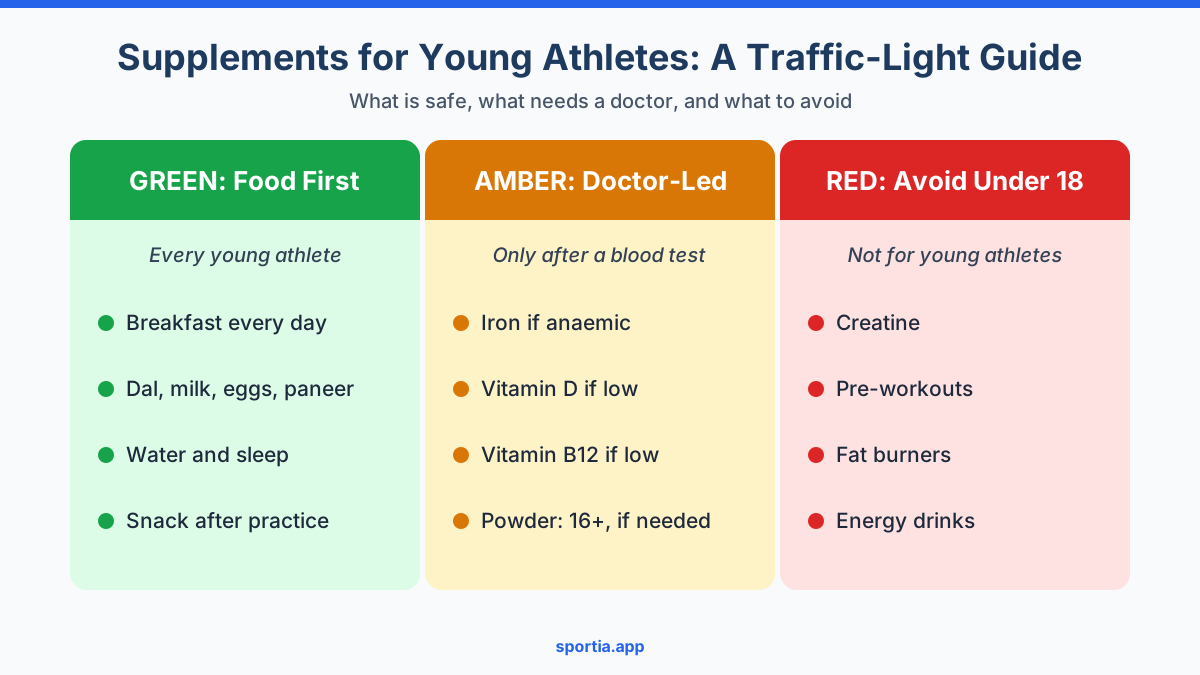
- An older teenager, say 16 or 17, training twice a day at a state or national level
- A child with a very small appetite who cannot eat enough after evening practice
- A vegetarian athlete who does not eat paneer, eggs or soy, and cannot reach the daily target
- A dietitian has checked the full diet and found a clear shortfall
Protein powder is wasted money in these cases:
- A child under 14 who eats regular home meals
- An athlete who trains three or four times a week for an hour
- A family hoping the powder will add muscle quickly, because muscle growth in children follows age and puberty
- Anyone using a shake to replace a missed meal every day
If a powder is used, choose a plain whey or a simple plant protein without added herbs or "fat burner" blends. Look for a brand that has its batches tested by an independent lab, and check the FSSAI licence on the pack. Keep it to one serving a day.
Creatine, Pre-Workouts and Fat Burners: Not for Under-18s
This section is short, because the answer is clear. The American Academy of Pediatrics advises that people under 18 should not take creatine. The reason is that nobody has properly studied its effect on growing bodies, and product quality is uneven.
Pre-workout powders are worse. Most rely on heavy caffeine, often 200 to 300 mg a scoop, which is about three cups of strong coffee. In a 13-year-old this can cause a racing heart, anxiety and poor sleep. Fat burners and "mass gainers" with herbal blends carry the same risk, plus unknown ingredients.
Energy drinks belong in the same group. A child who needs a can of caffeine to get through practice is short of sleep or food, so fix that instead.
Contamination and Doping Risk for Athletes Heading to State Level
This is the risk families least expect. India has reported some of the highest numbers of doping cases in the world in recent years. Several Indian athletes have argued that a contaminated supplement caused their positive test, and in some cases the panel accepted it. They still served bans.
The rule is called strict liability. Under the World Anti-Doping Code, the athlete is responsible for anything found in their body, however it got there. "I did not know it was in my protein" does not end the case.
A 15-year-old playing district cricket is unlikely to be tested. A 17-year-old at a junior national meet could be. Once a child competes at state level and above, every supplement becomes a career risk. The National Anti Doping Agency (NADA India) has warned athletes about supplements for this reason.
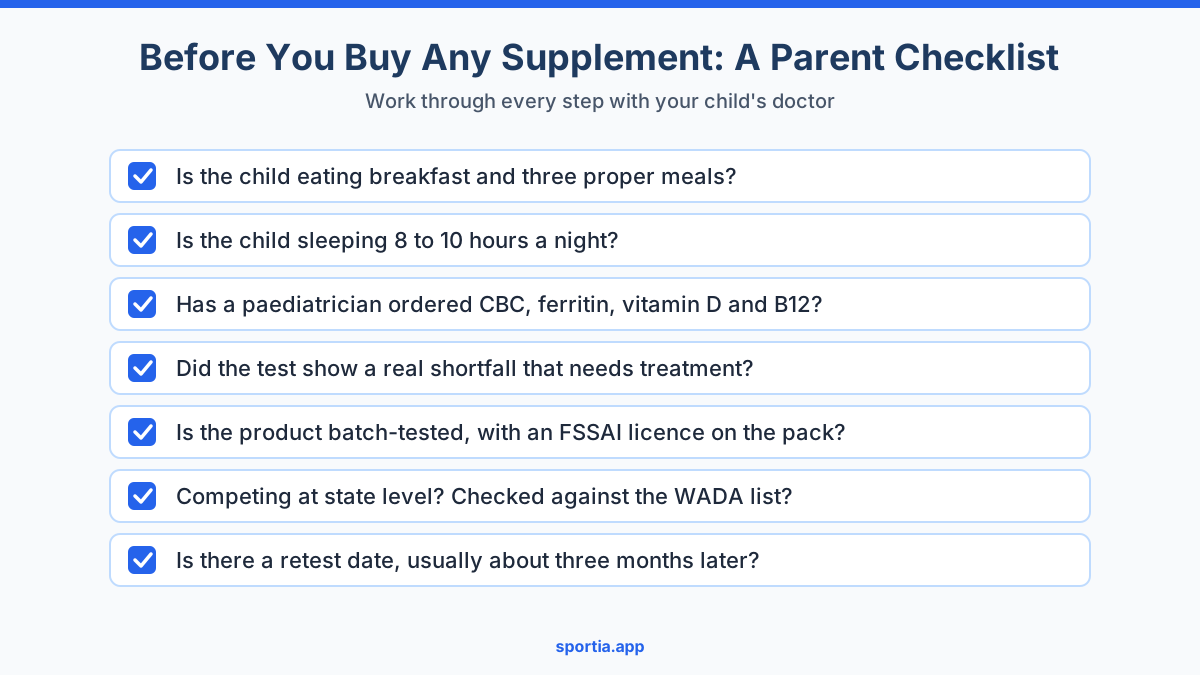
For athletes at this level, follow three rules:
- Use nothing that is not needed and prescribed
- Choose only batch-tested products, and keep the bill and the batch number
- Check every medicine and supplement against the WADA prohibited list before use
Get Blood Work Done Before Buying Anything
This is the single most useful piece of advice in this guide. Before a family spends Rs 3,000 on a tub, they should spend a similar amount on a blood test. A paediatrician can order a basic panel that shows what is actually missing.
A sensible panel for a young athlete who seems tired or keeps getting injured includes:
- Complete blood count and haemoglobin: checks for anaemia
- Serum ferritin: shows iron stores, which can be low before haemoglobin falls
- 25-OH vitamin D: the standard vitamin D test
- Vitamin B12: especially for vegetarian athletes
In most Indian cities this costs roughly Rs 1,500 to 3,000 at a good lab. If the results are normal, the family saves money on supplements they never needed. If something is low, the doctor prescribes the right dose for the right length of time. Then the child gets retested, usually after about three months.
What Coaches Should and Should Not Recommend
Coaches carry real authority with families. That is a strength, but it also means a careless tip can do harm. Here is a sensible line to hold.
Coaches can safely:
- Talk about meal timing around training, such as a snack before an early session
- Encourage water, sleep and regular home meals
- Notice warning signs like constant tiredness, pale skin or repeated injuries
- Suggest the family see a paediatrician for a blood test when those signs appear
Coaches should not:
- Recommend a brand, a dose or a product to a child
- Sell supplements at the academy, because it creates a conflict of interest
- Suggest creatine, pre-workouts or fat burners to anyone under 18
- Tell an athlete heading to state level that a product is "safe" without proof of testing
A written academy policy helps. Two lines in your parent handbook are enough. Say that the academy does not recommend supplements for under-18s, and that any concerns go to a doctor. This protects the children and the coach as well. For match-day eating, point families to our guide on pre-match and post-match nutrition.
Spotting the Signs Early With Wellness Tracking
The children who most need a blood test are often the quiet ones. They do not complain, and they just slow down over weeks. A coach with 60 athletes across four batches can easily miss this.
Simple tracking helps. When athletes record their sleep hours, energy level, mood and muscle soreness after training, patterns show up early. A girl whose energy has been "low" for three weeks is a prompt for a conversation with her parents. In Sportia, athletes can log these wellness details in their training log. Coaches can then see the trends across a batch, rather than relying on memory.
Frequently Asked Questions
Do young athletes need supplements?
Most do not. A young athlete who eats regular home meals with dal, milk, curd, eggs or paneer usually gets enough protein. The exceptions are confirmed shortages of iron, vitamin D or B12, which a doctor should treat after a blood test.
Is protein powder safe for a 13-year-old?
It is rarely needed at that age, and food is cheaper and safer. Many protein products sold in India do not match their labels. If a doctor or dietitian finds a real shortfall, a plain, batch-tested powder in a small daily serving is the cautious choice.
What is the best supplement for young athletes in India?
There is no single best product. For many Indian children, the most useful supplement is iron, vitamin D or B12, and only when a blood test shows it is low. The dose should come from a paediatrician, not from a gym store.
Can a young athlete take creatine?
The American Academy of Pediatrics advises against creatine for anyone under 18. Its effect on growing bodies has not been properly studied. Pre-workouts and fat burners should also be avoided at this age.
Can a supplement cause a failed dope test?
Yes. Contaminated supplements have led to bans for Indian athletes, because the athlete is responsible for anything found in their body. Athletes competing at state level and above should avoid unnecessary supplements and use only batch-tested products.
The Bottom Line
The best supplement for a young athlete in India is usually a proper breakfast, a full night of sleep and a blood test. Fix meal timing first, then test for iron, vitamin D and B12. Use only what a doctor prescribes, and stay away from powders built for adult gym-goers.
Coaches cannot run every child's diet, but they can notice who is struggling and send them to the right person. If you want a clearer view of how your athletes are sleeping, recovering and feeling across every batch, try Sportia free for 14 days and track wellness alongside training.