
Swimming Academy Management Software: What Pool-Based Academies Actually Need
A swimming academy can run for years on a register, a fee notebook and a WhatsApp group. Then one April, 90 new children sign up in two weeks, the pool gives you the same four lanes as before, and the system falls apart. Parents ask which batch their child is in. Coaches find 14 beginners in a lane meant for 8. Someone forgets to collect the medical form from a child with asthma.
This guide explains what swimming academy management software needs to handle, and why pool-based academies outgrow generic tools faster than a cricket or badminton academy. It covers lane capacity, learn-to-swim levels, the summer spike, package pricing and safety records. It ends with a comparison table and a checklist you can take into any software demo.
Why Swimming Academies Outgrow Generic Tools Faster
Most sports academies sell a monthly batch. A child joins the 5 PM batch, pays Rs 2,500 and turns up three times a week. A spreadsheet can handle that for a long time.
Swimming is different in three ways. First, your real limit is water, not coaches, because you rent lanes by the hour and cannot add more when demand jumps. Second, children move between levels every few weeks, so batches change far more often than in other sports. Third, demand is wildly seasonal, because most Indian families think of swimming as a summer activity.
Put those together and the admin load grows faster than the academy. A 60-swimmer academy in November can become a 200-swimmer academy in May, with the same owner and the same phone.
Lane Capacity: The Scheduling Limit Other Sports Do Not Have
A cricket academy with a full net can still squeeze two extra children into fielding drills. A swimming coach cannot do that safely. Every child in the water needs space and a clear line of sight from the coach.
So the useful unit for planning is the lane-hour, not the batch. Count how many lanes you get, for how many hours, and how many swimmers of each level fit in one lane.
Ratios from swim coaching bodies abroad give a sensible starting point. Australian coaching guidance suggests about 1 coach to 10 young beginners, with smaller groups for preschoolers in shallow water. Squads of competent swimmers can be much larger. Indian pools rarely publish limits, so you set your own, write them down and stick to them.
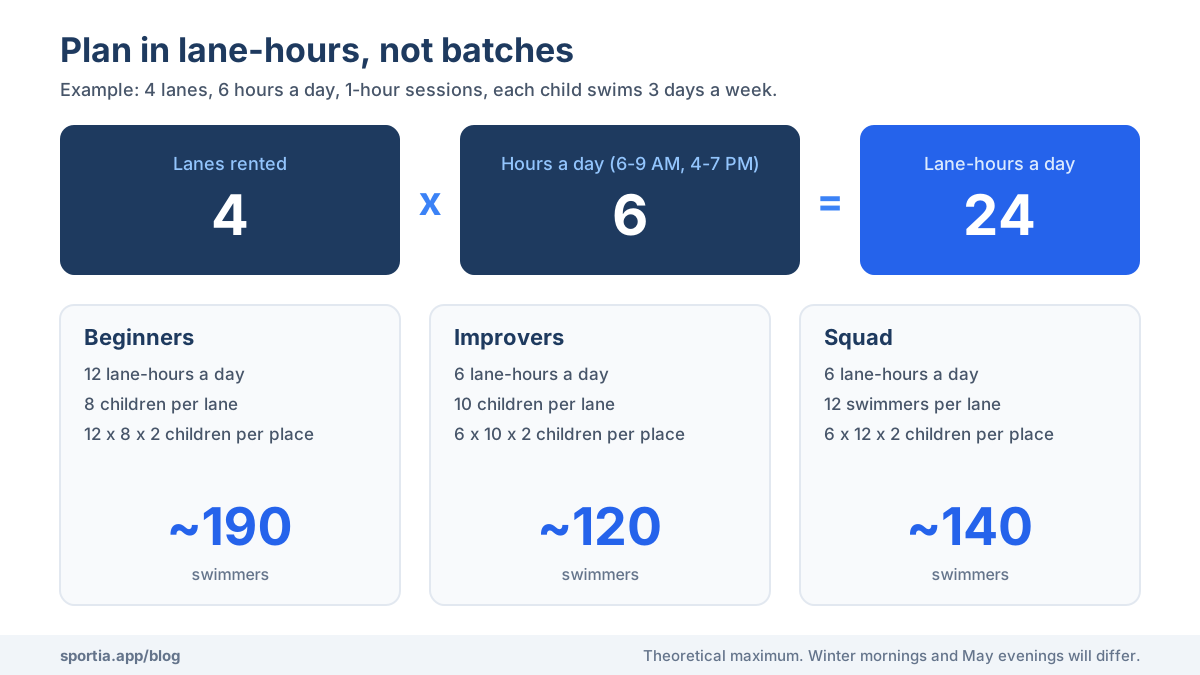
A worked example in Pune
Take an academy that rents 4 lanes of a municipal pool from 6 AM to 9 AM and 4 PM to 7 PM, six days a week. That is 6 hours a day, so 24 lane-hours daily.
- A beginner lane holds about 8 children with one coach.
- An improver lane holds about 10.
- A squad lane of confident swimmers holds about 12.
- Each session lasts one hour.
- Each child swims three days a week, so each place in the timetable serves two children across the week.
Say half the lane-hours go to beginners and the rest are split evenly between improvers and squad. In theory, the academy can then carry roughly 190 beginners, 120 improvers and 140 squad swimmers. In practice, early morning beginner slots stay empty in winter, and evening slots overflow in May. Your software should show you which lanes are full right now, not just how many children you have in total.
Learn-to-Swim Levels and How Swimmers Move Between Them
Most academies use a ladder of four to six levels. The names vary, but the steps look similar:
- Water confidence: entering the water, blowing bubbles and floating with support.
- Float and glide: front and back float, glide and kick without help.
- Basic strokes: freestyle and backstroke over one width, then one length.
- Stroke development: breathing technique, breaststroke and deep water skills.
- Endurance and pre-squad: 100 to 200 metres continuously, turns and dives.
- Squad: timed sets, all four strokes and preparation for district meets.
The problem is not the ladder. It is the paperwork every time a child climbs it. Moving a child up means changing their batch, often their timing, sometimes their fee, and always telling the parent. Do that 30 times a month by WhatsApp and something will slip.
A good rule is to assess every swimmer at fixed points, such as every eight weeks, rather than whenever a coach remembers. Record the result against the child, then move them in one step so the batch list, the attendance register and the parent all update together.
For squad swimmers, times matter more than levels. Record a swimmer's best time in each event, such as 50m freestyle, so parents can see progress and you can pick children for district or state meets organised under your state swimming association.
The Summer Spike: Handling Three Times the Enrollments in April and May
Across most of India, swimming demand peaks the week schools close. Summer fee listings for 2026 put group batches at roughly Rs 1,500 to Rs 3,500 a month in Pune and Rs 3,000 to Rs 7,500 in Mumbai. Short summer camps of 15 to 20 sessions are also common.
The spike creates four problems at once:
- Enquiries pile up across calls, Instagram messages and walk-ins, and nobody follows up.
- Batches overfill because two staff members confirm the last place to two families.
- Fees get messy as children join on random dates and pay for different camp lengths.
- Everyone leaves in June, and you lose them unless you offer a clear next step.
The fix starts in February. Decide your summer lane plan, set a hard cap on each batch and put every enquiry into one list. Then plan the conversion step, because a summer camp child who reaches level 3 is your best candidate for a year-round batch. The guide to converting summer camp students into year-round athletes covers that step in detail.
Packages and Session Quotas for Lesson-Based Pricing
Many swimming academies already think in sessions, not months. A parent pays Rs 3,600 for 12 lessons, or Rs 5,500 for a 20-session summer camp. That suits families, because children miss lessons for exams, illness and travel.
The trouble is tracking it. When a child has used 9 of 12 sessions, someone has to notice and tell the parent before the package runs out. In a notebook, that rarely happens on time, so children keep swimming on an expired package and the academy chases the money later.
In Sportia, a package sets the fee, the number of sessions and how many days or months it stays valid. A session is used only when the swimmer is marked present or late, so a missed lesson does not eat into the quota. When a swimmer checks in by QR with three sessions left, the parent gets a renewal reminder by email, and on WhatsApp if you have set it up. QR check-in is refused once a package expires or runs out, so nobody keeps swimming on an old package by accident.
For more on designing packages, read the guide to training packages with session quotas.
Safety Records: Medical Details, Swim Status and Guardian Contacts
India loses tens of thousands of people to drowning each year, and children make up a large share. Official figures from the NCRB put drowning deaths at about 38,500 in 2022. That is why swimming parents care about safety records more than parents in almost any other sport.
At minimum, every swimmer's record should hold:
- Medical conditions such as asthma, epilepsy, ear infections or heart conditions.
- Allergies, including reactions to chlorine.
- Two emergency contacts with phone numbers that actually work.
- Current level, so a lifeguard or new coach knows who cannot handle deep water.
- Parent consent for children under 18.
The key test is speed. If a child has a seizure in the water at 6:15 AM, can the coach on deck find the parent's number in under a minute? A paper file in the office does not pass that test. A phone with the right record open does.
Sportia includes a swimming template for athlete profiles, with fields for asthma, epilepsy, ear conditions and blood group, next to stroke, level and best-time fields. You can also upload a medical fitness certificate to each swimmer's documents, with an expiry date. Parents can be linked to their child's account, and the public registration form asks for parent details when the swimmer is under 18.
Spreadsheet vs Generic Class App vs Sports Academy Software
Owners usually compare three options. Global swim school platforms also exist, but most are priced in dollars or pounds, so check INR billing, GST invoices and Indian payment support before you sign up for one.
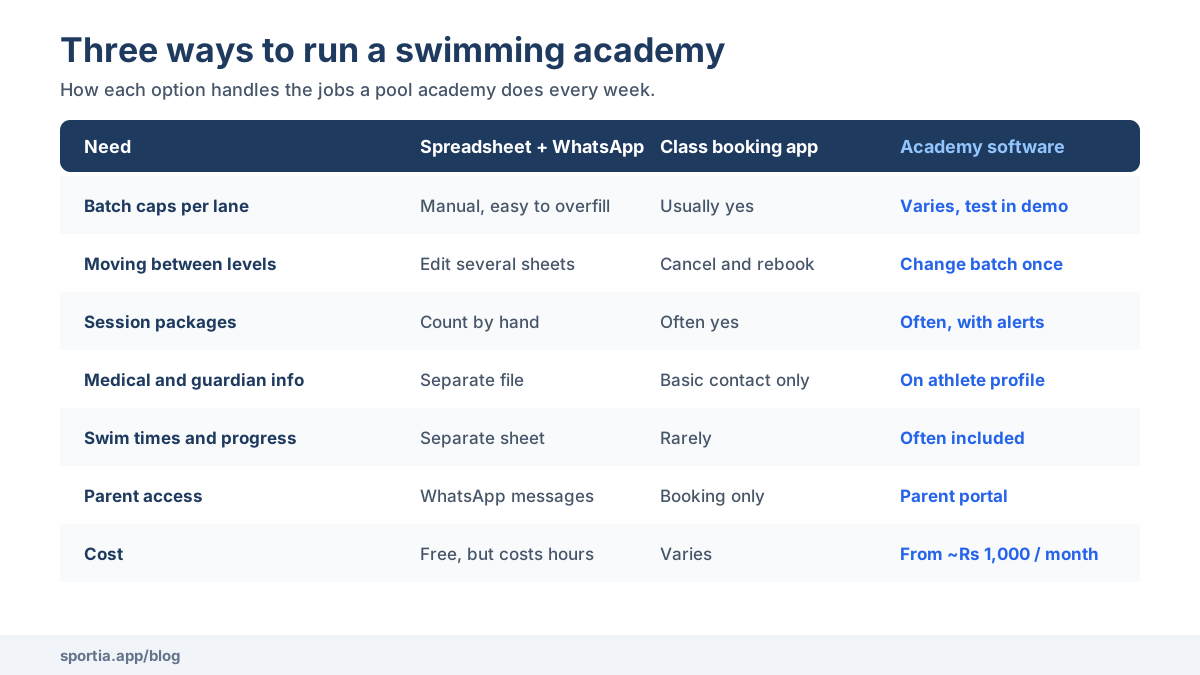
| Need | Spreadsheet + WhatsApp | Generic class booking app | Sports academy software |
|---|---|---|---|
| Batch caps per lane | Manual, easy to overfill | Usually yes | Varies, so test it in the demo |
| Moving swimmers between levels | Edit several sheets | Cancel and rebook | Change the batch once |
| Session packages | Count by hand | Often yes | Yes, often with alerts |
| Medical and guardian records | Separate file | Basic contact only | On the athlete profile |
| Swim times and progress | Separate sheet | Rarely | Often included |
| Parent access | WhatsApp messages | Booking only | Parent portal |
| Cost | Free, but costs hours | Varies | From about Rs 1,000 a month |
A spreadsheet is fine for a solo coach with 25 swimmers and one lane. Once you cross about 60 swimmers, or have more than one coach, the hours you spend fixing it cost more than software. The comparison of Excel and academy software shows where that line usually falls.
What to Check in a Demo Before You Choose
Do not judge software on its feature list. Bring your own messiest week and make the vendor walk through it. These questions expose weak tools quickly.
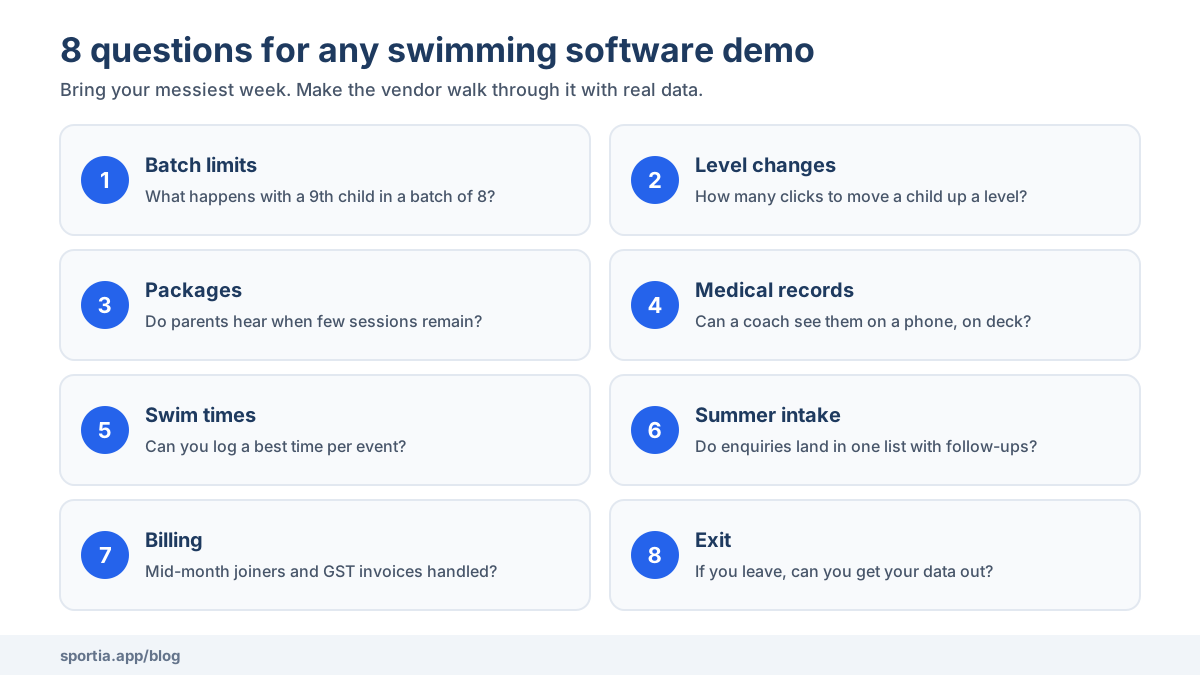
- Batch limits: What happens when you try to add a ninth child to a batch capped at eight?
- Level changes: How many clicks does it take to move a child from level 2 to level 3?
- Packages: Does the parent hear when only a few sessions remain?
- Medical records: Can a coach see a child's conditions and emergency contact on a phone, on deck?
- Swim times: Can you log a best time per event and show progress to the parent?
- Summer intake: Can enquiries from your website land in one list with follow-up dates?
- Billing: Does it handle children who join mid-month, and produce GST invoices if you need them?
- Exit: If you leave, can you get your data out?
Run any trial with real data from one batch, not demo data. Two weeks with 20 real swimmers tells you more than a polished sales call.
Frequently Asked Questions
What is swimming academy management software?
It is software that runs the daily admin of a swim school in one place. That usually means batches, attendance, fees, session packages, parent contact and safety records. Better tools also track levels and swim times.
How many swimmers should one coach teach in a lane?
For young beginners, about 8 to 10 per coach is a common guide, with smaller groups for preschoolers. Confident squad swimmers can train in larger groups. Set your own written limit based on pool depth, lane width and the age of your swimmers.
How much do swimming classes cost in India?
Group classes usually cost between Rs 1,500 and Rs 7,500 a month in 2026, depending on the city and the pool. Private lessons cost much more. Summer camps are often priced per camp of 15 to 20 sessions.
Should a swimming academy charge monthly or per session?
Session packages suit learn-to-swim children, who miss lessons often and progress at different speeds. Monthly fees suit squad swimmers who train on a fixed timetable. Many academies use packages for beginners and monthly fees for squads.
How can you keep summer swimming students after the camp ends?
Assess every child in the last week of camp and give parents a clear next level and batch. Offer a year-round slot at a convenient time before school reopens. Children who reach a visible milestone are far more likely to continue.
Run Your Pool Like a System, Not a Scramble
A swimming academy lives or dies on how well it uses limited water. When lanes, levels, packages and safety records sit in one place, the summer spike becomes an opportunity rather than a crisis. If you are planning your next intake, read the guide on starting a swimming academy in India for setup costs and pool agreements. When you are ready, try Sportia for your swimming academy with a 14-day free trial, and set up one real batch before you decide.