
10 Tennis Drills for Beginners to Build Strokes and Footwork
Every July, Wimbledon fills screens across India, and a fresh wave of kids asks to play tennis. Coaches then face the same challenge: how do you turn an excited beginner into a player with real strokes and footwork?
The answer is a focused set of tennis drills for beginners, run in the right order. Rallying for fun feels good, but it rarely builds skill, because it gives players no clear target. Focused drills give young players the repetitions they need to groove a stroke and move well.
This guide gives you 10 beginner drills that work for ages 7 to 14, and each one is simple to coach and needs little space. At the end, you get a ready-to-run 45-minute session plan you can use this week.
Start with the right ball and court size
Before the drills, one choice shapes everything: the ball. Beginners struggle with a standard yellow ball because it bounces high and fast, while slower stage balls give kids more time to move and swing.
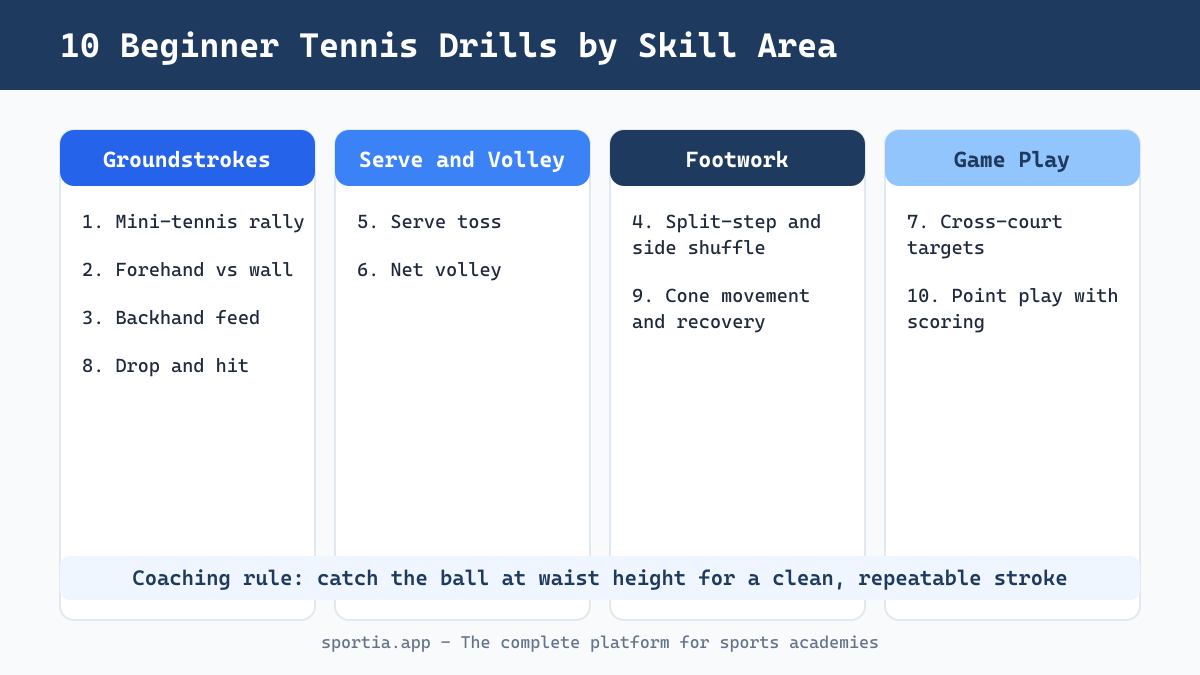
The AITA and ITF back a simple stage-ball path that is used across Indian academies:
- Red ball (ages 5 to 8): Slowest, largest bounce, played on a mini court.
- Orange ball (ages 8 to 10): A bigger court and more control.
- Green ball (ages 10 to 12): Full court with a slightly softer ball.
- Yellow ball (12 and up): The standard ball and full court.
Match the ball to the age, not the ego. A child who rallies happily with a red ball learns far faster than one who flails at a fast yellow one.
Groundstroke drills
Groundstrokes are the heart of tennis, and a beginner who owns a steady forehand and backhand can play real points. These four drills build that foundation.
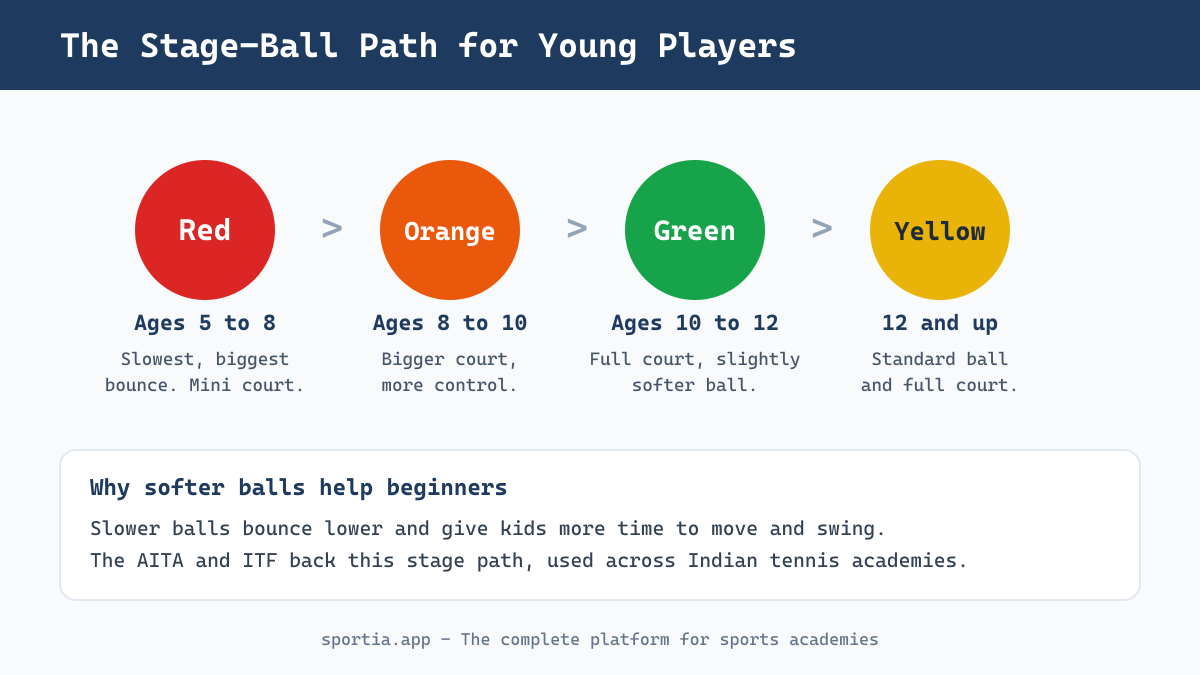
1. Mini-tennis rallying
Players stand inside the service boxes and rally with short, soft swings, aiming for control and placement rather than power. This teaches touch and keeps the ball in play, which builds instant confidence.
Cue them to watch the ball onto the strings and keep a relaxed grip, then count the rally length as a team target. A group aiming for 10 shots in a row stays focused and genuinely enjoys the challenge.
2. Forehand groundstroke against a wall
A wall is the most patient partner in tennis, because players hit forehands against it and reset after each bounce. The ball comes back every time, so they get many repetitions fast.
Teach the basics here: turn the shoulders, swing low to high, and finish over the shoulder. A wall is perfect for solo practice when court time is tight or a coach is busy elsewhere.
3. Backhand groundstroke feeding drill
The coach gently feeds balls to the player's backhand side, and the player hits and recovers to the middle. Feed at a steady pace so each repetition stays clean and controlled.
Beginners often avoid the backhand, so make it a rule to practice it as much as the forehand. A two-handed backhand suits most young players and gives them extra control.
8. Drop-and-hit consistency drill
The player drops the ball themselves, lets it bounce, and hits a controlled stroke to a target, with no feeder needed. It is the simplest way to groove a swing on their own.
Use this drill to fix form, because the player controls the drop and can slow right down. That lets them focus on one thing at a time, like the follow-through or the footwork.
Serve and volley drills
Serving and volleying feel hard to beginners, so coaches often skip them, which is a mistake. Simple versions of both build well-rounded players from an early stage.
5. Serve toss and contact practice
The serve starts with the toss, so have players practice the toss alone first. They should aim to place the ball just in front and above the hitting shoulder, because a steady toss fixes most beginner serve problems.
Once the toss is reliable, add a slow contact from the ready "throwing" position rather than the full motion. Build the serve in small pieces, not all at once, and it will hold up under pressure.
6. Volley drill at the net
The player stands at the net while the coach feeds soft balls, and the player blocks them back with a short, firm punch. There is no big swing at the net, just a controlled block.
Cue a strong wrist and eyes fixed on the ball. Net play teaches quick reactions and soft hands, and it makes practice fun and fast-moving for the whole group.
Footwork drills
Great coaches say the three keys to tennis are footwork, footwork, and footwork, because good feet get a player to the ball on time. These two drills build that movement.
4. Split-step and side-shuffle footwork
The split-step is a small hop as the opponent hits, and it gets a player ready to move in any direction. Practice it with a simple call: the coach points left or right, and the player split-steps then shuffles that way.
Add side shuffles between two cones to build speed and balance. Good footwork lets a player meet the ball at waist height every time, which is the real secret to a clean, repeatable stroke.
9. Cone-based movement and recovery drill
Place cones around the court, and have the player touch a cone, shadow-swing, then recover to the middle. This copies the move-hit-recover pattern of a real point.
Recovery is the step beginners always forget, so teach them to move back to the center after every shot. You can build the same quickness with our guide to speed and agility training for young athletes .
Game-play drills
Drills only matter if they show up in a match, so these two drills bridge practice and play. They keep sessions exciting at the same time.
7. Cross-court rally targets
Players rally only cross-court and aim for a target zone marked with cones. Cross-court is the safest and most common shot in tennis, so this drill carries real match value.
Set a team goal, like five shots into the zone, because targets turn a plain rally into a game with a clear aim. This sharpens accuracy without piling on pressure.
10. Point-play with simple scoring conditions
Finish with real points, but add a rule to teach a lesson. For example, every point must start with three cross-court shots before anyone can win it, which rewards control over wild winners.
Keep score to add excitement, and praise smart, safe shots more than lucky ones. This is where all the drills finally come together into real tennis.
How to structure a 45-minute beginner session
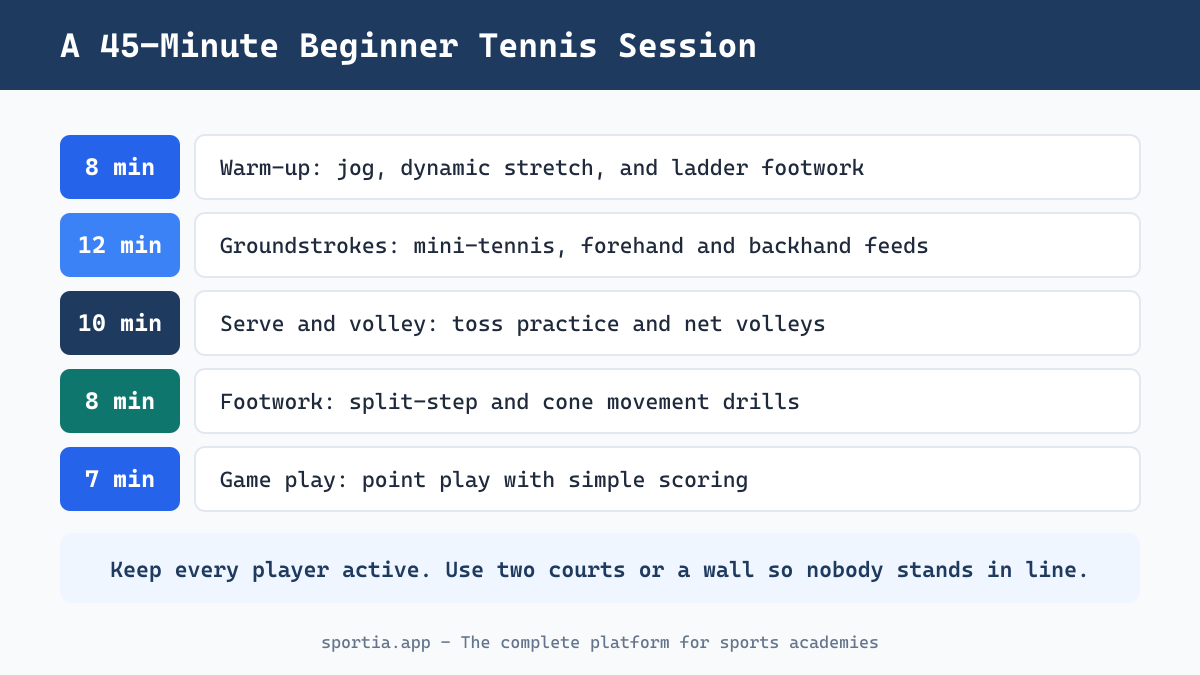
The order matters, so run drills from simple to complex and always end with a game. Here is a plan that works well for a group of 4 to 8 beginners.
- 8 minutes - Warm-up: A light jog, dynamic stretches, and ladder footwork.
- 12 minutes - Groundstrokes: Mini-tennis, plus forehand and backhand feeds.
- 10 minutes - Serve and volley: Toss practice and net volleys.
- 8 minutes - Footwork: Split-step and cone movement drills.
- 7 minutes - Game play: Point play with a simple scoring rule.
Two habits make this plan work. First, keep every player active by using two courts or a wall, so nobody waits in a long line. Second, demonstrate each drill briefly and then let players hit, because less talking and more repetition is the fastest route to skill.
Rotate the focus each week so one session leans on strokes while the next leans on footwork. This keeps training fresh and covers every skill over a month. If you also run other sports, our badminton drills for junior players follow the same build-up logic.
Save your drills and run better sessions
Once you have a set of drills that work, the next challenge is running them the same way across every coach and batch. That is where a system helps, because with Sportia you can save each drill in a coaching library, with steps, reps, and a short video.
You can then assign a drill plan to a batch so every coach runs the same session. New coaches get up to speed quickly, and your academy delivers a consistent standard. If you are just starting out, our guide on how to start a tennis academy in India covers the bigger picture.
Frequently Asked Questions
What are the best tennis drills for beginners?
The best beginner tennis drills are mini-tennis rallying, forehand and backhand feeds, serve toss practice, and net volleys. These cover the core skills, and adding footwork drills like the split-step, then finishing with point play, brings it all together.
At what age should kids start tennis?
Children can start tennis around age 5 or 6 using a red stage ball on a mini court. At this age, focus on fun, coordination, and basic strokes, then move to orange and green balls as they grow and improve.
How do I improve footwork in tennis?
Practice the split-step, side shuffles, and cone-based movement drills, because good footwork lets a player reach the ball at waist height for a clean stroke. Ladder drills in the warm-up also build speed and balance.
What tennis ball should a beginner use?
Beginners should use slower stage balls rather than the standard yellow ball. Red, orange, and green balls bounce lower and give kids more time to swing, which is why the AITA and ITF recommend this stage path by age and skill.
How long should a beginner tennis session be?
A beginner tennis session should last 45 to 60 minutes, because younger children lose focus after about an hour. Keep drills short, change activities often, and always finish with point play or a game.
How do I keep tennis practice fun for kids?
Use targets, team rally goals, and simple point-play games, and keep every player active with short lines or a wall. Praise effort and smart shots, and rotate the weekly focus to keep sessions fresh.
Turn beginners into real players
Skill in tennis is built one drill at a time. Match the ball to the age, run drills in the right order, and always end with a game. Do this every week, and your Wimbledon-inspired beginners will grow into confident players.
Want every coach to run the same proven sessions? Save these drills in Sportia's coaching library and assign them to your batches in a few clicks. Start a 14-day free trial and bring real structure to your tennis academy this season.