

Why Young Athletes Quit: The Dropout Problem and What Academies Can Do
Almost nobody quits an academy. They simply stop coming.
There is no resignation letter and no final conversation. A boy who came five days a week comes three. Then he misses a fortnight and nobody calls. Two months later his name is still on your roll. His fees have not been paid since June. Ask any academy owner why kids quit sports and most will say "studies". That is usually true, and it is also the least useful answer available, because it makes the loss sound like weather.
It is not weather. Youth sports dropout in India follows a pattern you can predict, see in your own attendance records, and change. This post covers when it happens and the six real causes. It also covers the warning signs that show up weeks early, and what the academies that keep their athletes do differently.
When Indian athletes drop out
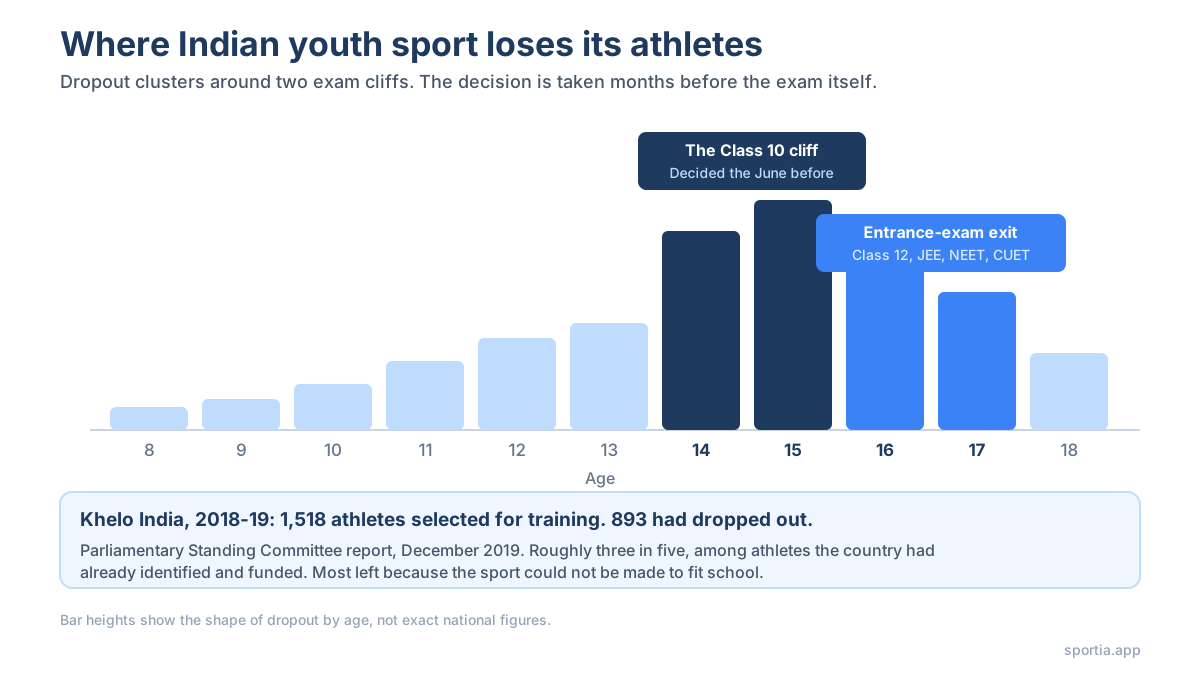
Around the world, the average child quits sport by about eleven, and studies put yearly dropout among 10 to 17 year olds at roughly a third. India follows the global curve but adds a cliff of its own.
Dropout here clusters around two moments:
- Ages 14 to 15, the Class 10 cliff. The single largest exit point. It is a family decision, made months before the exam, and it is almost never reversed.
- Ages 16 to 17, the entrance-exam exit. Class 12 plus JEE, NEET or CUET coaching. This one takes the athletes who survived the first cliff, including some good ones.
A smaller third exit comes at ages 11 to 12, when the child works out they will not be picked and nobody has given them a reason to stay anyway.
The scale is not a guess. Under Khelo India, 1,518 young athletes were selected for training in 2018-19. A Parliamentary Standing Committee report in December 2019 found that 893 of them had dropped out of their accredited academies. That is roughly three in five, among athletes the country had already identified as its best and funded. If national scholarship holders leave at that rate, your U14 batch is not immune.
The reason matters just as much, because most of them left when the sport could not be made to fit school.
The Class 10 cliff, and the paperwork almost no academy uses
Here is what actually happens. The board exams are in February and March. The choice to stop sport is made the June or July before. The school year starts, a tuition timetable arrives, and sport loses. By the time you notice the absence in November, the family had settled it five months earlier.
Most academies respond with a speech about balance. That rarely works, because the parent is not weighing values. They are weighing hours, and they have concluded there are not enough.
What works is solving the actual constraint. Three things do that:
A real reduced-load option, offered before they ask. Not "come when you can", which means never. A named board-year batch: one weekday evening and one weekend morning, at a lower fee, held for the exam year. Families accept a smaller commitment far more readily than they resume an abandoned one.
A pause with the place held. If a family needs three months off, let them freeze rather than leave. An athlete who has paused still belongs to the academy. One who has cancelled has to start over socially, and most will not.
The attendance certificate, handed over in December. This is the lever almost nobody pulls. CBSE asks for 75 percent school attendance to sit the boards, but allows up to 25 percent relief for students who play at national level, with papers to prove it. Schools must send shortage cases to the board in early January. If your athlete plays at that level, get the letters and certificates to the parent in December, because asking in March is too late. An academy that manages this paperwork becomes an ally in the exam year instead of a competitor for hours.
The wider talk with parents is covered in the guide to balancing studies and sports for Indian families, and it is worth sending to every Class 9 parent in June.
Early specialisation and burnout
The second cause is one that academies create themselves, usually with the best of intentions.
A promising nine-year-old gets moved to the advanced batch. Sessions go from three a week to six. A summer camp is added, then a tournament series. By twelve the child has trained more hours than many college athletes and has played only one sport for four years.
Two things follow. Overuse injuries rise sharply in single-sport children, and enjoyment falls. When researchers ask children why they stopped, the most common answer everywhere is that it stopped being fun. Not "I was not good enough". Not "too expensive". It stopped being fun.
Practical limits that protect the athlete and your roll:
- Under 12: three sessions a week is plenty. Six is a warning sign, not a badge.
- Keep one day a week completely free of your sport, and say so to parents.
- Do not schedule competition every month. A season needs an off-season.
- Let a child play a second sport without treating it as disloyalty.
Coaches rarely think of themselves as the cause. The post on coaching mistakes that drive athletes away goes through the others, including the ones that look like high standards.
The permanent bench, and what selection does to a twelve-year-old
Every academy has a squad and a rest, and the rest is where dropout lives.
Watch what a twelve-year-old actually experiences. The same nine names go to every tournament. The coach's attention follows those nine. The others do throwdowns, field for the batters, or wait. Nobody tells them they are out of the running, because nobody wants that talk, so they work it out over a season and leave quietly.
Three changes cost nothing:
- Rotate exposure below 14. Age-group squads should not harden before puberty, because growth timing alone changes the order. Give every athlete competitive minutes at some level.
- Give the non-selected a goal that is theirs. A personal best, a skill target, a role. An athlete with a goal that does not need selection has a reason to come on Tuesday.
- Say it out loud. "You are not in this squad, and here is what would change that by March." That is kinder than silence, and children take it far better than adults expect.
Parent pressure, cost, and the exits nobody announces
Two more causes rarely get named, because both are uncomfortable to raise.
Support versus expectation
A supportive parent asks whether the child enjoyed the session. An expectant parent asks what the score was. Children can tell the difference within a year, and the ones under pressure to justify the fees start dreading match days. Some of the most talented dropouts leave because the sport stopped being theirs.
Academies can shift this. Talk to parents about effort and attendance rather than results. Do not read out rankings at pickup time. Ban post-match analysis in the car, and say why. The guide to mental health for academy coaches covers the signals worth watching.
The quiet fee exit
Sports fees in India run from about Rs 800 a month in a tier-3 town to Rs 6,000 in a metro academy, and that is before kit, travel and entry fees. A family under strain almost never says "we cannot afford it". They say the child is busy with studies, and you believe them, because it is the easy answer for both sides.
You will not fix every case, but you can make the easier answer possible. Offer a three-month payment option, a sibling discount, or one or two quiet scholarships. A package with a set number of sessions also helps, because it is not an open monthly bill. Families who feel they can flex without being judged tend to stay.
The warning signs in your attendance data
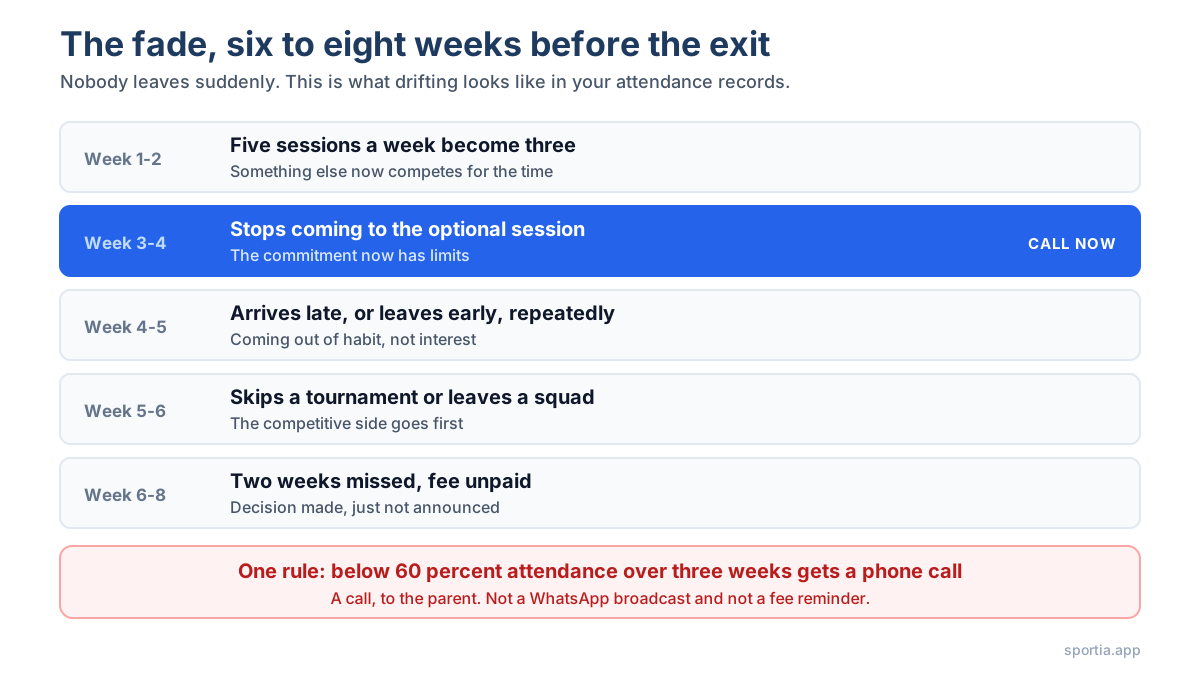
This is the part most academies miss, and it is the most fixable. Nobody leaves suddenly. The fade takes six to eight weeks, and it is visible if you look.
The signals, in the order they usually appear:
| Week | What you see | What it means |
|---|---|---|
| 1 to 2 | Drops from 5 sessions a week to 3 | Something else now competes for the time |
| 3 to 4 | Stops coming to the extra or optional session | The commitment now has limits |
| 4 to 5 | Attends but leaves early, or arrives late repeatedly | Coming out of habit, not interest |
| 5 to 6 | Skips a tournament or withdraws from a squad | The competitive side goes first |
| 6 to 8 | Two consecutive weeks missed, fee unpaid | The decision is made, just not announced |
Set one rule and you catch most of them: any athlete below 60 percent attendance over three weeks gets a phone call. Not a WhatsApp broadcast, not a fee reminder. A call, to the parent, asking how the child is doing.
Half those calls will surface something you can fix. A clashing tuition slot, a friend who left, or a coach the child quietly fears. A fee problem, or a small injury nobody mentioned. Calls made in week three save athletes. Calls made in week ten are exit interviews.
Doing this by hand across 150 athletes is where it collapses, which is the real argument for recording attendance properly. Platforms like Sportia track attendance per athlete per session, including check-ins at a batch other than their own. A drop from five days to three then shows up as a number, rather than a vague feeling that you have not seen someone in a while.
What retaining academies do differently
Compare two academies of 150 athletes. One loses 45 a year and replaces them with frantic enrolment drives. The other loses 15. The difference is rarely coaching quality. It is usually these habits:
- They know their number. They can tell you how many athletes left last year and at what age. Most academies genuinely cannot.
- They have a board-year batch and offer it in June, before it is needed.
- They allow a formal pause instead of forcing leave-or-pay.
- They call at 60 percent attendance rather than waiting for a month of silence.
- They track something other than results so a non-selected athlete still has progress to see.
- They keep alumni close. Former athletes come back to coach, umpire or just play on Sundays.
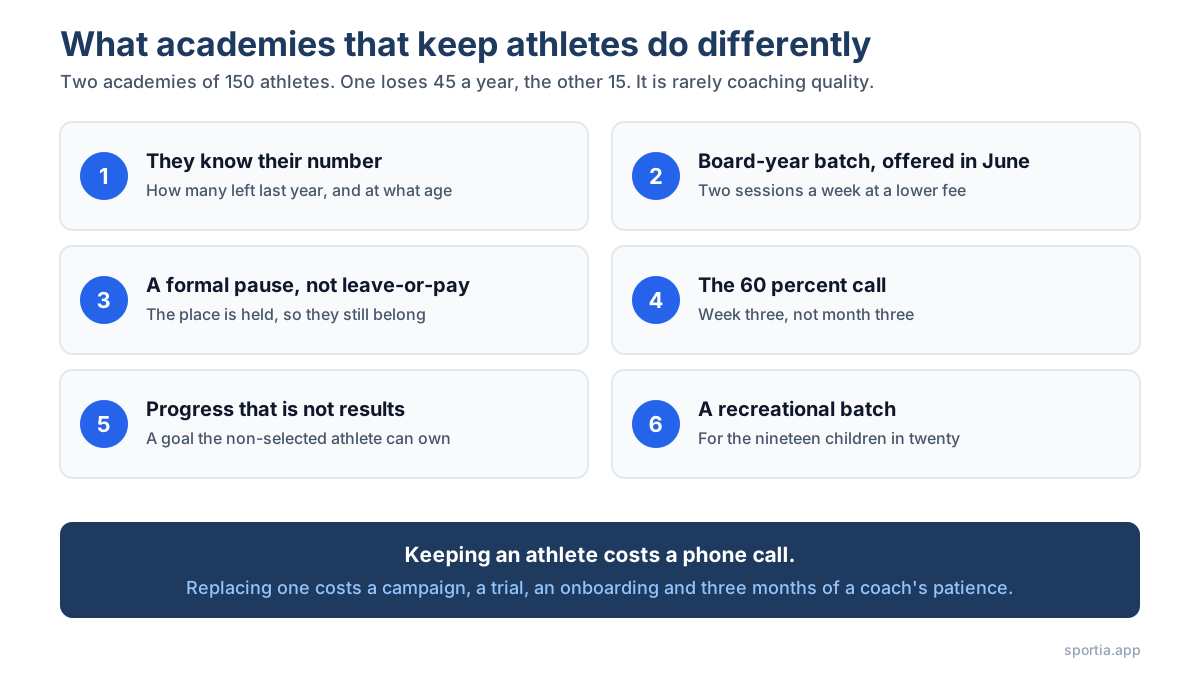
Keeping a customer is cheaper than winning a new one in every business, and academies are an extreme case. Keeping an athlete costs a phone call. Replacing one costs a campaign, a trial, an onboarding and three months of a coach's patience.
The exit conversation worth having
When someone does leave, have one short conversation. Not to win them back, because by then you usually cannot. To learn.
Four questions are enough: When did you start thinking about stopping? What would have made a difference at that point? Was there anything about the coaching or the group? Would you want to come back after the exams, and shall I keep the spot?
Ask ten families and patterns appear fast. Say six of them name the evening batch timing, which stopped working once Class 9 tuition began. That is not a dropout problem at all. It is a scheduling problem with an obvious fix, and you would never have found it from a spreadsheet.
Keep the answers somewhere you will read them. A one-line note on the athlete's record is enough.
Room for the athlete who will never compete
One last thing, and it may be the biggest opportunity in Indian youth sport.
Almost every academy is built for the selection pathway. District, state, nationals, scholarship. That pathway fits perhaps one child in twenty. The other nineteen are the supporting cast, and they leave at fourteen having decided that sport is for people who win things.
A recreational batch fixes this. Same coaches, same facility, two sessions a week, lower fee, no selection pressure, no need to enter tournaments. It is often the best earning group an academy runs, because those athletes stay for years, their parents are relaxed, and they bring friends. They also become the adults who play club cricket at thirty and send their own children to you.
The Khelo India number is worth remembering here. Three in five identified athletes left. The system was built only for the ones who would win, and even most of them did not stay. An academy that gives the other nineteen somewhere to belong keeps more athletes and, usually, finds more talent too.
Frequently Asked Questions
At what age do most kids quit sports in India?
Two clusters dominate. The largest is ages 14 to 15, around Class 10 board exams, and the second is 16 to 17 with Class 12 and entrance-exam coaching. Globally the average child leaves organised sport by about eleven.
Why do kids quit sports?
The most common reason children give is that it stopped being fun. In India the stated reason is usually studies, but the real mix includes burnout, never being picked, parent pressure and fees the family cannot meet.
How can an academy tell an athlete is about to quit?
Watch attendance. Five sessions a week become three, then optional sessions go, then they start leaving early. Two missed weeks follow, and the whole fade takes six to eight weeks. Call any athlete below 60 percent attendance over three weeks.
Should athletes stop training during board exam years?
No. A reduced load works better than a full break, because habits are far harder to restart than to maintain. Offer a named board-year batch of two sessions a week at a lower fee, and offer it in June rather than waiting to be asked.
Can sports participation affect CBSE attendance eligibility?
CBSE requires 75 percent attendance, with up to 25 percent relaxation for students representing at national level, supported by documents. Schools send shortage cases to the board in early January, so give parents the certificates and tournament letters in December.
What is a good retention rate for a sports academy?
Losing under 15 percent of athletes a year is strong for an Indian academy, while 30 percent or more points to a problem you can fix. Start by measuring the number and the age at which athletes leave, which most academies have never done.
Want to see the fade before it becomes an exit? Start a 14-day free trial of Sportia and track attendance per athlete, so a drop from five sessions to three reaches you in week three rather than month three.