

Wrestling for Young Athletes in India: From the Akhara to the Olympic Pathway
India has won eight Olympic medals in wrestling. Only hockey has more. Every one of those eight came through the same route. A village akhara, a coach who spotted a kid at eleven, and years of dal, milk and mud before a single mat session. No other Indian sport has a grassroots system this deep, and no other sport is as cheap to start.
Yet parents outside Haryana, Punjab, Maharashtra and Uttar Pradesh rarely think of wrestling for their child. It looks rough, the weight categories sound worrying, and nobody in the family knows where the nearest akhara is. This guide to wrestling training for beginners in India fixes that. It covers the akhara and the mat, the two Olympic styles and the right starting age. It also covers weight classes for children, what a first year should look like, and the ladder from district dangal to the Asian Games.
The timing is not an accident. India's wrestlers compete at the Asian Games from 30 September to 3 October. If a child in your house or your academy asks about the sport this fortnight, here is what to tell them.
Why wrestling is India's deepest grassroots sport
Kushti has been organised in India for centuries. The akhara is a training ground, a club and a small community in one. A typical village akhara in Haryana or western UP has a mud pit, a guru and twenty to sixty boys. More and more often, it has a batch of girls too. Training starts before dawn and costs almost nothing.
The medals prove the system works. KD Jadhav's bronze in 1952 was India's first individual Olympic medal in any sport. Sushil Kumar won in 2008 and 2012, Yogeshwar Dutt in 2012, Sakshi Malik in 2016, Ravi Dahiya and Bajrang Punia in 2020, and Aman Sehrawat in 2024. India has taken at least one wrestling medal at each of the last five Olympics. Most of those athletes came through akharas. They then moved to mat programmes such as Chhatrasal Stadium in Delhi or the SAI centres in Sonipat and Rohtak.
The gap is geographic. Haryana alone supplies a large share of India's national-level wrestlers. Cities in the south and east have few akharas and fewer mat centres. A coach who opens one there has almost no rivals and a lot of untapped interest.
Akhara versus mat: how a young athlete moves between them
Akhara wrestling happens in a pit of soft, tilled earth mixed with ghee, turmeric and sometimes buttermilk. Bouts are long, holds are traditional, and the aim is to pin both shoulders. Mat wrestling follows United World Wrestling rules on a 12 metre square mat with a 9 metre circle. Bouts are two periods of three minutes for seniors, with points for takedowns, exposures and pushouts.
The two are not rivals. Most Indian champions did both. The akhara builds base strength, balance and a feel for grappling that is hard to teach any other way. The mat teaches the scoring, speed and tactics that win international bouts.
A sensible path for a beginner looks like this:
- Ages 8 to 11: akhara or general wrestling games on any soft surface. Learn to fall, roll, bridge and hold a stance. No formal competition.
- Ages 11 to 14: introduce the mat two or three times a week. Learn the freestyle scoring system. First U15 district bouts.
- Ages 14 onwards: mat becomes the main surface. Akhara sessions stay as strength and conditioning work, once or twice a week.
If your academy has no pit, do not worry. A good coach can build the same base on a mat with games and drills. If you have a pit but no mat, borrow mat time at a school or SAI centre before your athletes enter their first U15 event. Turning up to a mat competition with only pit experience is the most common reason talented village wrestlers lose early.
Freestyle and Greco-Roman, explained simply
Freestyle allows holds anywhere on the body, including the legs. Greco-Roman allows holds only above the waist, so the leg attacks that beginners find natural are banned. Women's wrestling at the Olympics is freestyle only.
For almost every beginner in India, the answer is freestyle. It is closer to what the akhara teaches, and it is the style of every Indian Olympic medal. It also has far more events at district and state level. Greco-Roman is worth trying later, around 15 or 16, for athletes with strong upper bodies who struggle with leg defence.
The right starting age, and what a first year looks like
Children can start structured wrestling at eight. Before that, the best thing is general movement: climbing, tumbling, kabaddi, running. Many strong wrestlers played kabaddi first, and the two sports share a lot. The guide on starting a kabaddi academy covers that overlap.
A first year should have no weight cutting, no pressure to compete and no long bouts. The aim is to make the child love the sport and build a base. A realistic weekly plan for a nine-year-old:
| Session | Duration | Content |
|---|---|---|
| Monday | 60 min | Warm-up games, falling and rolling, stance and motion, 10 min light grappling |
| Wednesday | 60 min | Bridging, sprawl, basic takedown drills, partner carries, flexibility |
| Friday | 60 min | Live situational wrestling in 30-second bursts, games, cool-down |
| Saturday (optional) | 45 min | Rope climb, bodyweight circuits, running, tumbling |
Three sessions a week is enough. Akharas often train six days, but that is for older athletes with a different goal. A child who trains six days at nine is usually gone from the sport at fourteen.
Fees for beginner wrestling in India are low. Village akharas often charge nothing beyond a monthly contribution of Rs 200 to Rs 500 for the pit and milk. A private mat academy in a city charges Rs 1,000 to Rs 2,500 a month. Compare that with Rs 3,000 to Rs 6,000 for badminton or swimming in the same city.
Weight categories, and the risk of cutting weight in growing athletes
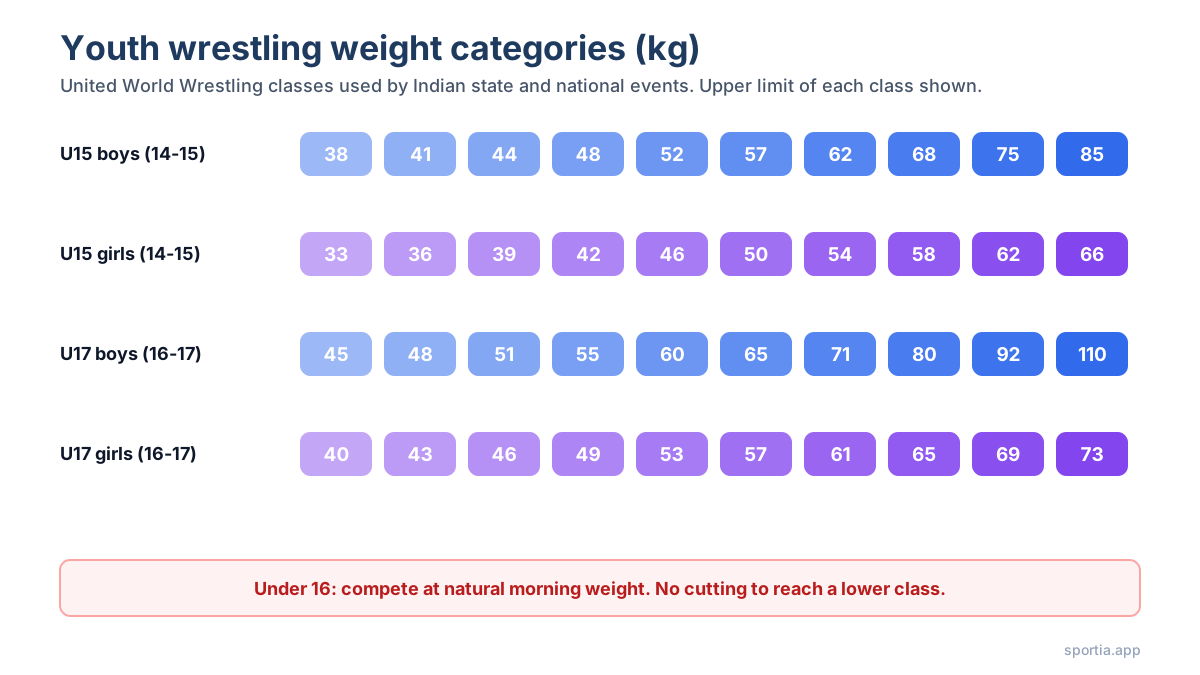
Wrestling is divided by weight so that a 40 kg child never faces a 60 kg child. The categories used in India follow United World Wrestling. For U15 boys (ages 14 to 15) the classes run from 38 kg up to 85 kg in ten steps. For U15 girls they run from 33 kg to 66 kg. At U17 (ages 16 to 17) boys go from 45 kg to 110 kg and girls from 40 kg to 73 kg. Below U15, state associations run sub-junior events with their own lighter classes.
The categories are useful. The problem is what coaches and parents do with them. In every wrestling state, children as young as eleven are told to drop two or three kilos before a district event. The aim is to "make weight" in a lower class. They skip meals, run in plastic jackets and spit into bottles the night before weigh-in.
For a growing athlete this is harmful. Cutting weight in childhood can stall growth, weaken bones, hurt concentration in school and, in the worst cases, damage the kidneys. It also does not work. A dehydrated twelve-year-old wrestles worse, not better, than a fed one.
The rule that protects every young wrestler: compete at the weight you wake up at. Not one kilo lighter. If the child sits at 43 kg, they wrestle in the 44 kg class and eat a proper breakfast.
Coaches who insist on weight cutting for anyone under 16 are a red flag. It does not matter how many medals their senior wrestlers have won. Academies that put this rule in writing, and enforce it, earn parent trust quickly. A good diet matters more than a light one. The post on protein-rich Indian foods for young athletes covers what a wrestling child should eat on a normal family budget.
Equipment and facility needs
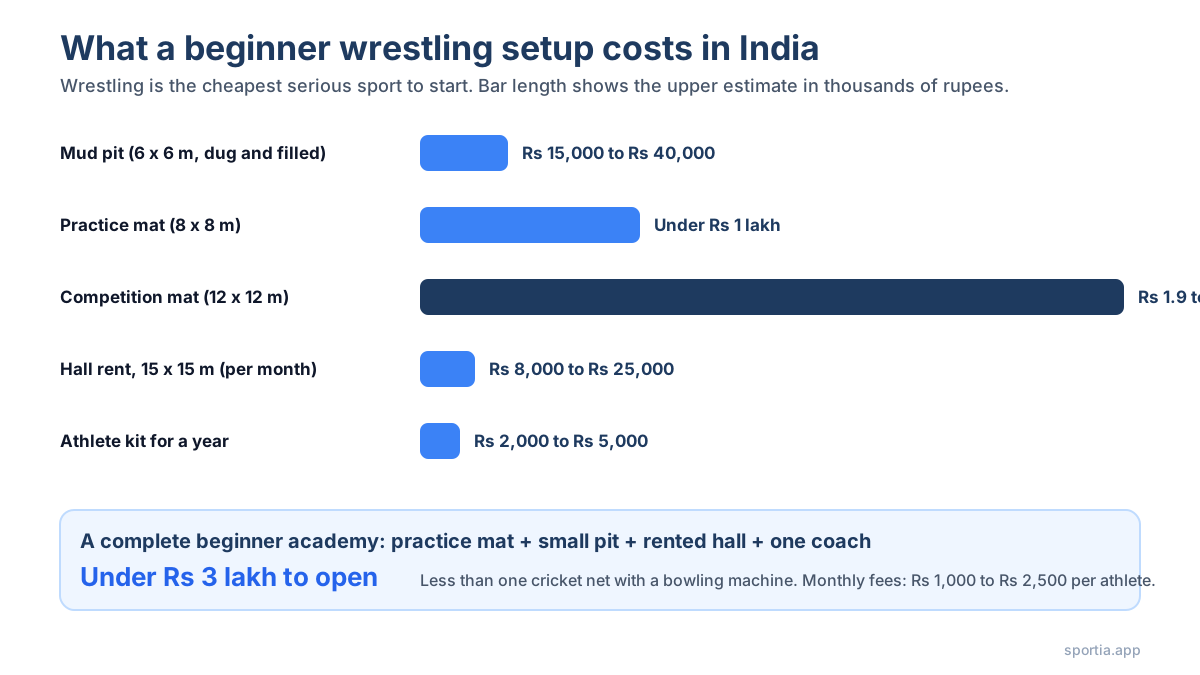
Wrestling is the cheapest serious sport to set up in India. A child needs a singlet (Rs 400 to Rs 800), wrestling shoes (Rs 1,200 to Rs 3,000) and headgear for mat work (Rs 500 to Rs 1,000). For the akhara, shorts and bare feet are enough. That is the full kit for a year.
For an academy, the facility choice is between a pit and a mat:
- Mud pit: a 6 by 6 metre pit dug to half a metre and filled with sieved soil costs Rs 15,000 to Rs 40,000 to build. It needs daily raking and watering. It needs a covered shed in monsoon states.
- Training mat: a 12 by 12 metre competition-size mat from a Meerut or Delhi manufacturer runs Rs 1.9 lakh to Rs 3.2 lakh. Smaller 8 by 8 metre practice mats cost less than Rs 1 lakh and are enough for a beginner academy.
- Room: a mat needs a covered hall of at least 15 by 15 metres with a fan and ventilation. A school gym, a community hall or a rented industrial shed all work.
A complete beginner academy with a practice mat, a small pit, a hall on rent and one coach can open for under Rs 3 lakh. That is less than a single cricket net setup with a bowling machine. There is more on the business side of low-cost sports in the guide to what it costs to set up a sports academy in India.
Strength work before puberty, and what to avoid
Akhara culture prizes strength. The traditional tools, the gada (mace), the mugdar (clubs) and the rope, are excellent for older teenagers. For children under 13 they are too heavy and too easy to misuse.
Before puberty, strength work should be bodyweight only. Pull-ups, push-ups, bridges, bear crawls, partner carries, rope climbing and dand-baithak (the traditional push-up and squat) are all fine. They build the core and shoulder stability that wrestling needs without loading the growth plates.
Avoid these until at least 14, and later for light athletes:
- Barbell squats and deadlifts with more than bodyweight
- Heavy gada swings or mugdar above 5 kg
- Neck bridges with full weight on the head, which many akharas still teach early
- Any exercise done to failure while tired at the end of a session
Once a child passes puberty, usually between 13 and 15, a coach can add light barbell work with proper teaching. The akhara tools then become useful again, in the right doses.
Injury patterns specific to wrestling, and what prevents them
Wrestling injury rates among children are lower than in football or gymnastics. The pattern, though, is specific. Four injuries account for most of the missed training:
- Cauliflower ear from friction and impact on the ear. Prevented almost entirely by headgear on the mat. Many Indian coaches skip it because the akhara never used it. Insist on it.
- Skin infections such as ringworm and impetigo, spread through mat contact. Prevented by mopping the mat daily with disinfectant and showering after every session. Any athlete with a visible rash stays off the mat.
- Shoulder and elbow strains from bad falls and over-extended arms during throws. Prevented by teaching falling before teaching throwing, and by never allowing full throws in a beginner's first six months.
- Knee ligament strains from single-leg attacks that go wrong. Prevented by strong hip and hamstring work and by drilling the finish of each takedown slowly.
Concussion is rarer than parents fear. Still, every coach should know the signs and pull an athlete who has taken a head knock. The children's sports injury first aid guide covers what to do in the first ten minutes.
The competition ladder
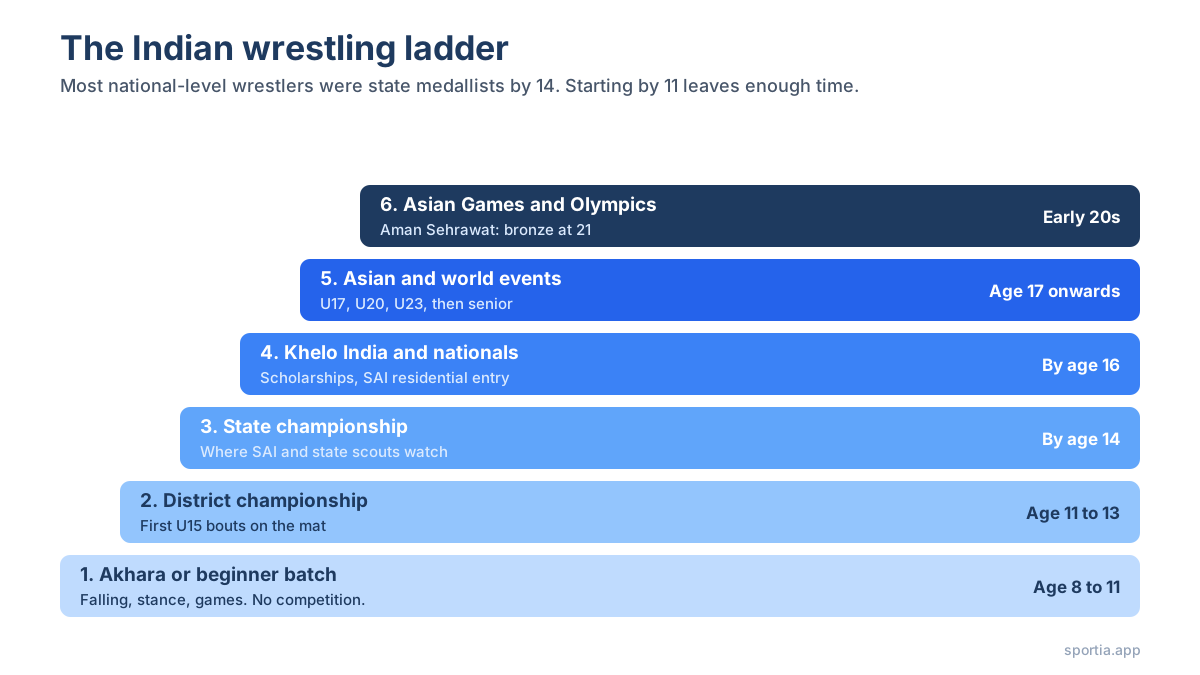
The ladder in India runs through the Wrestling Federation of India and its state units. A beginner's route looks like this:
- Local dangal: village or town open bouts, often with cash prizes, usually on mud. Great for experience, but unregulated. Under 14s should skip the cash bouts.
- District championship: the first official step. Run by the district wrestling association in sub-junior, U15 and U17 age groups.
- State championship: winners and runners-up from districts. Medals here get an athlete noticed by SAI and state sports departments.
- Khelo India Youth Games and national championships: the national stage for U17 and U19. Medals bring scholarships and entry to SAI residential programmes.
- Junior and senior internationals: Asian championships, world championships, the Asian Games and the Olympics.
Most Indian Olympic wrestlers were state medallists by 14 and national medallists by 16. That is a fast ladder, and it is why the starting age matters. A child who begins at 11 and trains three days a week has enough time. A child who starts at 15 is competing against athletes with seven years on the mat.
Girls' wrestling: the fastest-growing part of the sport
Twenty years ago, a girl in an akhara was unusual enough to make a film. Today, girls' wrestling is the fastest-growing segment in the sport, and Haryana's girls dominate U15 and U17 nationals. Sakshi Malik's 2016 bronze and Vinesh Phogat's run to the Paris 2024 final turned a trickle into a flow.
For an academy, girls' batches are the biggest open chance in wrestling. The demand is real and few coaches serve it. The parents who bring their daughters are the most loyal customers you will have. Three practical points:
- Run separate girls' batches at the start. Many families will not enrol into mixed sessions, even if the coach is fine with it. Mixed drilling can come later.
- Hire or train a female coach or assistant as early as you can. It changes who enrols.
- Apply the same no-weight-cutting rule with extra care. Weight loss in adolescent girls affects periods and bone density, and coaches need to know this and say it plainly to parents.
Managing this well means tracking a lot at once. Each athlete's weight class, session attendance, event entries and progress notes, often across boys' and girls' batches at different times. Platforms like Sportia let you record sport-specific fields such as weight category and style for each athlete. You can track attendance by batch and log training progress. That is the kind of paperwork akharas never had and modern academies cannot skip.
Frequently Asked Questions
What age should a child start wrestling in India?
Structured wrestling can start at eight, with free movement and play before that. Between 8 and 11 the focus should be falling, rolling, stance and games. Mat training and first competitions usually begin around 11 to 12.
Is akhara training or mat wrestling better for beginners?
Both help, and most Indian champions did both. The akhara builds base strength and grappling feel; the mat teaches the scoring and speed needed in official competition. A beginner should get mat time before their first U15 event.
Should young wrestlers cut weight to compete in a lower category?
No. Weight cutting in children under 16 can stall growth, weaken bones and hurt performance. Compete at the child's natural morning weight. Coaches who push weight cuts on children should be avoided.
How much does wrestling training cost in India?
Village akharas often charge Rs 200 to Rs 500 a month. Private mat academies in cities charge Rs 1,000 to Rs 2,500 a month. Kit for a year, including singlet, shoes and headgear, costs about Rs 2,000 to Rs 5,000.
What is the difference between freestyle and Greco-Roman wrestling?
Freestyle allows holds on any part of the body including the legs. Greco-Roman allows holds only above the waist. Beginners in India should start with freestyle, which is the style of every Indian Olympic wrestling medal.
How does a young wrestler reach the national level in India?
District championship, then state championship, then Khelo India Youth Games and the national championships in U15, U17 and U19 age groups. Most national-level wrestlers were state medallists by 14, so starting by 11 gives enough time.
Running a wrestling academy or adding wrestling batches this season? Start a 14-day free trial of Sportia to manage weight categories, sessions and progress for every athlete in one place.