

How to Plan a Youth Training Season: Periodization Made Simple
Periodization for youth athletes means splitting the training year into phases, each with a clear focus. Instead of running the same session every week, you plan a rhythm: build a base, sharpen skills, peak for competitions, then recover. Done well, it helps young athletes get better, avoid burnout, and stay fresh. This guide shows you how to plan a youth training season in plain language, mapped to the Indian school calendar, with a sample plan you can adapt.
Most academy coaches are good at running a single session. Far fewer plan a whole season. So athletes drill the same things all year and slowly stop improving. Periodization fixes this. It is not complicated, and you do not need a sports science degree to use it.
Why Training Without a Plan Plateaus Young Athletes
Imagine a batch that does the same drills every week for a year. At first, they improve fast. Then progress stalls. The body adapts to a fixed load and stops changing. This is the plateau, and unplanned training almost always leads to it.
There is a second problem: burnout. If every session is hard, young bodies never fully recover, so fatigue slowly builds up. Injuries and boredom follow close behind. Many talented kids quit not because they lack skill, but because they are tired and stale.
Periodization solves both problems at once. By varying the focus and the effort across the year, you keep athletes improving and fresh, because hard blocks are always followed by easier ones. The plan also respects that young athletes are still growing.
Periodization in Plain Language
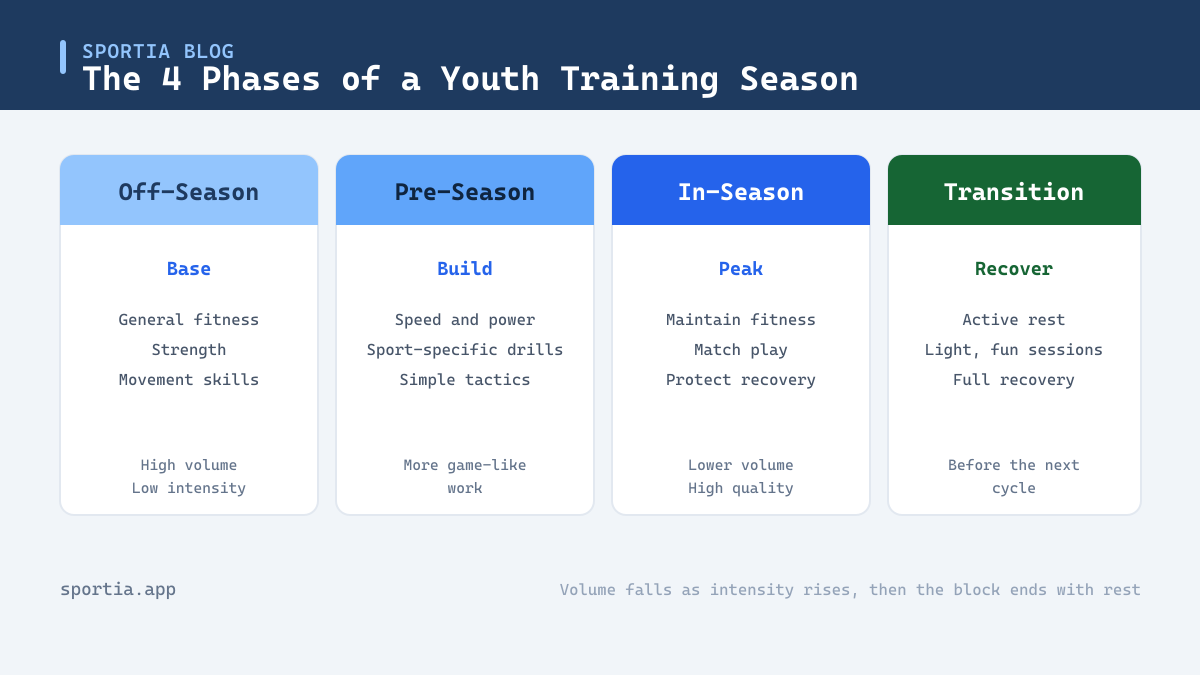
At its heart, periodization has three main phases. Each one has a different job. Together they make a full season.
- Off-season (base building): the foundation phase. You build general fitness, strength, and basic movement skills. Volume is higher, and sport-specific intensity is lower.
- Pre-season (sharpening): the bridge to competition. You add sport-specific skills, speed, and power. The work gets more game-like.
- In-season (competing): the performance phase. You maintain fitness and focus on playing well. Recovery matters most here, so training volume drops.
There is also a short transition phase after the season. This is active rest. Athletes stay lightly active but recover fully before the next cycle begins. This simple four-part rhythm is the backbone of any good youth plan.
Mapping Your Season Around Indian School Terms
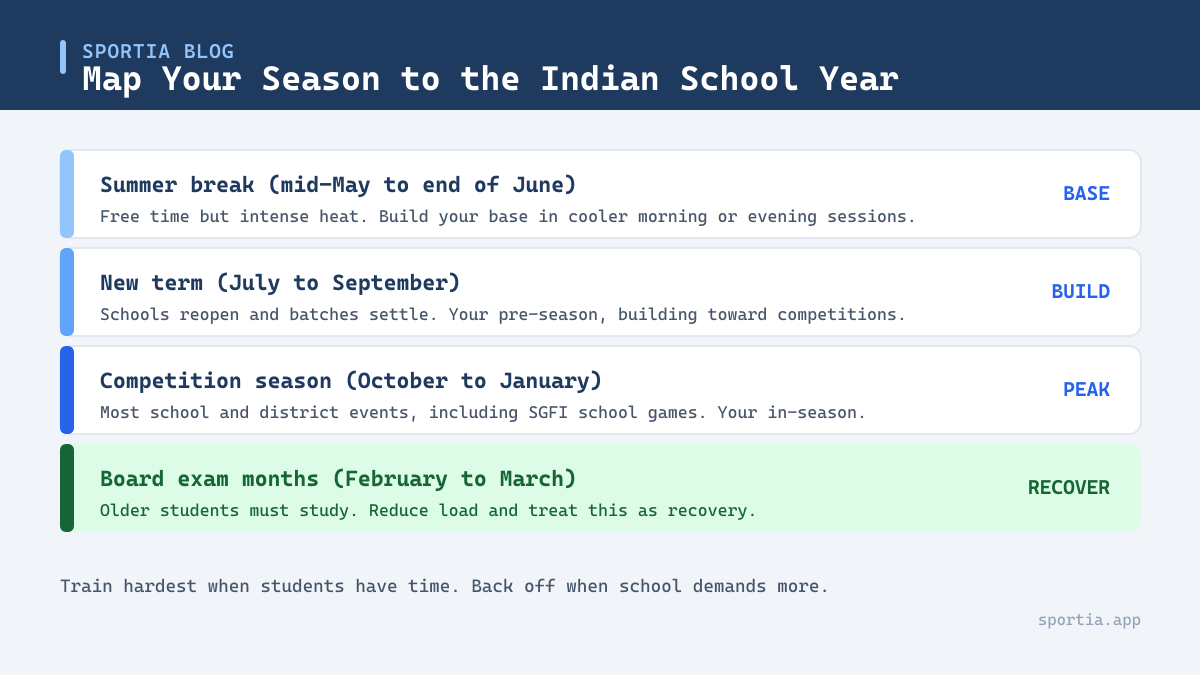
A plan only works if it fits your athletes' real lives. In India, that means planning around the school calendar. The academic year runs from April to March, and a few fixed points shape your season.
- Summer break (mid-May to end of June): kids have free time but the heat is intense. Use it for base building, with sessions in the cooler morning or evening.
- New term (July to September): schools reopen and batches settle. This is your pre-season, building toward competitions.
- Competition season (October to January): most school and district events, including SGFI school games, fall here. This is your in-season.
- Board exam months (February to March): older students must study for exams. Reduce load and treat this as your transition and recovery phase.
This mapping is powerful. It means you are not fighting your athletes' schedules. You are training hardest when they have time, and backing off when school demands more. Aligning your batches and timetables to these phases is far easier with a proper schedule. For help there, see the guide on scheduling batches and timetables .
The Building Blocks of Each Phase
Every phase mixes four ingredients. What changes is how much of each you use. Think of these as dials you turn up or down.
- Skill: the core techniques of the sport. Present all year, but the main focus off-season and pre-season.
- Fitness: strength, speed, and stamina. Built in the off-season, sharpened pre-season, maintained in-season.
- Tactics: game understanding and decision-making. It grows through pre-season and in-season.
- Recovery: rest, sleep, and light days. Never optional, and most important in-season.
In the off-season, you turn up skill and fitness. In pre-season, you add tactics and speed. In-season, you protect recovery and keep skills sharp. Speed and agility work fits mostly in the pre-season, when athletes are fresh and building toward competition. The guide on speed and agility training is a useful companion here.
Balancing Load and Rest to Avoid Burnout
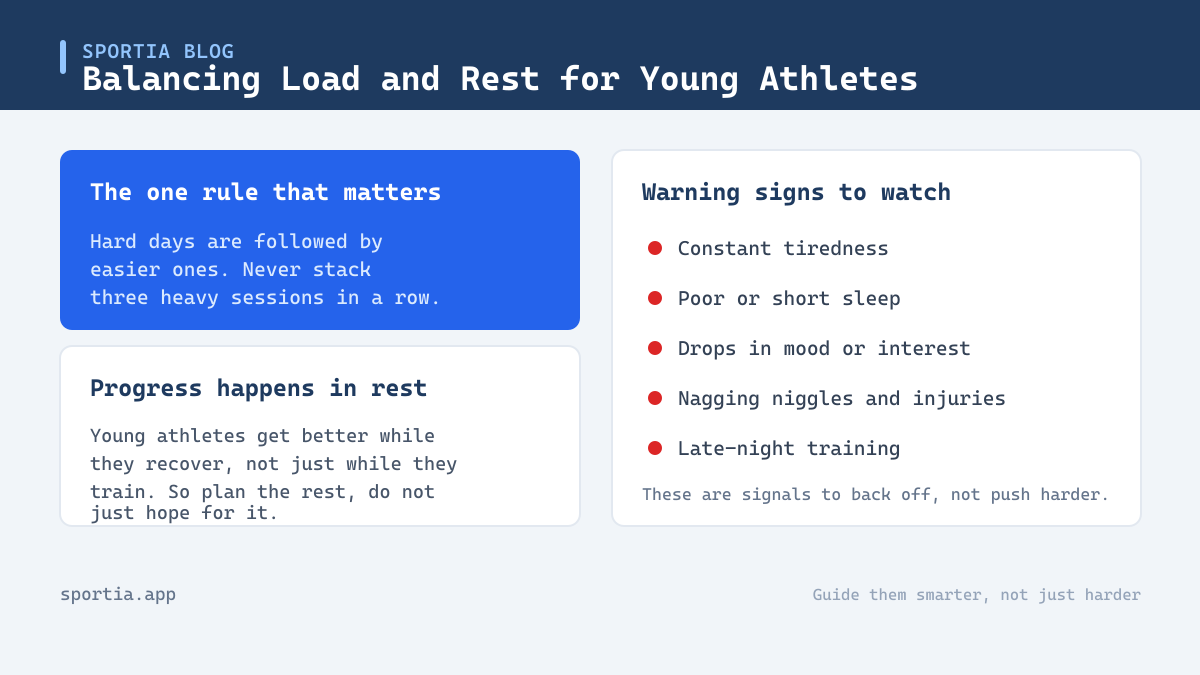
This is the part most coaches get wrong. They think more training always means more progress. For young athletes, that is false. Progress happens during recovery, not just during work.
Follow a simple rule: hard days are followed by easier ones. Never stack three heavy sessions in a row. Watch for the warning signs of too much load, such as tiredness, poor sleep, drops in mood, or nagging niggles. These are signals to back off.
Late-night training also hurts. Youth athletes who finish sessions late get less sleep, and less sleep slows recovery and growth. Where you can, keep sessions earlier in the evening. Knowing the signs of overtraining is a core coaching skill. The guide on overtraining in young athletes covers this in detail.
Adapting the Plan for Mixed-Age or Mixed-Ability Batches
Most Indian academies do not have neat, single-age groups. One batch may hold a range of ages and skill levels. Your plan must flex to fit them.
The phases stay the same for everyone. What changes is the load within each phase. A simple approach works well.
- Same drill, different level: run one skill drill, but adjust the distance, speed, or reps for each child.
- Group by readiness, not just age: a strong 12-year-old may train with older kids for some blocks.
- Protect the youngest. Younger athletes need more skill and fun, and less heavy load.
The goal is one shared plan with room to adjust. Every athlete follows the same season, but at a level that is right for them.
A Sample 12-Week Season You Can Adapt
Here is a simple block you can shape to your sport and calendar. Treat it as a starting point, not a rule.
- Weeks 1 to 4 (base): general fitness, movement skills, and core techniques. Keep volume high and intensity lower to build the engine.
- Weeks 5 to 8 (build): add speed, power, and sport-specific drills, and start small-sided games and simple tactics.
- Weeks 9 to 11 (peak): sharpen for competition by cutting volume and raising quality, with a focus on match play and confidence.
- Week 12 (recover): active rest with light sessions, fun games, and full recovery before the next cycle begins.
Notice the rhythm. Volume falls as intensity rises, and the block ends with rest. You can repeat this 12-week cycle two or three times across a year, aligned to your competition dates.
Here is how it looks in practice. A district-level football academy might start its base block in July, when schools reopen and kids are fresh. It builds speed and small-sided games through August and September, then peaks for the October school tournament. As board exams approach in the new year, it eases right back so the older players can study without falling apart.
Tracking the Plan and Adjusting As You Go
A plan on paper is only the start. Real seasons are messy. Kids miss sessions, fall sick, or hit exam weeks. A good coach tracks the plan and adjusts.
Keep it simple. Note what each batch actually did each week. Watch how athletes respond, and be ready to add rest if they look tired. If a competition date shifts, move your peak phase to match. Your athletes always come first, and the plan should bend to fit them, never the reverse.
Tracking is far easier with the right tools. A platform like Sportia lets you plan batches, save training plans, and see attendance and progress over the season. When your plan and your daily records live in one place, adjusting on the fly becomes simple. You coach with a clear view of the whole season, not just today's session.
Start Simple and Build From There
You do not need a perfect plan to start. Pick your next competition. Count back the weeks. Split them into base, build, peak, and recover. That is periodization, and it already puts you ahead of most academies.
Young athletes thrive on a plan with rhythm and rest. Give them one, and you will see steadier progress, fewer injuries, and kids who stay in the sport they love.
Frequently Asked Questions
What is periodization for youth athletes?
Periodization for youth athletes is planning the training year in phases, each with a clear focus. The main phases are off-season base building, pre-season sharpening, in-season competing, and a short recovery phase. It keeps young athletes improving while lowering the risk of burnout and injury.
How do I plan a training season for young athletes?
Start with your key competition date and count back the weeks. Split them into base, build, peak, and recover phases. Turn training volume down as intensity rises, and finish with rest. Map the whole plan to your athletes' school calendar so it fits their real lives.
How should I plan a season around the Indian school calendar?
Use the summer break for base building, the new term from July for pre-season, and October to January for competition, when most school games happen. Treat the board exam months of February and March as a lighter transition and recovery phase so older students can study.
How do I avoid burnout in young athletes?
Follow easy days after hard days, and never stack three heavy sessions in a row. Watch for tiredness, poor sleep, low mood, and small injuries as warning signs. Keep sessions earlier in the evening, since late training cuts into the sleep young athletes need to recover.
Can one plan work for a mixed-age batch?
Yes. Keep the same phases for everyone, but change the load within each phase. Run the same drill at different distances, speeds, or reps to suit each child. Group by readiness rather than age alone, and give younger athletes more skill work and less heavy load.
How long should a training cycle be for youth athletes?
A 12-week cycle works well: about four weeks of base, four of build, three of peak, and one of recovery. You can repeat this cycle two or three times a year, lined up with your competition dates. Adjust the length to fit your sport and season.