
ACL Injury Prevention for Young Footballers: What Every Academy Should Do
The ISL season kicks off on 10 October, and academy grounds across India will fill with children copying their heroes. They will copy the sprints, the sharp turns and the celebration jumps. Most of them will never copy the 20-minute warm-up that protects a professional's knees. That gap is where ACL injuries begin, and ACL injury prevention for young athletes is one of the few areas in youth sport where a simple routine has strong evidence behind it.
This guide explains how ACL tears happen, who is most at risk, and the warm-up programme that cuts the risk sharply. It also covers what to do in the first 48 hours if a knee goes, and how to make prevention a habit at your academy.
Why ACL Injury Prevention Matters for Young Athletes
The anterior cruciate ligament, or ACL, is a short band inside the knee. It stops the shin bone sliding forward and twisting underneath the thigh bone, so whenever a player plants a foot and turns, the ACL is what holds the knee together.
A torn ACL is not a "few weeks out" injury. Most young players need reconstruction surgery, which costs roughly Rs 1.5 lakh to Rs 3.5 lakh at private hospitals in India. Return to football usually takes nine months or more of rehabilitation, which for a 15-year-old can mean missing an entire season of state trials and school nationals.
The long-term cost is higher still. Players who tear an ACL young are more likely to injure the same knee again, and to develop knee arthritis earlier in adult life. So for an academy, preventing even one ACL tear a year is worth far more than any trophy.
How Most ACL Tears Happen Without Any Contact
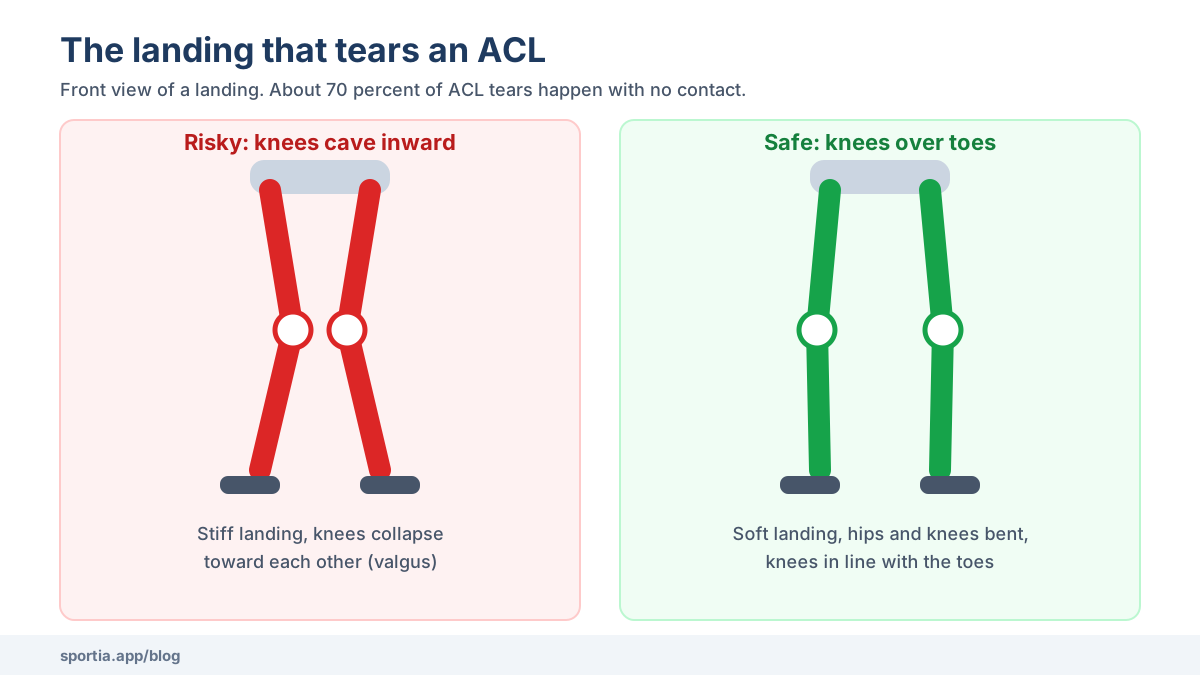
Parents often imagine a crunching tackle, but in reality around 70 percent of ACL injuries happen with no contact at all. The player tears it alone, during one of three movements:
- Landing from a header or jump with stiff, straight legs
- Cutting, which means planting a foot and changing direction sharply
- Stopping suddenly from a sprint, especially on one leg
The danger sign in all three movements is identical: the knee caves inward, toward the other leg, while the foot stays planted. Coaches call this "knee valgus". You can see it in slow-motion phone video of almost any youth match, and it is the main thing prevention training tries to fix.
Fatigue makes the problem considerably worse. Late in a session, or in the second half of a tournament day, tired muscles stop controlling the knee well. That is why many ACL tears happen in the final minutes, not the first.
Why Girls Face a Higher Risk, and What It Means for Co-Ed Batches
Research consistently finds that girls and women tear their ACL two to eight times more often than boys and men in the same sport. The risk peaks during the teenage years, roughly between 14 and 18.
Several factors combine here, because girls often land with straighter knees and more inward collapse. Hormonal changes, hip shape and differences in muscle strength around puberty also play a part. None of these are reasons to keep girls out of football. They are reasons to make prevention training non-negotiable for every girl in your academy.
Growth spurts raise the risk for boys too. During a rapid growth phase, bones lengthen faster than muscles adapt, and coordination can temporarily drop. A 13-year-old who suddenly looks clumsy is not being lazy, and that player actually needs more control work, not less.
For co-ed batches, run the same prevention warm-up for everyone. Do not make it a "girls' routine", because that can make girls feel singled out and lets boys skip work that protects them too.
The FIFA 11+ Programme, Explained in Plain Terms
FIFA 11+ is a warm-up designed by FIFA's medical research centre with sports scientists. It replaces your normal warm-up rather than adding to it, needs no equipment beyond a few cones, and takes about 20 minutes once players learn it.
It has three parts:
- Running exercises (about 8 minutes): jogging with hip movements, side shuffles and short bursts, at a slow pace.
- Strength, jumping and balance (about 10 minutes): planks, single-leg balance, squats, jumping and the Nordic hamstring exercise. Each exercise has three levels, so players progress as they get stronger.
- Running exercises (about 2 minutes): faster running with cutting and bounding at match speed.
The evidence is strong. Large studies have found that teams doing FIFA 11+ at least twice a week cut overall injuries by around 30 to 50 percent. Some research suggests the effect on ACL injuries in particular is even larger. For children under 14, FIFA has a shorter version called FIFA 11+ Kids, which takes about 15 minutes and uses more playful exercises.
The catch is compliance, because the programme only works if players actually do it properly, week after week. Teams that do it once in a while see little benefit.
Five Landing and Cutting Drills for Your Normal Warm-Up
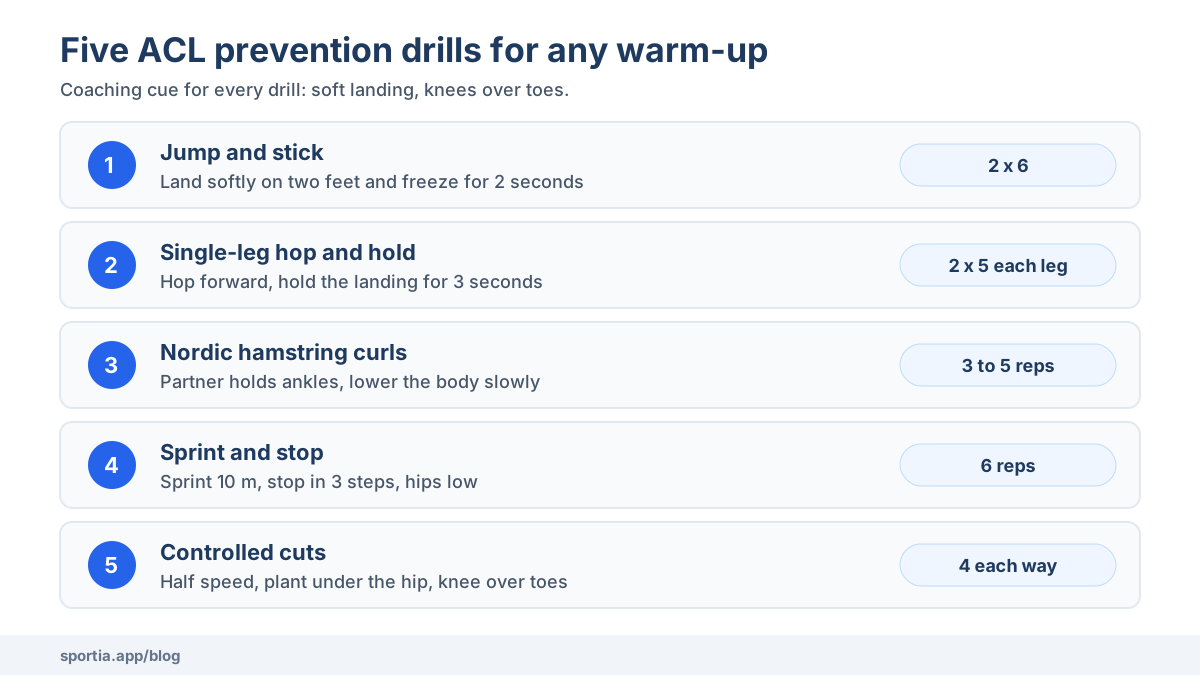
If you cannot adopt the full programme yet, start with these five drills. Each fits into the first 15 minutes of a normal session.
- Jump and stick. Jump forward off two feet, land softly, and freeze for two seconds. Knees bend and stay over the toes. Do 2 sets of 6.
- Single-leg hop and hold. Hop forward on one leg and hold the landing for three seconds without wobbling. Do 2 sets of 5 on each leg.
- Nordic hamstring curls. Kneel while a partner holds the ankles, then lower the body forward slowly. Strong hamstrings protect the ACL. Start with 3 to 5 reps.
- Sprint and stop. Sprint 10 metres, then stop within three steps with hips low and knees bent. Do 6 reps.
- Controlled cuts. Run at half speed and change direction at a cone. Plant the foot under the hip, keep the knee over the toes, and push off. Do 4 cuts each way.
The coaching cue that matters most is short: "soft landing, knees over toes". Say it every session until players say it back to you. The guide to a proper warm-up routine before sports training explains how to structure the rest of the warm-up around these drills.
Surfaces and Footwear in Indian Conditions
Indian grounds create their own particular risks. After the monsoon, many school grounds dry out hard and uneven by October. In cities, more and more training happens on rented artificial turfs. Each surface needs a different approach.
- Hard, dry grounds: long studs grip too much and can lock the foot during a turn. Moulded boots with shorter studs are safer.
- Artificial turf: use turf shoes or boots made for artificial grass. Firm-ground boots with long studs catch in the turf and twist the knee.
- Muddy or patchy grounds: uneven surfaces make landings unpredictable, so mark off the worst areas with cones.
Many families buy one pair of boots for every surface, usually the cheapest pair with the longest studs. A short note to parents about the right boots for your ground costs nothing and can prevent a serious injury.
What to Do in the First 48 Hours After a Knee Injury
Every coach should recognise the warning signs of a possible ACL tear:
- The player felt or heard a "pop" in the knee
- The knee swelled quickly, within a few hours
- The knee feels unstable or "gives way" when the player tries to turn
If you see these signs, stop the player from returning to the session, even if they say they feel fine. Apply ice wrapped in a cloth, raise the leg, and avoid putting weight on it if it hurts. Then advise the family to see a sports orthopaedic doctor within a few days. An MRI scan is usually needed to confirm the injury.
Two common mistakes make things worse. One is telling the player to "walk it off" and finish the session. The other is massaging the knee with oil, which is common in Indian households but can increase swelling. The guide to return to play after injury covers the steps that come after diagnosis.
Building ACL Injury Prevention Into the Weekly Plan
Knowing about FIFA 11+ is easy, but doing it every session for a whole season is difficult, because it feels slow when children simply want to play. Three habits help.
Make it the warm-up, not an extra. If prevention work happens after the warm-up, it gets cut when time runs short. Replace your current warm-up with it entirely.
Assign it like any other training plan. Put the routine in writing, so every coach runs the same version. In Sportia, you can save it in the coaching library as a training plan, assign it to each football batch, and track whether it is being done. That way the routine does not depend on one coach remembering it.
Explain it to players and parents. When a 14-year-old understands that the warm-up protects their season, they stop rushing through it. A short message to parents also shows them your academy takes their child's safety seriously. Pair this with sensible training loads, because tired players get injured more often. The guide to football drills for young players has more session ideas that fit around the warm-up.
Frequently Asked Questions
How can young athletes prevent ACL injuries?
The best evidence supports a structured warm-up such as FIFA 11+, done at least twice a week. It builds strength, balance and safe landing technique. Good footwear for the surface and avoiding heavy fatigue also lower the risk.
Why are girls more likely to tear their ACL?
Girls tend to land with straighter knees that cave inward, and puberty brings changes in hip shape, hormones and muscle strength. As a result, their ACL injury rate is two to eight times higher than boys in the same sport.
How long does the FIFA 11+ warm-up take?
About 20 minutes once players know the exercises. It replaces your normal warm-up rather than adding to it. The FIFA 11+ Kids version for under-14s takes about 15 minutes.
What are the signs of an ACL tear in a child?
Common signs are a pop at the moment of injury, quick swelling within a few hours, and a knee that feels unstable when turning. Any child with these signs should stop playing and see a sports orthopaedic doctor.
How long does it take to return to football after an ACL tear?
After reconstruction surgery, most young players need nine months or more of rehabilitation before returning to full football. Returning too early increases the risk of tearing the ligament again.
Protect Every Knee This Season
The ISL season will inspire thousands of young footballers this month. The best way to keep them on the pitch is not more drills, but the right 20 minutes at the start of every session. Adopt FIFA 11+ or the five drills above, check boots for your surface, and teach every coach the warning signs. Then use Sportia's coaching library to keep the routine consistent across every batch, all season long.