

Martial Arts for Kids in India: Benefits, Styles, and How to Choose
Martial arts benefits for children are real but often oversold. The evidence points to better self-control and focus, with mixed findings on cutting aggression. Choosing well matters more than picking the "best" style. In India, one thing most parents never check is whether the body issuing your child's belt is approved. This guide covers what the research backs, how karate, taekwondo, judo and kalaripayattu compare, and what to ask before you pay a rupee.
What Martial Arts Actually Builds
Start with the honest version, because the marketing version helps nobody.
The strongest evidence sits around self-control. Studies of school-based martial arts training report gains in focus, self-awareness and mood. Children finish sessions calmer and get better at handling impulses.
That matters for a seven-year-old who cannot sit still. It is why many Indian parents notice a change in homework habits before they notice anything physical.
On aggression, the picture is less tidy. Several trials report less aggression and better social skills. Reviews note that results vary a lot by study design, course length and what was taught. So it can help an angry child, but no good coach should promise it.
The physical gains are easier to state. Balance, footwork, core strength and body awareness all improve, and they carry into every other sport.
One point worth making to parents. A style built on respect, control and slow progress tends to deliver those gains. A class that is really just fighting with a belt attached often does not.
Karate, Taekwondo, Judo and Kalaripayattu
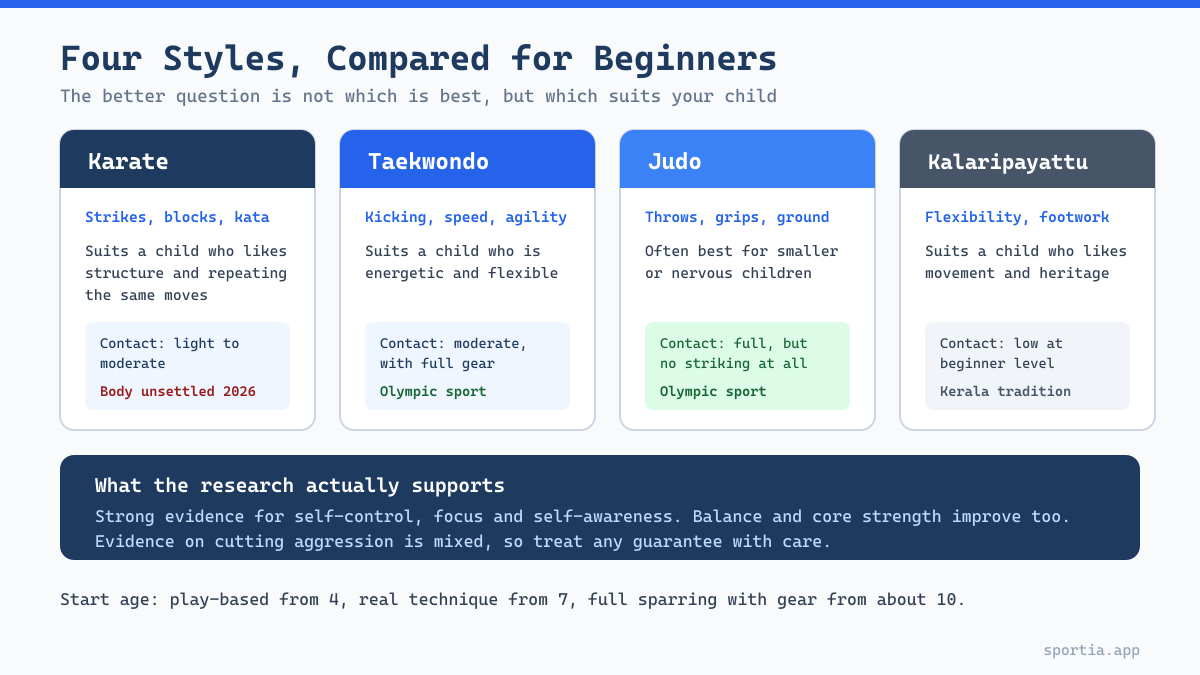
Parents usually ask which is best. The better question is which suits your child, and what is actually taught well near you.
| Style | Emphasis | Suits a child who | Contact level |
|---|---|---|---|
| Karate | Strikes, blocks, forms (kata) | Likes structure and repetition | Light to moderate |
| Taekwondo | Kicking, speed, agility | Is energetic and flexible | Moderate, with gear |
| Judo | Throws, grips, groundwork | Is strong and enjoys grappling | Full, but no striking |
| Kalaripayattu | Flexibility, footwork, traditional forms | Enjoys movement and heritage | Low at beginner level |
One tip. Judo suits nervous or smaller children better than parents expect, because there is no striking at all. The child learns to fall safely in the first weeks, which is a useful life skill.
Kalaripayattu, from Kerala, is one of the oldest fighting arts anywhere. It is taught widely in Kerala and more often elsewhere now, and it doubles as superb flexibility work.
The Recognition Problem Most Parents Miss
Read this part twice. It decides whether your child's belts and medals count for anything beyond the wall.
In India, each sport is run by a National Sports Federation approved by the Ministry of Youth Affairs and Sports. That approval matters. It shapes picking for national events, and papers or medals from bodies without it may not be accepted for government sports schemes.
Here is where each style stands.
- Taekwondo - India Taekwondo is approved by the sports ministry as the national body, and is tied to World Taekwondo. It replaced an older body in 2019, and groups using similar names still operate.
- Judo - the Judo Federation of India is the approved national body, and is tied to the International Judo Federation.
- Karate - this one is unsettled. As of February 2026, no karate body held national approval in India. The sports ministry told the Indian Olympic Association to set up an ad-hoc panel to run the sport, after several rival groups claimed control.
This does not mean you should avoid karate. It is an excellent art and there are outstanding karate instructors across India.
It does mean you should ask one blunt question before paying: which body issues the grading, and is it approved right now? This changes, so check the ministry list rather than a poster on the wall.
The families this hurts find out at 16, while applying through a sports quota or for a sports scholarship, that ten years of paper carry no official weight.
The Right Starting Age
Most academies in India take a child from about four. Whether they should is another matter.
- Ages 4 to 6. Sessions should be play. Balance games, animal walks, following orders, basic stances. No sparring, no board breaking, no grading pressure.
- Ages 7 to 9. Real technique can be taught. Light partner work is fine. This is the age where the focus gains show up most clearly.
- Ages 10 to 13. Real sparring with full gear, and the start of a contest route if the child wants one.
- 14 and above. Full training, contests, and in judo and taekwondo a real route to state and national events.
A five-year-old doing push-ups on knuckles or sparring without gear is not advanced training. It is a warning sign.
How Belts Really Work
Belts are a way to keep children keen. They are not a national standard, and this is where a lot of money quietly goes.
In a good school, grading happens every four to six months at junior levels, tests real skill, and can be failed. If nobody in your child's class has ever failed one, it is a way to collect fees.
Ask three questions:
- What does the grading fee cover, and how often will it come up?
- Who issues the paper, and is that body approved?
- Has any student been asked to re-take a grading in the last year?
Be careful with a "black belt in two years" pitch for a child. Real junior routes take longer, and many schools issue a junior grade rather than a full adult black belt for good reason.

Safety and Contact Rules
Martial arts is safer than most parents fear and less safe than most academies admit. The gap is down to how a class is run.
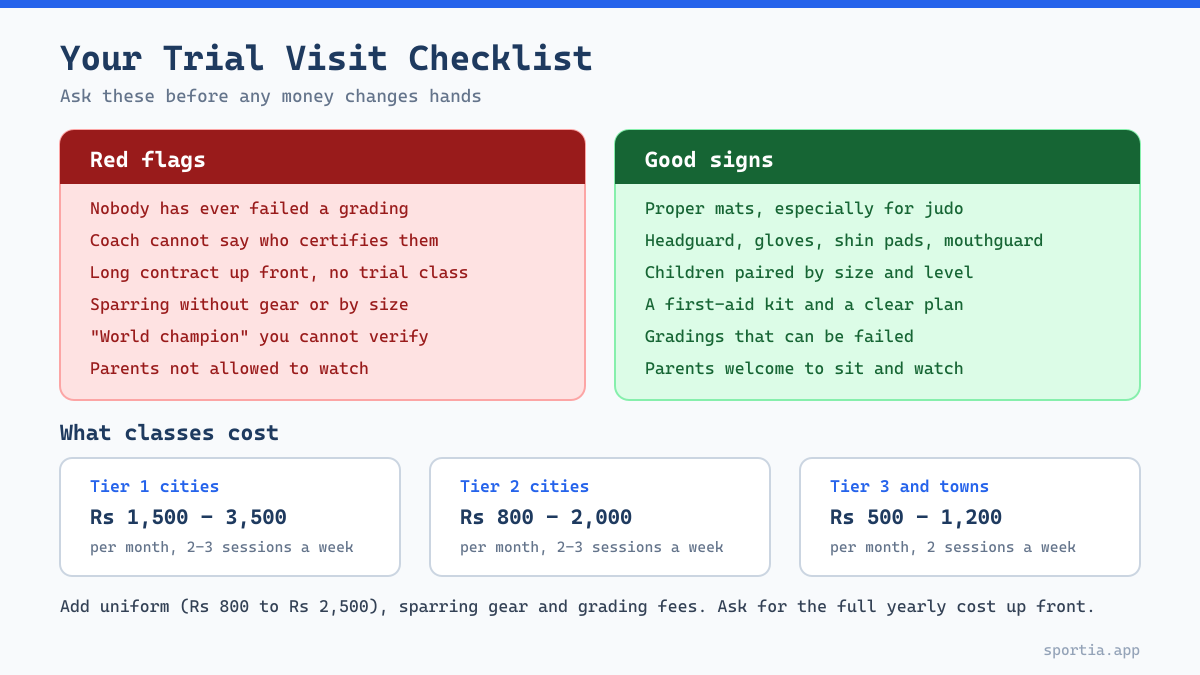
What to look for on a trial visit:
- Mats. Judo needs proper tatami. Throwing on a bare hard floor is never ok.
- Gear. Headguard, gloves, shin pads and a mouthguard for any real sparring.
- Matching. Children paired by size and level, not by who turned up.
- Ratios. One coach to 20 small children cannot watch contact safely.
- A first-aid kit and a plan. Ask what happens if a child is hurt. Hesitation is the answer.
Our guide to common sports injuries in children covers the basics every academy should have in place.
What Classes Cost in India
Fees vary a lot by city, and by whether the class runs in its own hall or a school room.
| City tier | Typical monthly fee | Usually includes |
|---|---|---|
| Tier 1 (Mumbai, Delhi, Bengaluru) | Rs 1,500 to Rs 3,500 | 2 to 3 sessions a week |
| Tier 2 | Rs 800 to Rs 2,000 | 2 to 3 sessions a week |
| Tier 3 and smaller towns | Rs 500 to Rs 1,200 | 2 sessions a week |
Budget on top for the uniform, usually Rs 800 to Rs 2,500, plus sparring gear once contact work starts, and grading fees a few times a year. Ask for the full yearly cost up front, not in bits.
Red Flags When Choosing an Academy
Most are obvious once you know to look.
- Nobody has ever failed a grading.
- The coach cannot say clearly which body certifies them.
- Long contracts paid up front with no trial class.
- Sparring without gear, or mixed-size children in contact drills.
- "World champion" claims from events you cannot find any record of.
- Parents not allowed to watch a session.
That last one matters more than it sounds. A school happy with how it treats children has no reason to shut the door.
The Competitive Pathway
If your child takes to it, the route runs district, then state, then nationals held by the approved body.
Taekwondo and judo both have clear routes, are Olympic sports, and feature in Khelo India Youth Games. That mix matters, because it links to scholarships, sports quota seats and state support.
Karate's route is harder to follow while control of the sport is unsettled, which is another reason to ask which body your school competes under.
Keep perspective. Most children who train will never compete nationally, and that is fine. The self-control, fitness and confidence need no medal. Our post on mental health and sports performance covers keeping that balance right.
For Academy Owners
If you run a martial arts school, your problems are the same as any academy: attendance across batches, grading records, fees and parent updates.
Grading history is the bit most schools track worst, usually in a notebook. With Sportia, you can hold each student's grades next to attendance and invoices, run batches across sites, and let parents see it all in one place. Setting up a martial arts school follows much the same path as any sport, covered in our guide to starting a kabaddi academy. Martial arts also has one of the healthiest gender balances in Indian youth sport, which our post on growing girls' participation explores.
Frequently Asked Questions
What are the real benefits of martial arts for children?
The strongest evidence is for self-control: better focus, self-awareness and mood. Balance, footwork and core strength improve too. Evidence on cutting aggression is mixed, so treat any promise with care.
Which martial art is best for a child in India?
Judo suits smaller or nervous children because there is no striking. Taekwondo suits energetic, flexible children. Karate suits children who like structure and repetition. A good local coach matters more than the style itself.
At what age can a child start martial arts?
Around four for play-based classes, with real technique from about seven and full sparring with gear from around ten. A five-year-old sparring without gear is a warning sign, not advanced training.
Are karate belts in India officially recognised?
It depends on the issuing body. As of February 2026 no karate group held national approval in India, and the sports ministry told the Indian Olympic Association to set up an ad-hoc panel. Papers from bodies without approval may not count for government sports schemes, so check the current list.
How much do martial arts classes cost in India?
Roughly Rs 1,500 to Rs 3,500 a month in tier-1 cities, Rs 800 to Rs 2,000 in tier-2, and Rs 500 to Rs 1,200 in smaller towns. Add the uniform, sparring gear and grading fees, and ask for the full annual cost before enrolling.
How often should a child grade for a new belt?
Every four to six months at junior levels, and a grading should be possible to fail. If nobody in the class has ever failed, it is a fee exercise rather than a test.
Choose the Instructor, Not the Style
Parents spend weeks weighing karate against taekwondo, when the thing that shapes a child's experience most is the person running the room.
Visit a class. Watch how the coach speaks to the smallest child there. Ask who certifies the grading, and check that body is approved. Then let your child try it for a month before signing up for longer.
Run a martial arts school yourself? Start your free 14-day Sportia trial to keep attendance, grading records and fees in one place.