
Winter Batch Planning: How to Reshuffle Timings Without Losing Athletes
Every year it happens the same way. Your 5:30 PM batch looks full on paper. Then one week in early November, eight children stop coming, and nobody tells you why. The reason is simple: by 5:30 it is already getting dark, and parents do not want their child cycling home at dusk.
Winter quietly breaks the summer timetable. A good sports batch management system is not only software. It is the habit of reading your data, planning the switch early and telling families in good time. This guide walks you through the full winter reshuffle, from spotting the weak slots to the first two weeks after the change.
Why November Breaks the Summer Timetable
Three things change at once, and each one hits a different batch.
Early darkness hits evening batches
In mid-November the sun sets at roughly 5:25 PM in Delhi and close to 4:55 PM in Kolkata. Bengaluru and Chennai get a little longer, at around 5:40 to 5:50 PM, and Mumbai stays light until about 6 PM. An outdoor batch that ran from 5 to 7 PM in September now loses half its light. Without floodlights, the last hour of training becomes unsafe for cricket, football and tennis.
Fog and cold hit morning batches
In Punjab, Haryana, Delhi-NCR, Uttar Pradesh and Bihar, dense morning fog usually arrives from December. Parents are wary of early starts in near-zero visibility, and schools themselves push timings later. In January 2024, Delhi's Directorate of Education ordered that no school start before 9 AM because of fog and cold. If schools are shifting, your 6 AM batch is next.
Pollution hits everyone in the north
From late October, air quality in North India often turns poor, and the worst readings tend to come early in the morning. Our guide to training through pollution season covers the AQI rules in detail. For timetable planning, the lesson is simple. Have an indoor or late-morning option ready before you need it.
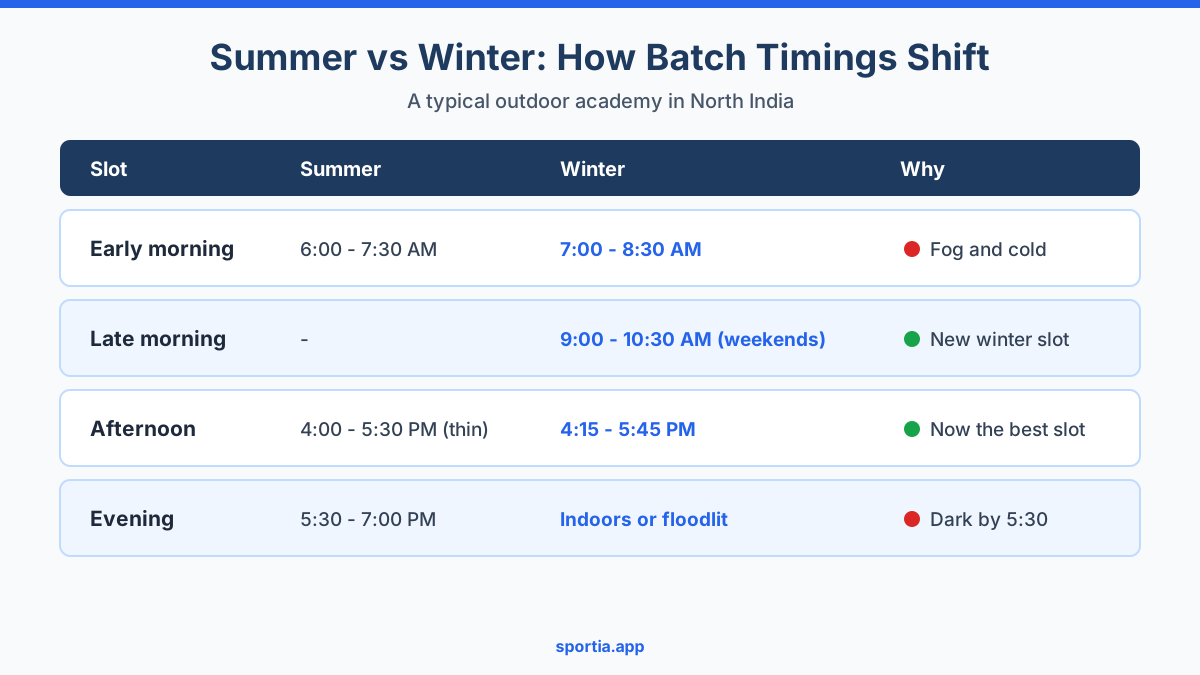
The result is that your strongest summer slots, early morning and late evening, become your weakest winter slots. Meanwhile, the afternoon slots that nobody wanted in May start to look attractive.
Read Your Attendance Data Before You Change Anything
Most owners reshuffle by gut feeling. That is how a healthy batch gets moved and a struggling one gets left alone. Your attendance records already tell you which slots are fading, so look before you act.
Pull attendance for each batch across the last six to eight weeks and compare it with September. Look for three warning signs:
- A steady drop week after week: attendance falling from 85 percent to 60 percent over four weeks is a timing problem, not a motivation problem
- The same few names missing: often children who travel the furthest or rely on a parent for pickup
- Late arrivals rising: a sign that the slot clashes with school, tuition or traffic
Then sort your batches into three groups. Healthy batches stay as they are. Fading batches need a timing change. Thin batches, those under about 60 percent of capacity, may need to be merged. Our attendance tracking guide explains how to set up records that make this kind of review quick.
Your Options for a Winter Batch Schedule
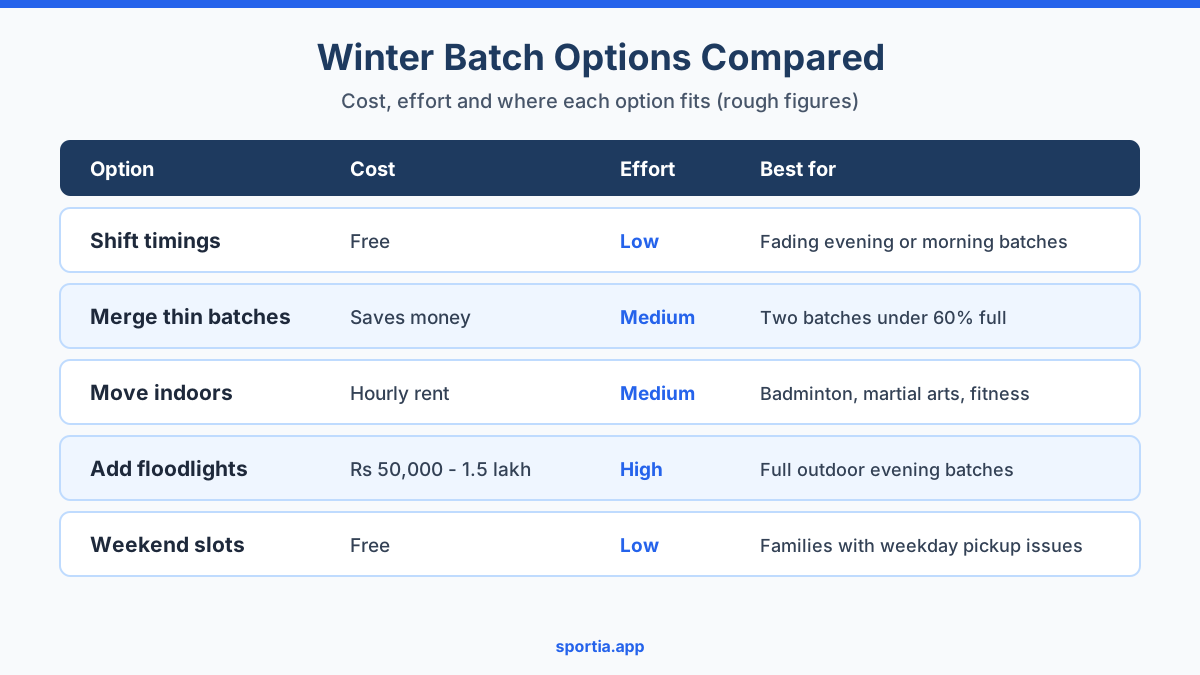
Once you know which batches are struggling, you have five main options. Most academies use two or three of them together.
1. Shift timings
Move evening batches 30 to 60 minutes earlier, and move morning batches 30 to 60 minutes later. A 5:30 to 7 PM batch might become 4:15 to 5:45 PM. The catch is school timings. Children who finish school at 3:30 PM and travel 40 minutes cannot make a 4 PM start, so check with a few parents before you commit.
2. Merge thin batches
Two batches of 9 and 11 children each are less fun and cost you the same coach hours as two full ones. Merging them into one batch of 20 frees a slot and a coach. Merge only batches at a similar level, though. Putting beginners with advanced players to save a slot usually costs you both groups.
3. Move indoors
Badminton, table tennis, martial arts, gymnastics and fitness training can move indoors easily. Cricket academies can switch the late batch to indoor nets, and football can use a covered futsal court. Indoor space costs money, so use it for the hardest slots only.
4. Add weekend slots
Weekend mornings at 8 or 9 AM avoid the worst of the cold and the darkness. Many winter academies run a heavier Saturday and Sunday programme and a lighter weekday one. This also suits families who struggle with weekday pickups.
5. Reduce frequency, raise quality
Some children do better with three focused sessions a week in winter than five rushed ones. If you change the number of sessions, be clear about whether fees change too. Families accept fewer sessions far more easily when the reason is explained up front.
Floodlight and Indoor Court Costs: When They Pay for Themselves
Floodlights are the obvious fix for evening darkness. They are also expensive, so do the maths before you buy.
A badminton court light costs roughly Rs 4,000 to 4,500 a fixture, and cricket floodlights range from about Rs 7,000 to well over Rs 15,000 each. A single outdoor court or a pair of cricket nets usually needs four to eight fixtures. Add poles, cabling and an electrician, and a basic setup lands somewhere between Rs 50,000 and Rs 1.5 lakh. These are rough figures, so always get two or three local quotes.
Now look at what floodlights earn. Say they let you keep one evening batch of 15 children at Rs 1,500 a month. That is Rs 22,500 a month that would otherwise disappear for four months. Running six 200 W lights for two hours a day costs only a few hundred rupees a month in electricity. In that case, the lights pay for themselves within one winter.
Renting is the other route. Evening turf slots in most cities cost about Rs 1,200 to Rs 2,000 an hour, with the highest prices at peak evening times. That works out well for a full batch of 20, but badly for a batch of 8. If you rent, fill the slot first.
A simple rule: if a light or a rented slot keeps a full batch running through winter, it usually pays for itself. If the batch is half-empty anyway, merge it first.
Tell Parents Two Weeks Ahead, in One Clear Message
Most dropouts after a timetable change come from bad communication, not the change itself. Parents need time to rearrange school pickups, tuition and office hours. Two weeks is the minimum, and three is better.
Send one message to each batch, not one to the whole academy. A good message covers five things:
- The new day and time, and the date it starts
- The reason, in one line: darkness, fog or air quality
- Whether the fee changes, and if so, how
- What to do if the new time does not work, such as a named alternative batch
- A deadline to reply, so you can plan numbers
Here is an example you can adapt:
"From Monday 2 November, the U-12 evening batch will run from 4:15 to 5:45 PM instead of 5:30 to 7 PM. It gets dark by 5:30 now, and we want the children to train and travel home in daylight. Fees stay the same. If the new time does not suit you, the Saturday 9 AM batch has 6 places. Please reply by 25 October."
Avoid sending the change in a big WhatsApp group where it gets buried under 40 replies. Our post on parent communication beyond WhatsApp groups has more on this.
Coach Availability and the Knock-On Effect
Moving one batch rarely moves only one batch. If your head coach takes the 5:30 PM slot in summer and that slot moves to 4:15 PM, check what else that coach was doing at 4:15.
Map every coach against every slot before you announce anything. Look for three common problems:
- Double-booking: one coach is now due in two batches at the same time
- Travel gaps: a coach who runs batches at two locations needs time between them
- Day jobs: part-time coaches who work until 5 PM cannot take an earlier evening slot
Talk to your coaches before you talk to parents. A coach who learns about a new timing from a parent will not feel very valued, and they may not be able to make it anyway. If your timetable lives in a spreadsheet, these clashes are easy to miss. Our guide to sports academy scheduling and timetables covers how to structure batches so changes like this are easier.
Watch Attendance for the First Fortnight
The change is not done when the message goes out. The first two weeks tell you whether it worked.
- Check attendance for every changed batch after each session, not at the end of the month
- Call any family whose child has missed two sessions in a row, because a call in week one saves the enrollment
- Compare each batch with its September numbers, not with October, since October was already falling
- Be ready to adjust once more, by 15 minutes, if a slot is clearly still wrong
Children who drift away in winter often do not come back in spring. Once the training habit breaks and the evening fills with something else, it is hard to win back. Our article on why young athletes quit sports goes deeper. A quick call now is much cheaper than finding a new athlete in March.
Making the Switch in a Sports Batch Management System
If your timetable lives in a spreadsheet, every winter change means editing the timetable, the attendance sheet and the fee list one by one. Academy software takes most of that work away, though it does not replace the planning above.
In Sportia, you edit a batch's days and times once, and its upcoming sessions are rebuilt on the new schedule. Past attendance stays as it was. You can move an athlete into another batch at the same location and sport when a family needs a different slot. You can also open any athlete's attendance history for a chosen date range to see their attendance rate before and after the change.
If your academy uses WhatsApp session reminders, they are sent ahead of each scheduled session, so they follow the new timings. You still need to tell families about the change yourself, using the message format above.
Your Winter Switch Checklist
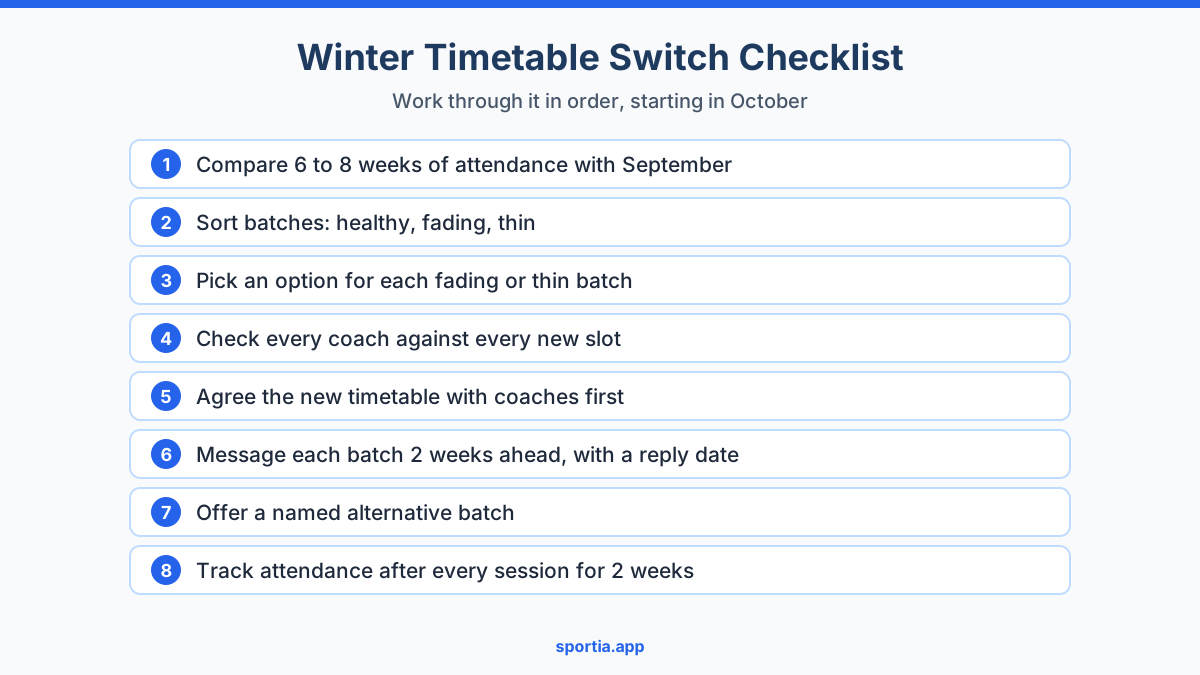
- Pull six to eight weeks of attendance for every batch and compare it with September
- Sort batches into healthy, fading and thin
- Choose an option for each fading or thin batch: shift, merge, indoors, weekend or fewer sessions
- Check every coach against every new slot for clashes
- Get quotes for floodlights or indoor time, and work out the payback
- Agree the new timetable with your coaches
- Message each batch at least two weeks before the change, with a reply deadline
- Offer a named alternative batch to families who cannot make the new time
- Track attendance after every session for the first two weeks
- Note what worked, so next year's switch takes half the time
Frequently Asked Questions
When should a sports academy switch to winter timings?
Most academies switch in the first week of November, when evenings get dark before 5:30 PM in much of India. In the north, plan a second change for December or January if fog arrives. Announce each change at least two weeks ahead.
How do I change batch timings without losing students?
Check your attendance data first, then talk to coaches and a few parents. Give families two to three weeks' notice in a clear message per batch, and offer a named alternative slot. Call anyone who misses two sessions in a row after the change.
Should I merge batches in winter?
Merge batches when both are thin, under about 60 percent full, and at a similar skill level. Merging frees a coach and a slot. Avoid merging beginners with advanced players just to save time, because both groups usually suffer.
Are floodlights worth it for a small academy?
They often are if they keep a full evening batch running through winter. A basic setup for one court or a pair of nets costs roughly Rs 50,000 to Rs 1.5 lakh. One batch of 15 children at Rs 1,500 a month can repay that within one winter.
What is a sports batch management system?
It is the way your academy organises batches, timings, coaches, enrollments and attendance. Many academies use spreadsheets and WhatsApp, while others use academy management software. Either way, it should let you see attendance by batch and change timings without losing track of who goes where.
Plan the Switch, Do Not React to It
Winter will thin your evening and early morning batches every year. The academies that hold on to their athletes are not the ones with the best facilities. They are the ones that read their data in October, plan the change and tell families early.
Sportia helps you rebuild batch schedules, move athletes between batches and check attendance as the winter timetable settles in. Try Sportia free for 14 days and plan this year's switch on one system.