
Cricket Bowling Techniques: Coaching Pace and Spin to Young Players
Good cricket bowling techniques come down to four things a young player can control: grip, run-up, front-arm drive, and wrist position at release. Get those right and pace or spin follows. This guide covers seam and spin fundamentals, six drills you can run with cones and one ball, safe workload limits by age, and the five faults that show up in almost every Indian academy.
Start With What Indian Kids Actually Bring
Most children who join an academy in India have already bowled thousands of deliveries. They just did it with a tennis ball, on a street or a school corridor.
That background gives them two habits. They bowl with a slingy, chest-on action, because a tennis ball needs arm speed rather than body drive. And they grip across the ball, because seam position does nothing on a taped tennis ball.
Neither habit is laziness, because both were correct for the ball they had. Your first task is not to correct technique, it is to explain why a leather ball rewards something completely different.
Grip and Seam Position
This is where a beginner gains the most in the shortest time.
For a basic seam-up delivery, the first two fingers sit either side of the seam, roughly a centimetre apart. The thumb rests underneath on the seam. The ball sits in the fingers, not jammed into the palm.
The palm gap matters more than coaches expect. A ball buried in the palm kills wrist snap and takes pace off, so you should be able to slide a finger between the ball and the palm.
Then comes the part most young bowlers miss: the seam must stay upright through the air, angled slightly towards first slip. A wobbling seam does nothing off the pitch, but a stable, upright seam grips the surface and moves.
On the matting and cement wickets common at Indian academies, seam movement is smaller than on turf. Do not let that convince a child the skill is pointless. The habit built on matting pays off the first time they bowl on grass.
Building a Repeatable Run-Up
A run-up has one purpose: to arrive at the crease balanced, at a speed you can control.
Most young bowlers run too far and too fast, when twelve to fifteen paces is sufficient for an under-14 quick. The last four strides matter more than the first ten.
Mark the run-up properly and make the child measure it themselves:
- Start at the crease and run back at bowling pace, counting strides.
- Mark the spot with a cone or a scuff line.
- Run in three times and check they hit the crease without stretching or chopping the last stride.
- Adjust once, then leave it alone for a month.
During the monsoon, a soft or slippery run-up wrecks this rhythm. Shorten the approach rather than letting a child slide into the crease. Our guide to indoor circuits during the monsoon covers what to run when the ground is unusable.
The Load-Up and Front-Arm Drive
The load-up is the moment the bowler gathers before delivery. The ball comes up near the chin, the front arm points high, and the back foot lands.
From there, the front arm does the work. A strong front arm pulled down hard into the ribs accelerates the bowling arm through, while a limp front arm that drifts sideways leaks pace and pushes the body off line.
Two cues that work with children:
- "Point at the sky, then pull the rope." Front arm high, then pulled straight down.
- "Chest to the target." Finish with the chest facing where the ball is going, not square to it.
The front leg should brace at contact rather than collapse. Research on bowling loads finds that front-knee flexion under about 30 degrees pushes lumbar loading up sharply. In plain terms, a bowler who lands with a soft, buckling front knee is putting the force through their back instead of their leg.
Action Type: The Safety Check Most Academies Skip
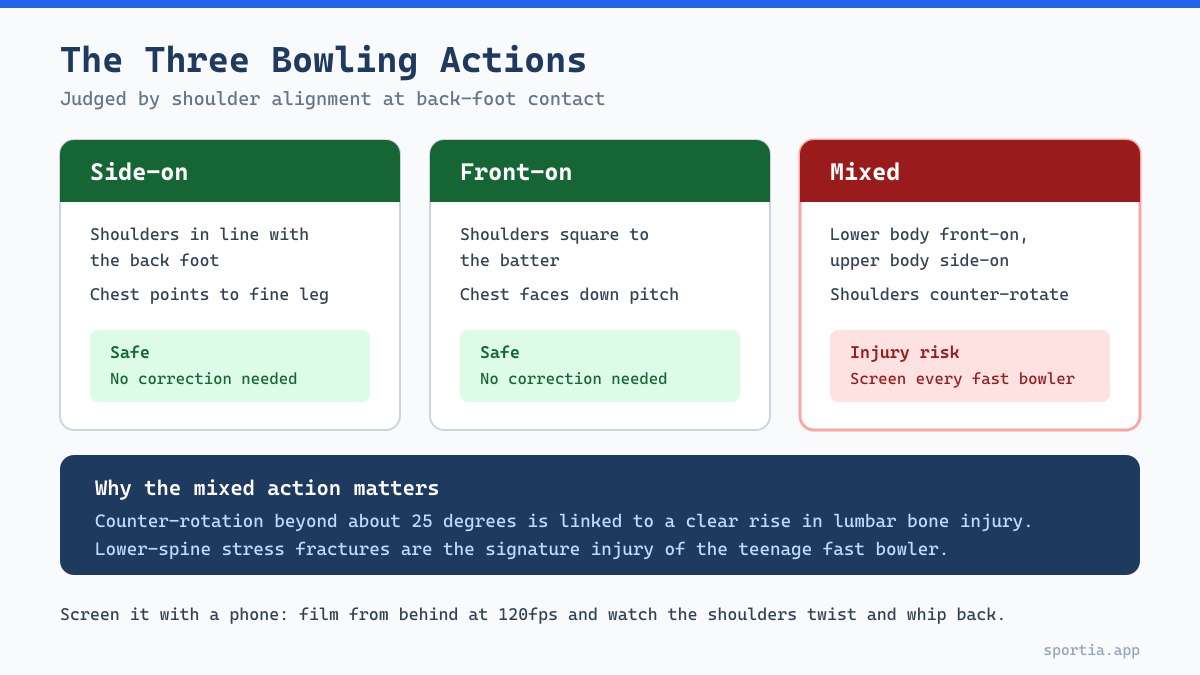
Bowling actions fall into three broad types, judged by shoulder alignment at back-foot contact.
- Side-on - shoulders in line with the back foot, chest pointing towards fine leg.
- Front-on - shoulders square, chest facing the batter.
- Mixed - lower body front-on, upper body side-on, or the reverse.
Side-on and front-on are both perfectly acceptable, and neither is better than the other. The mixed action is the problem, because the upper body has to counter-rotate away from the batter to square up before release.
That counter-rotation is what breaks young backs. Studies link counter-rotation beyond about 25 degrees to a clear rise in lumbar bony injury, and one review found the mixed action in nearly two thirds of the bowlers sampled. Stress fractures of the lower spine are the signature injury of the teenage fast bowler.
You do not need motion-capture equipment to screen for it, because a phone filming from behind the bowler at 120 frames per second is enough. Watch the shoulders between back-foot contact and release. If they visibly twist away from the target and then whip back, you are looking at a mixed action.
Fixing it takes months, not sessions, and it is worth involving a qualified coach. What you must not do is add workload to a bowler with a heavy mixed action and hope it settles.
Wrist Position and Swing
Swing is a wrist skill rather than an arm-speed skill, because a slower bowler with a locked wrist will swing it further than a quick with a floppy one.
- Outswing - seam angled towards slip, shiny side on the leg side, wrist behind the ball at release.
- Inswing - seam angled towards fine leg, shiny side on the off side, wrist slightly rotated inwards.
The rule for children: shine one side only, and always the same side. A ball shined on both sides swings nowhere. Give each batch one designated ball for the session and make shining someone's job.
Teach outswing before inswing, because it is the harder ball to bat against and it builds a cleaner wrist position that transfers to everything else.
Off-Spin Fundamentals
Off-spin is the easier spin to coach and the faster one to see results from.
The index and middle fingers do the spinning. Spread them wide across the seam, with the index finger doing most of the work. At release the fingers rip down and across the ball, like turning a door handle.
Three things to build, in order:
- Revolutions before turn. A ball that fizzes with side spin will turn eventually. Chase the revs first.
- Flight before speed. Young off-spinners bowl flat because flat feels safe. Slower and higher takes more wickets.
- A stock ball before variations. The doosra and the carrom ball can wait several years.
A useful check is to ask the child to bowl one delivery and watch the seam in flight. If the seam is spinning cleanly like a wheel the fingers are working, and if it is tumbling they are pushing the ball.
Leg-Spin Fundamentals
Leg-spin is the hardest skill in cricket to coach, and the one that needs the most patience from you and the parents.
The grip runs across the seam with the third finger bent along it. That third finger does the work at release, flicking the ball out with the back of the hand facing the batter.
Expect a difficult first year, because a young leg-spinner will bowl full tosses and long hops for months. Coaches who panic and shorten the run-up or flatten the trajectory produce a bowler who never turns it.
Protect them instead. Give leg-spinners their own net time, avoid putting them into pressure games too early, and count progress in revolutions rather than wickets.
Workload Limits by Age
This is the part of coaching that actually prevents careers from ending at sixteen.
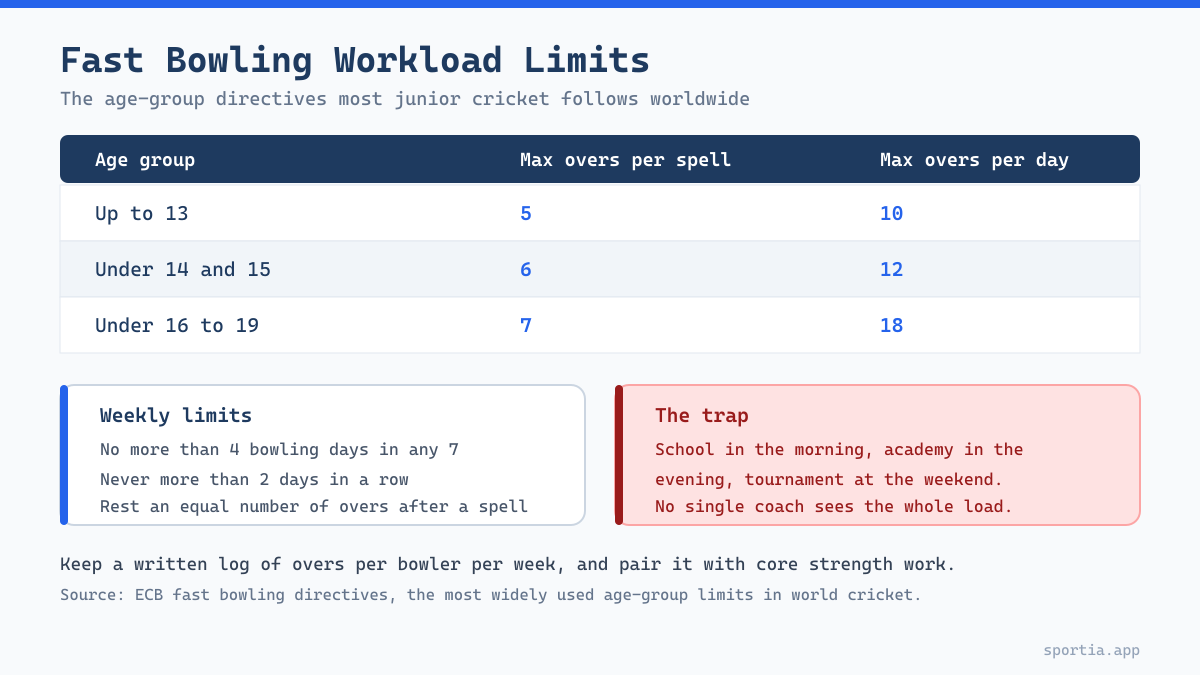
The England and Wales Cricket Board fast bowling directives are the most widely used age-group limits in world cricket, and most Indian age-group coaching follows the same numbers.
| Age group | Max overs per spell | Max overs per day |
|---|---|---|
| Up to 13 | 5 | 10 |
| Under 14 and 15 | 6 | 12 |
| Under 16 to 19 | 7 | 18 |
Two further rules matter as much as the table:
- A fast bowler should bowl on no more than four days in any seven, and never more than two days running.
- After a spell, the bowler rests for the same number of overs before bowling again from that end.
The danger in Indian academies is not the match itself, it is the cumulative total. A child bowls at school in the morning, at the academy in the evening, and in a tournament at the weekend. No single coach sees the whole load, so nobody notices it is double the safe limit.
Keep a written log of overs per bowler per week. Poor trunk control has been linked to a large rise in lumbar stress injury risk, so pair the log with core work. Our post on overtraining in young athletes covers the wider warning signs, and common sports injuries in children covers what to do when something does go wrong.
Six Drills You Can Run Today
All of these need cones, a wall, and one ball.
- Seam-up wall throws. Standing five metres from a wall, throw the ball with a seam-up grip and catch it. Check the seam stays upright in flight. Two minutes, every session.
- Target bowling with a cone. Place a cone on a good length. Six balls, count hits. Simple, competitive, and it builds line without a batter.
- Front-arm shadow bowling. No ball. Ten deliveries focusing only on the front arm coming down hard into the ribs.
- One-knee release drill. Kneeling on the back knee, bowl at a target ten metres away. Removes the run-up and isolates wrist and front arm.
- Spin the ball up. Sitting down, spin the ball straight up and catch it. Count clean revolutions. The single best drill for young spinners.
- Three-cone run-up rhythm. Cones at the mark, midway, and the crease. Run through them at bowling pace without a ball, checking the last four strides stay even.
Athleticism underpins all of it. Speed and agility work builds the base a bowling action sits on, as covered in our guide to speed and agility training for young athletes.
Five Common Faults and the Cue That Fixes Each
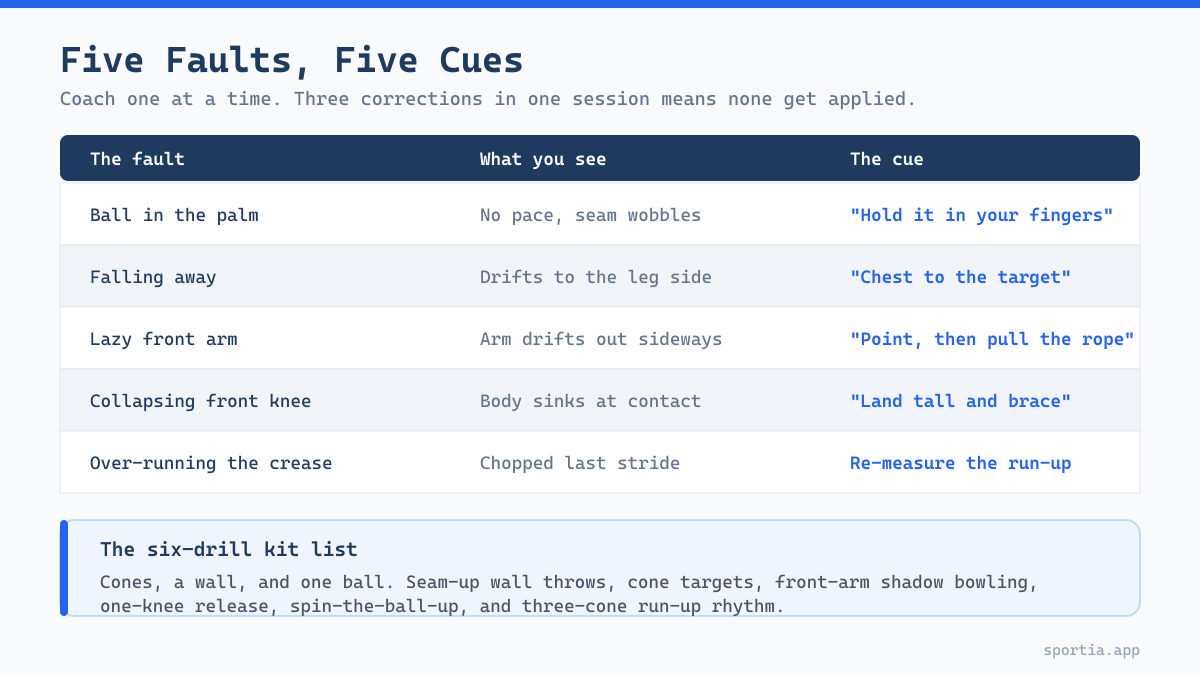
| Fault | What you see | The cue |
|---|---|---|
| Ball in the palm | No pace, seam wobbles | "Hold it in your fingers" |
| Falling away at release | Bowler drifts to the leg side | "Chest to the target" |
| Lazy front arm | Arm drifts out sideways | "Point, then pull the rope" |
| Collapsing front knee | Body sinks at contact | "Land tall and brace" |
| Over-running the crease | Chopped or stretched last stride | Re-measure the run-up |
Coach one fault at a time, because a child given three corrections in one session will apply none of them.
Keeping It Consistent Across Coaches
The biggest quality problem in a growing academy is not coaching knowledge, but that three coaches teach the same skill three different ways.
Write your bowling progression down once: the grips, the cues, the six drills, and the workload table. Every coach then runs the same session, and a stand-in knows exactly what to deliver.
With Sportia, you can store those drills and training plans in a coaching library, assign them to specific batches, and track whether they were actually run. Attendance and workload records sit alongside them, so the over counts you need are already there.
For batting, see our companion guide to cricket batting tips for young players.
Frequently Asked Questions
What are the basic cricket bowling techniques for beginners?
Start with grip, run-up, front-arm drive, and wrist position at release. Hold the ball in the fingers with two either side of the seam, run in at a controlled pace, pull the front arm down hard, and keep the wrist behind the ball. Everything else builds on those four.
At what age should a child start fast bowling?
Children can bowl seam-up from around eight, but should stay well within age-group workload limits. Under-13 bowlers are capped at five overs per spell and ten in a day. Build technique and athleticism first, and add volume slowly.
How do I stop young fast bowlers getting injured?
Screen for a mixed action, track weekly over counts across school and academy, and build core strength. The mixed action forces the upper body to twist away and back, which is strongly linked to lower-back stress fractures in teenagers.
How long does it take to learn leg-spin?
Expect one to two years before a young leg-spinner controls line and length consistently. Progress should be measured in revolutions on the ball, not wickets. Coaches who flatten the trajectory to reduce runs usually stop the bowler ever turning it.
Should young bowlers learn swing or spin first?
Teach whichever suits the child's natural action, but teach one properly before adding the other. For seamers, outswing before inswing builds a cleaner wrist position. For spinners, revolutions come before turn and flight before speed.
How many overs should a young fast bowler bowl per week?
No more than four bowling days in any seven, and never two heavy days back to back. Add up school, academy, and tournament overs together, because the total is what causes injuries, not any single session.
Build the Action, Then the Pace
Young bowlers get quicker by bowling well, not by bowling harder. Grip, run-up, front arm, and wrist give you almost everything, and a workload log protects the child long enough for the skill to arrive.
Write your progression down, run it the same way across every coach, and count the overs. Start your free 14-day Sportia trial to keep your drills, training plans, and attendance in one place.