
Back Outdoors After the Monsoon: Ground, Athlete, and Schedule Readiness
Every September, academies across India lose athletes to injuries that had nothing to do with bad luck. A boy who trained indoors for six weeks rolls an ankle in his second session back. A promising runner picks up shin pain that lingers into October.
Coaches call it a bad patch. It is not. It is a workload spike meeting a changed surface, and both are predictable enough to plan around.
This guide covers post monsoon sports ground preparation, the reconditioning ramp that prevents the September spike, and how to rebuild a schedule and a roll that both drifted during the rains.
Check Which Restart You Are Actually Facing
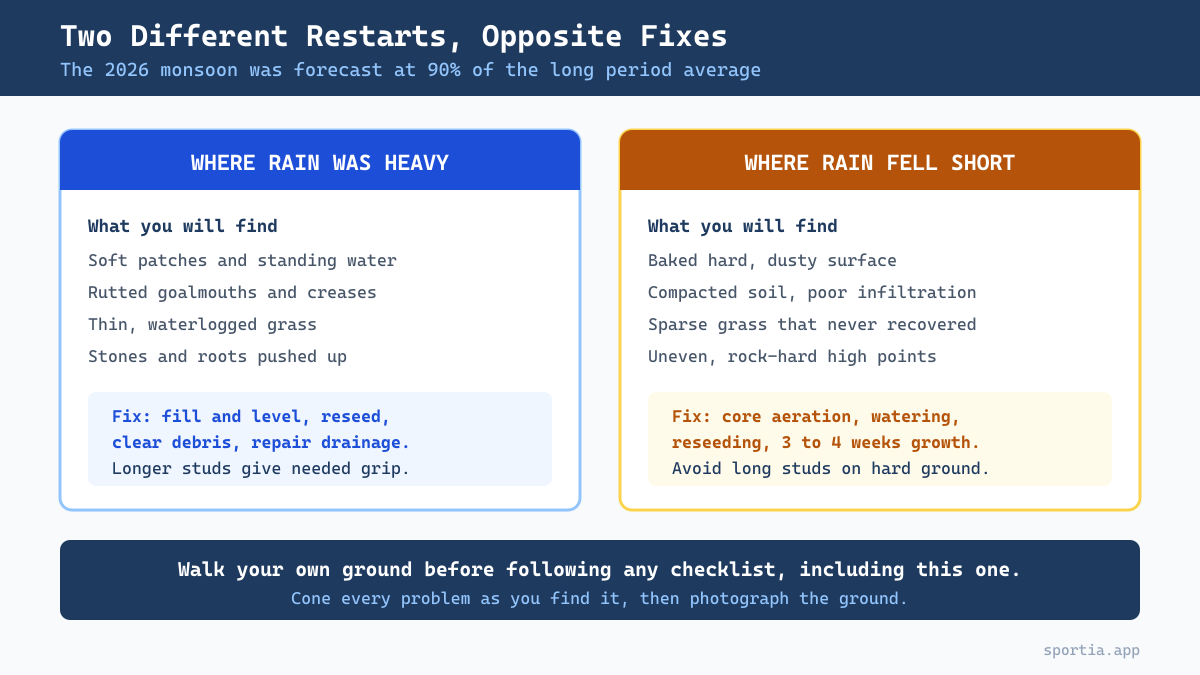
Most monsoon advice assumes a waterlogged ground. In 2026 that assumption may not fit your city.
The India Meteorological Department revised its forecast for the 2026 southwest monsoon to about 90 percent of the long period average, with a 60 percent chance of a deficient season and below normal rainfall likely across most of the country.
That splits academies into two very different restarts:
- Where rainfall was heavy, the classic problems apply. Soft patches, poor drainage, rutted goalmouths and thin waterlogged grass.
- Where rainfall fell short, the ground may be baked hard, dusty and compacted, with sparse grass cover that never properly recovered.
These need opposite fixes, so walk your own ground before following any checklist, including this one. Withdrawal itself is gradual. The monsoon does not leave north west India before September, and it clears the southern peninsula only after the start of October, so many academies restart while rain is still possible.
Why the September Injury Spike Happens
The mechanism is well documented, and it is arithmetic rather than mystery.
Sports science measures this with the acute to chronic workload ratio. It compares what an athlete did this week against their average over the previous four weeks. The research is consistent:
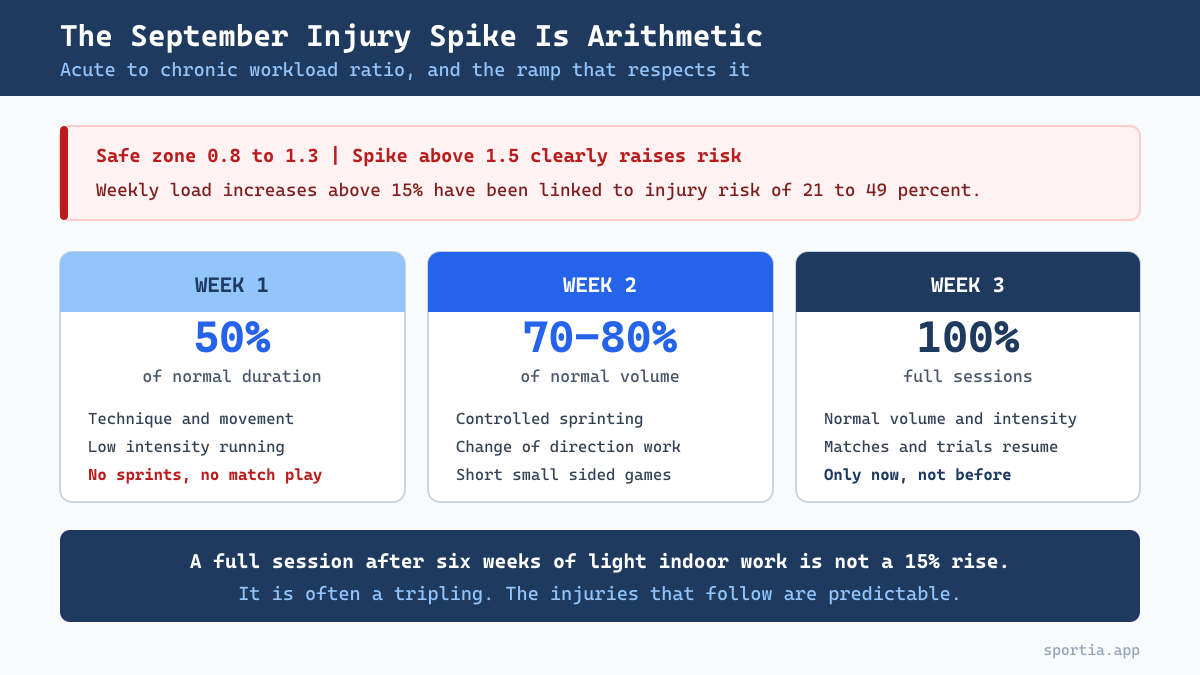
- The safe zone sits between roughly 0.8 and 1.3.
- A spike above 1.5 clearly raises injury risk.
- Weekly load increases above 15 percent have been linked to injury risk between 21 and 49 percent.
- Small weekly changes, in the range of minus 5 to plus 10 percent, are associated with fewer injuries.
Now apply that to a real academy. Athletes did light indoor fitness circuits twice a week through the rains. Their chronic load is low. On the first Monday back, a coach runs a full outdoor session with sprints, match play and two hours on the ground.
That is not a 15 percent increase. It is often a tripling. The injuries that follow are the predictable outcome, not misfortune.
Assessing the Ground
Walk the whole surface slowly, in ordinary shoes, before any athlete uses it. Twenty minutes here prevents most of what follows.
Look for:
- Soft patches. Press with your heel. Anywhere that gives noticeably is a twisted ankle waiting to happen.
- Standing water and slow drainage. Note where water sits two hours after rain, because that is where the surface will fail first.
- Ruts and uneven ground. Goalmouths, crease areas, sprint lanes and the paths people walk take the most damage.
- Grass cover. Thin or bare areas will not recover on their own once play resumes.
- Hidden objects. Stones, glass and roots surface after heavy rain, and drainage covers move.
- Boundaries and fixtures. Nets, posts, fencing and sight screens loosen over eight weeks of wind and water.
Mark every problem with a cone as you find it. A photograph of a coned ground is also the clearest possible request when you are asking a school or municipal body to fund repairs.
If the same patches fail every year, the fix belongs in next season's plan rather than this one. The guide on monsoon proofing a sports academy covers the drainage and scheduling decisions worth making before the rains arrive.
What to Fix Yourself, and What Needs Help
Do it yourself: filling small depressions with soil, levelling and rolling minor ruts, clearing debris, reseeding thin patches, re-marking lines, and tightening or replacing nets and fixtures.
Get outside help for: drainage that has genuinely failed, large scale levelling, and compaction.
Compaction deserves a specific mention because most academies never address it. Weeks of rain and traffic squeeze the soil, which reduces pore space, cuts oxygen to the roots and slows water infiltration. Grass then struggles to recover no matter how much you water or seed it.
Core aeration is the standard remedy and is widely considered the single most effective tool against compaction. It loosens the soil, improves drainage and lets roots grow again. Turf specialists also suggest allowing three to four weeks of decent growing conditions for a surface to recover properly, so schedule repairs with that lead time rather than expecting a usable ground in three days.
The Two Week Reconditioning Ramp
Do not resume full intensity in week one. Build back using the workload numbers above.
Week 1: reintroduce the surface. Keep sessions to about half of normal duration. Work on technique, movement quality and low intensity running. No sprinting at full effort, no jumping onto hard ground, no match play. The aim is to let feet, ankles and shins meet the surface again at low speed.
Week 2: rebuild intensity gradually. Move to roughly 70 to 80 percent of normal volume. Add controlled sprinting, change of direction work and short small sided games. Watch who is limping, lagging or unusually sore.
Week 3: full sessions. Return to normal volume and intensity, and only now consider competitive matches or trials.
Two details matter more than the percentages. First, athletes who trained through the rains and athletes who disappeared entirely need different ramps, so do not treat a returning group as one block. Second, ask about soreness at every session for the first fortnight. Young athletes rarely volunteer it. The guide on returning to play after injury covers how to phrase those questions so you get honest answers.
Footwear and the Surface Change
This is the most overlooked risk of the season, and it costs academies more ankles than anything else.
Athletes spent weeks on smooth indoor floors in flat trainers. They now step onto grass or mud in studs, or onto baked hard ground in worn shoes. Research shows that surface hardness changes an athlete's movement strategy, and that biomechanical problems associated with injury show up far more on harder surfaces than softer ones.
Practical steps for the first fortnight:
- Inspect every athlete's footwear in week one. Studs blunt, soles separate and shoes are outgrown over a long break.
- On soft or recovering ground, longer studs give grip. On baked hard ground they concentrate force and should be avoided.
- Watch heel pain in growing children specifically, because the heel growth plate is vulnerable and hard surfaces aggravate it.
- Add ankle and calf strengthening to warm ups for the first two weeks rather than treating it as optional.
A short conversation with parents about shoes in the first week is cheaper than a month of missed sessions. The guide on common sports injuries in children covers what to watch for.
Rebuilding the Schedule and the Roll
Two things shrank during the monsoon: your timetable and your attendance. Both need deliberate work.
Reclaim your slots. Evening slots given up during the rains rarely come back on their own, and schools and municipal grounds reallocate quickly. Contact whoever controls your ground now, not in October, and confirm your full timetable in writing.
Publish the restart schedule early. Families plan September around school terms. A timetable that appears on the first day back loses you the parents who already committed elsewhere. The guide on scheduling batches and timetables covers rebuilding a full week cleanly.
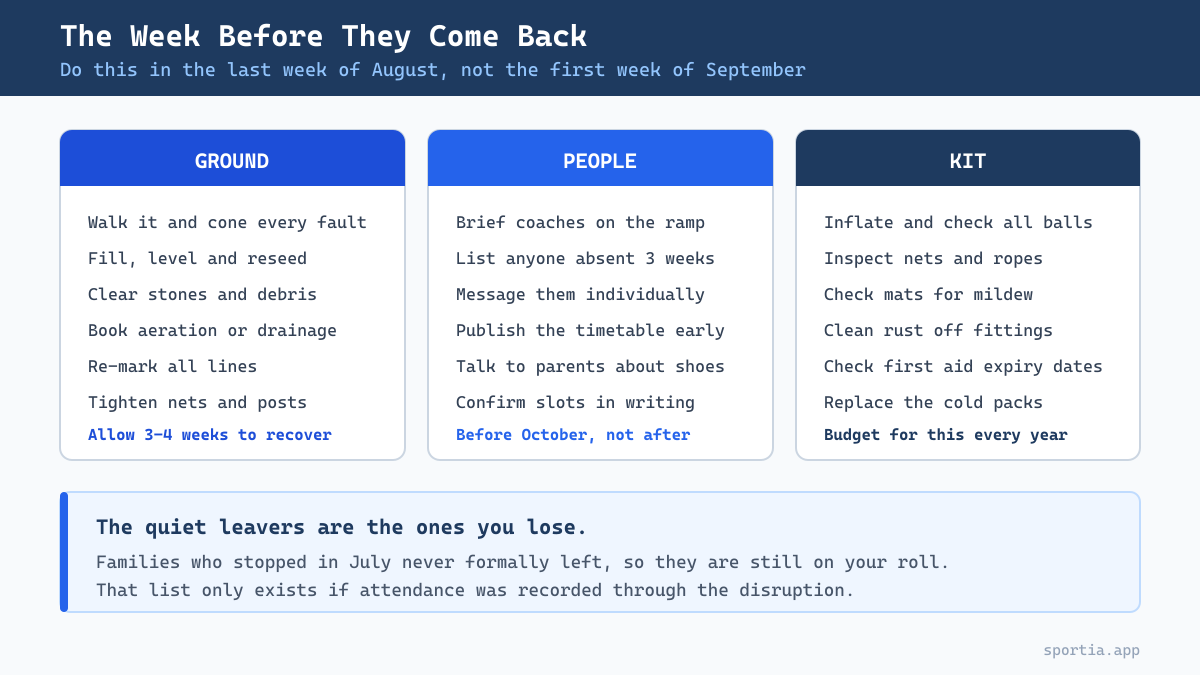
Chase the quiet leavers. Some families stopped attending in July and never formally left. They are still on your roll and still counted in your head, but they are gone unless someone contacts them. Pull a list of anyone who has not attended in three weeks and message them individually before the restart, not after.
That list only exists if attendance was actually recorded through the disruption. Academies that stopped marking attendance during the rains restart in September with no idea who has drifted.
Equipment After Eight Weeks in Storage
Damp storage does quiet damage. Check before the first session, not during it.
- Balls lose pressure and leather cracks. Inflate and inspect the full set.
- Nets and ropes rot at contact points and fray where they were tied.
- Cones warp, and mats and pads hold moisture and mildew.
- Metal fittings, studs and stumps rust, especially where they were stacked on the floor.
- First aid supplies expire. Check dates on tape, antiseptic and ice packs, and replace the cold packs.
Budget for a small replacement round every September. It is a predictable annual cost, not an emergency.
Frequently Asked Questions
How do you prepare a sports ground after the monsoon?
Walk the full surface first and cone every soft patch, rut and bare area. Fill and level minor damage, clear debris, reseed thin grass and re-mark lines yourself. Bring in help for failed drainage, major levelling and compaction, where core aeration is the standard fix. Allow three to four weeks of growing conditions for a proper recovery.
Why do injuries increase when outdoor training resumes?
Because training load jumps far faster than the body adapts. Research on the acute to chronic workload ratio shows risk rising sharply once weekly load spikes above about 1.5 times the recent four week average, and weekly increases above 15 percent have been associated with injury risk of 21 to 49 percent. A full session after weeks of light indoor work is often a tripling of load.
How long should a return to outdoor training take?
Around two weeks before full intensity. Use week one at roughly half normal duration with technique and low intensity running, week two at 70 to 80 percent with controlled sprinting and small sided games, and resume full sessions and competition in week three.
Do studs help or hurt on post monsoon grounds?
It depends entirely on the surface. On soft or recovering ground, longer studs give necessary grip. On ground baked hard by a dry spell they concentrate force through the foot and should be avoided. Check every athlete's footwear in the first week back, since shoes are outgrown and studs blunt over a long break.
How do you bring back families who stopped attending during the rains?
Pull a list of everyone who has not attended for three weeks and message them individually before the restart rather than after. Publish the September timetable early, because families commit to activities around the school term. This only works if attendance was recorded through the disruption.
When does the monsoon actually withdraw in India?
Gradually, and later than most restart plans assume. Withdrawal is not attempted from extreme north west India before 1 September, and the monsoon leaves the southern peninsula and the country as a whole only after 1 October. Plan for rain-affected sessions well into your restart period.
The Week Before They Come Back
The academies that get through September without an injury run did the work in the last week of August.
Walk and cone the ground. Book any outside repairs now. Check every piece of equipment and the first aid kit. Confirm your slots in writing. Publish the timetable. Pull the list of families who drifted and message them one by one. Brief your coaches on the two week ramp so no one runs a full session on day one.
Through a disrupted restart, attendance data is what tells you who actually came back and which batches are quietly half empty. Sportia lets you reschedule batches, track attendance session by session and see which athletes have stopped appearing before they are gone for good. Start a free 14 day trial and go into September knowing your real numbers.